


A modular building shipment can cross an ocean successfully and still fail to reach its installation point as planned.
For mining camps, renewable-energy construction bases, infrastructure compounds and other remote projects, modular building last mile logistics begin when cargo is released from the destination port or inland terminal and must be transferred through the actual road network, project access road, site gate, unloading zone and laydown area. This final inland leg exposes the shipment to constraints that standard ocean-freight assumptions do not resolve: vehicle geometry, bridge and culvert capacity, overhead clearance, turning space, seasonal road deterioration, local permits, crane availability, unloading conditions and the order in which components must be released for installation.
The key procurement question is therefore not simply whether the modular buildings can be shipped internationally. It is whether the exact transport packages, vehicles, route, unloading resources and installation sequence remain compatible all the way from port release to their final position.
Summary
The main conclusion is straightforward: a port-to-port freight plan is not a port-to-site logistics plan.
Remote project prefab transport should be treated as a linked engineering and execution interface. The project team needs to confirm the dimensions and mass of the transported load, match those values to the intended inland vehicle and route, verify bridge and clearance restrictions, understand seasonal access conditions, identify permit or escort requirements, confirm the site entrance and manoeuvring envelope, reserve suitable unloading equipment, prepare a stable unloading and laydown area, and coordinate arrival sequence with foundation and installation readiness.
This matters because the last mile can convert an otherwise efficient modular system into a rehandling problem. A package may fit a shipping container yet be difficult to unload with locally available equipment. A vehicle may be legal on the main highway but unable to negotiate the project access road. A site may technically be accessible in the dry season but unusable after sustained rainfall. A container may arrive intact while its internal load has shifted, making premature restraint removal hazardous.
The IMO/ILO/UNECE CTU Code provides a global, non-mandatory framework for packing, securing, handling and unpacking cargo transport units across an intermodal transport chain, including responsibilities and information flow between participants. UK Health and Safety Executive guidance separately emphasizes advance coordination between companies involved in loading and unloading and checking whether a load has shifted before restraints are removed.
The practical implication for project owners and EPC contractors is that last-mile inputs should be resolved before shipment, not discovered when the trucks reach the site gate.
Why Ocean Freight Assumptions Break Down After Port Release
International modular-building procurement often creates a misleading sense of logistics certainty.
The shipment has a packing list. Container types are known. Ocean freight has been booked. The destination port is confirmed. Cargo documentation has been prepared. From a commercial shipping perspective, the logistics package may appear substantially defined.
The inland leg asks different questions.
A maritime container route is based on established terminal and carrier infrastructure. The final road journey may involve regional highways, local roads, temporary construction roads, unsealed sections, mountain approaches, narrow gates or roads originally designed for much smaller vehicles. The controlling constraint can change repeatedly along the route.
Consider the difference:
| Ocean-freight question | Port-to-site question |
| Can the cargo be packed into the selected transport unit? | Can the loaded inland vehicle physically traverse every section of the route? |
| Is the container or cargo accepted by the carrier? | Are bridge, ramp, culvert, axle, height and width limits compatible with the actual vehicle and load? |
| Is there a vessel service to the destination port? | Is the final road accessible during the required season and delivery window? |
| Can the terminal handle the unit? | Can the project site unload it using the equipment actually available? |
| Are shipping documents complete? | Are local road access, abnormal-load, escort or third-party approvals complete where applicable? |
| Has cargo arrived at destination? | Can it enter the site, manoeuvre, unload, stage and move into installation without uncontrolled rehandling? |
The last-mile problem is therefore an interface problem rather than a single transport problem.
A buyer may have a competent freight forwarder, an experienced modular manufacturer, a qualified inland haulier and a capable civil contractor, yet still experience a delivery failure if each party assumes another has checked the connection between their scopes.
That is why a constraint register and responsibility matrix are more useful than a simple statement such as “inland transport by buyer.”
Start With the Transported Load, Not the Building Drawing
A modular building drawing describes the finished building. The inland haulier needs the transported condition.
Those are not necessarily the same geometry.
Depending on the selected system and packing method, the shipment may consist of flat-packed structural frames, panels, bundled components, containerized kits, partially assembled sections or more complete modules. The route assessment therefore needs transport-package data rather than nominal room dimensions.
At minimum, the project should distinguish:
- package or module length;
- package or module width;
- package or module height;
- package mass;
- expected vehicle configuration;
- combined running height;
- combined vehicle-and-load width;
- combined vehicle-and-load length;
- relevant axle or load-distribution information from the transport provider;
- centre-of-gravity or handling considerations where required;
- approved lifting or handling points;
- whether components can be separated if the planned route becomes unavailable.
The UK HSE’s workplace transport guidance illustrates the underlying engineering questions clearly: route planning should consider vehicle width, length, height, mass and manoeuvrability, while overhead clearances should be measured and bridges and ramps should be suitable for the vehicle and its load. Those HSE provisions are UK guidance and should not be treated as universal road-law limits for another country.
The principle, however, travels well: route compatibility must be checked against the transported configuration that will actually arrive.
Port-to-Site Constraint Register for Modular Projects
A constraint register converts general concerns such as “remote access may be difficult” into variables that somebody must verify.
The following register can be adapted during logistics planning.
| Constraint | Information required | Why it matters | Typical decision or hold point |
| Load geometry | Transported length, width and height of each load category | Finished-building dimensions may not equal transport dimensions | Confirm vehicle and route compatibility |
| Load mass | Package/module mass and transport configuration | Affects vehicle selection, road structures, unloading and lifting | Haulier and lifting review before dispatch |
| Running height | Vehicle, trailer and cargo geometry in travelling condition | Overhead structures, utilities and entrances may control the route | Verify critical clearances |
| Route width | Road, gate, temporary road and restricted-section widths | Wide loads need usable envelope, not merely nominal pavement width | Route survey or alternative path |
| Bridge/culvert/ramp capacity | Applicable restrictions and engineering information | Structures may govern vehicle or axle access | Authority/engineer confirmation where required |
| Turning and manoeuvring | Vehicle length, steering geometry, intersection radius, reversing requirements | A route can be wide enough but still impossible to negotiate | Trial path, route survey or vehicle change |
| Road surface and gradient | Surface type, steep sections, erosion, soft shoulders | Influences traction, stability and access reliability | Seasonal or weather hold point |
| Overhead obstruction | Bridges, cables, gantries, temporary works, trees or site structures | Effective clearance can differ from mapped data | Physical verification before movement |
| Seasonal access | Rainfall, flooding, snow, thaw, dust, road maintenance or closure patterns | A usable dry-season route may not remain usable | Define weather-triggered alternatives |
| Permits and escorts | Local abnormal-load, road-use, pilot vehicle or movement requirements | Legal access may require prior approval | No-dispatch or no-movement gate |
| Third-party approvals | Road owner, bridge owner, utility operator or other relevant consent | One permit may not cover every infrastructure owner | Approval register |
| Site entrance | Gate dimensions, security process, road transition and gradients | Public-road access does not guarantee site access | Site-entry check |
| Unloading zone | Stable area, usable working space and traffic separation | Truck arrival alone does not mean cargo can be safely unloaded | Receiving-area release |
| Laydown area | Space, bearing condition, drainage and installation proximity | Poor staging creates repeated handling | Laydown readiness approval |
| Handling equipment | Crane, forklift or other equipment matched to the supplied packages | Equipment availability and capacity must match the handling method | Equipment confirmation |
| Installation interface | Foundation status, sequence, crew and component demand | Delivery order should support erection rather than obstruct it | Release by installation coordinator |
| Contingency trigger | Defined event requiring stop, reroute or revised handling plan | Prevents improvised field decisions | Escalation procedure |
The register should be a controlled project document rather than a one-time procurement checklist. Route conditions can change between tender, shipment and delivery.
Route Width Is Only One Part of Accessibility
Remote projects sometimes describe access with a single statement:
“The road is wide enough for trucks.”
That is not enough to establish modular camp port-to-site feasibility.
A vehicle may fit a straight section while failing at:
- a hairpin bend;
- a narrow bridge approach;
- a village intersection;
- an offset gate;
- a road edge with insufficient shoulder support;
- a steep crest or dip;
- a temporary traffic diversion;
- an entrance with a sharp change in grade;
- an internal construction road blocked by other work fronts.
For long or wide vehicles, the swept path through a turn may control access more strongly than the width of the straight road.
This is particularly important when procurement teams compare flat-packed and more highly preassembled modular systems. A more complete module may reduce field assembly interfaces, but its transported dimensions may impose a more demanding inland route. A compact component-based delivery may improve road compatibility but transfer additional work into unloading, sorting, staging and assembly.
Neither approach is automatically better. The relevant comparison is total execution risk.
Height Should Be Treated as Running Height
Nominal cargo height is not the value that route planners ultimately need.
They need the total running height of the vehicle, trailer and load in the intended transport configuration.
That distinction matters at:
- bridges;
- tunnels;
- overhead utility crossings;
- gantries;
- warehouse or terminal entrances;
- mine or industrial site structures;
- temporary construction works;
- site gates with overhead signage or services.
UK bridge-strike guidance tells operators to plan routes in advance and make vehicle and trailer running-height information available to people planning or altering the route. That guidance is specific to Great Britain, but it illustrates why relying on cargo dimensions alone creates an incomplete route input.
A remote modular-project route review should therefore record both transported-package dimensions and the actual vehicle configuration proposed by the inland haulier.
Bridge, Culvert and Ramp Restrictions Need Named Owners
A route map showing a bridge does not establish that the bridge can take the proposed transport movement.
The project may need to resolve:
- posted mass restrictions;
- axle restrictions;
- structural or temporary restrictions;
- lane restrictions;
- width constraints;
- bridge approach geometry;
- culvert capacity on local or project roads;
- privately controlled structures;
- restrictions created by construction or maintenance work.
The key management question is: who is responsible for obtaining the authoritative answer?
The modular manufacturer can provide package data within its supply scope. The inland haulier can provide vehicle data and usually contributes route expertise. The owner or EPC may control the site and local interface. An authority, road owner or engineer may control whether a particular structure can legally or technically be used.
Unless this responsibility is explicitly assigned, a bridge restriction can remain invisible until movement is already scheduled.
Jurisdiction Matters: Oversize and Overmass Access Is Local
Permit requirements should never be copied from one country to another.
For example, Australia’s National Heavy Vehicle Regulator includes modular buildings and large prefabricated structures among cargoes that can fall within oversize/overmass movements under the applicable Australian framework. Its access process directs operators to check relevant notices and network maps, determine third-party approval requirements and apply for a permit when movement is not covered by an applicable notice. Those requirements are specific to the Australian heavy-vehicle regulatory environment.
A project elsewhere needs the equivalent local assessment.
The useful procurement principle is not “obtain an Australian-style permit.” It is:
identify the governing road-access framework for the actual destination, confirm whether the proposed vehicle and load fall within normal access, and allocate responsibility for any permits, escorts, route approvals or infrastructure-owner permissions before shipment.
Seasonal Access Can Change an Approved Route
A road that exists on a map is not necessarily a reliable logistics corridor throughout the year.
Remote project access can be affected by:
- prolonged rainfall;
- wet-season softening;
- flooding;
- snow or ice;
- freeze-thaw deterioration;
- erosion;
- landslides;
- dust conditions;
- road maintenance;
- construction traffic;
- temporary closures;
- agricultural or community traffic patterns.
The right question is therefore not simply:
Can the road reach the site?
It is:
Under what weather and operating conditions can the proposed transport vehicle reach the site without creating an unacceptable movement, recovery or unloading risk?
This distinction affects shipment batching and staging.
If seasonal uncertainty is material, the project may need a defined upstream holding point where cargo can remain until the site road is released. That location should itself be evaluated for security, handling capability, storage conditions and the risk of additional lifting or rehandling.
A contingency based on “wait somewhere near the project” is not a logistics plan.
Site Entry Is a Separate Route Segment
The public-road route can be acceptable while the project entrance fails.
Common interfaces include:
- narrow gates;
- security checkpoints;
- temporary fencing;
- wheel-wash areas;
- drainage crossings;
- sharp transitions from paved to unsealed roads;
- steep entrance ramps;
- nearby utility lines;
- insufficient turning space after the gate;
- conflict with construction plant or personnel.
The final route survey should therefore continue beyond the legal site boundary.
For a large camp or phased project, internal logistics may be just as important as external access. One shipment may need to travel to a laydown zone, another directly to a building pad, and another to a temporary storage area.
The delivery point should be defined operationally rather than described only as the project address.
What KUBO Project Photographs Reveal About the Last-Mile Interface
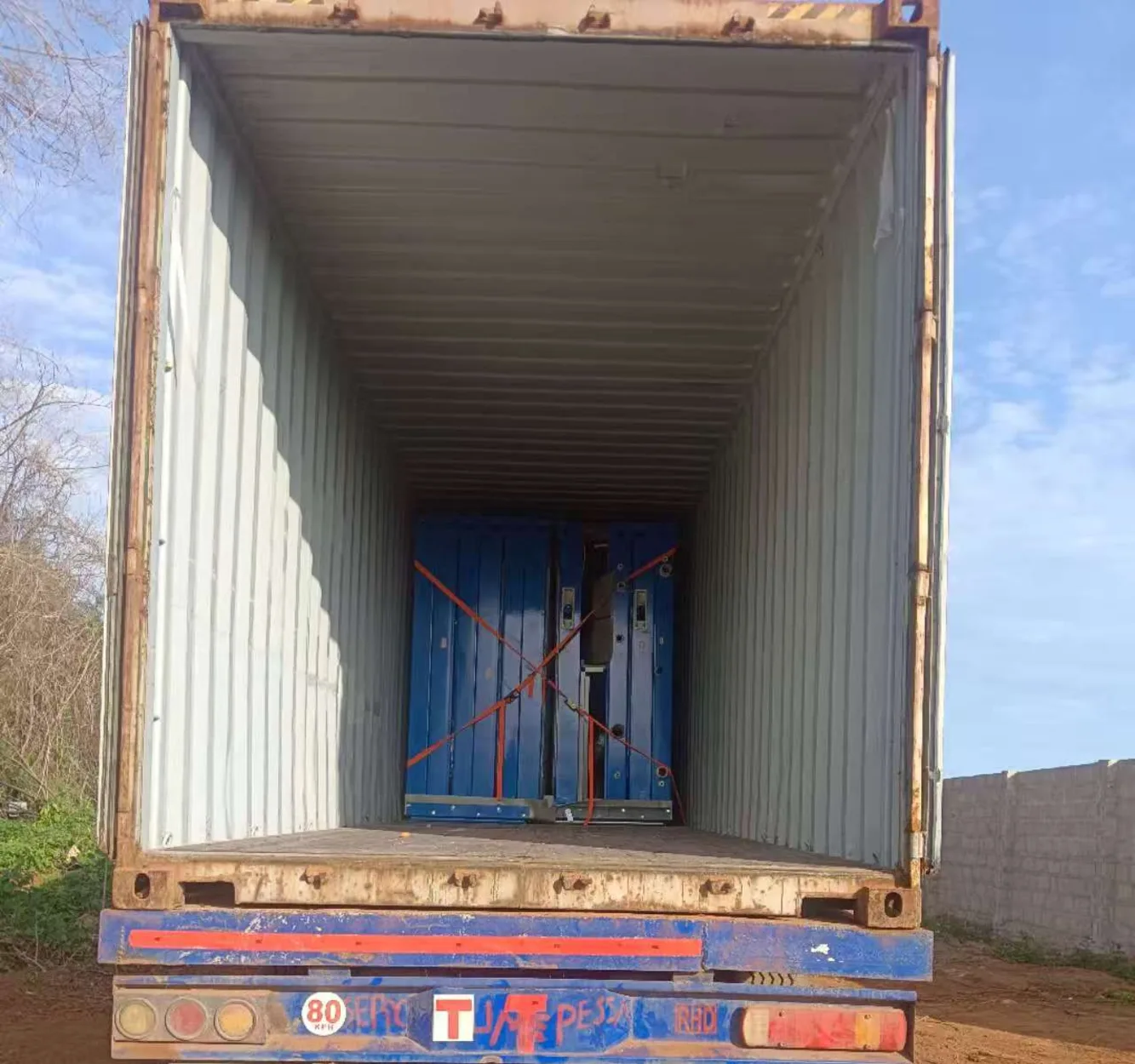
Three verified KUBO project photographs provide useful first-party evidence without needing to identify the customer, country, route, project quantity or lifting-equipment specification.
Observation 1: The cargo is still an active transport risk when the container doors open
One overseas project photograph shows modular frame components still restrained inside a freight container after the unit has reached its destination.
The photograph does not prove what occurred during transport. It does show why the receiving process cannot begin with uncontrolled restraint removal.
The UNECE CTU framework covers the transport chain through receipt and unpacking, while UK HSE loading guidance states that checks should be made before unloading to determine whether loads have shifted and whether they could move or fall when restraints are removed.
For a modular project, that translates into a receiving hold point:
- identify the transport unit;
- compare seals and documents where applicable;
- observe visible external condition;
- open only under the agreed receiving procedure;
- assess whether cargo or restraints appear displaced;
- determine how restraints can be released without exposing personnel to movement;
- unload according to the approved component sequence.
A schedule that assumes “container arrives at 08:00, unloading starts at 08:05” can therefore be structurally wrong. Inspection and safe release are part of the operation.
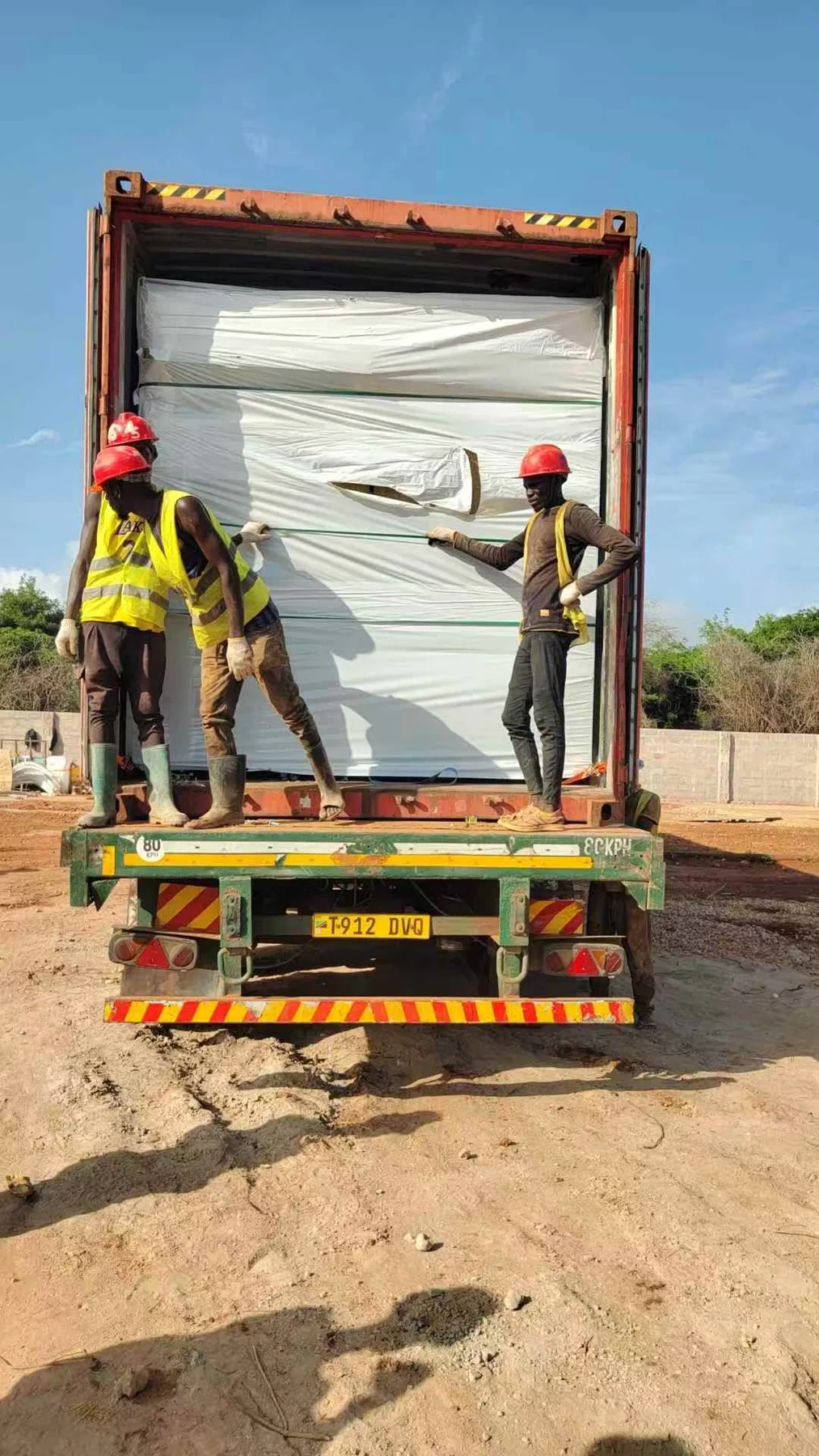
Observation 2: Unloading is an information-flow task
A second KUBO project photograph shows receiving personnel removing structural components from a freight container at the project site.
The visible interface is not merely labor plus a container. The unloading team needs to know what is being removed, where it belongs and what should be accessible next.
For component-based modular systems, a weak unloading process can create a downstream sorting problem. Structural frames, panels, connection components and other items may reach the site correctly but become difficult to locate if they are distributed around the laydown area without an agreed coding and release sequence.
The information accompanying each delivery batch should therefore allow the site team to answer:
- What is in this transport unit?
- Which building, block or installation phase does it support?
- Which items must remain protected?
- Which items are needed first?
- Where should each component group be staged?
- Which components should not be buried beneath later-use material?
- Who records shortages, packaging damage or visible condition issues?
This is a logistics-control function, not administrative paperwork.
Observation 3: Installation readiness starts before the lift
A third KUBO photograph shows a vertical structural member being lifted into a staged module frame.
The image supports only the visible physical interface, but that interface carries several planning requirements.
Before material is released into installation, the project team needs to know that:
- the relevant support or foundation condition is ready;
- required lifting equipment is available;
- the ground or working position used for lifting is suitable under the project’s method and local requirements;
- the component can be identified;
- the installation sequence is known;
- personnel exclusion and work zones are controlled by the responsible site team;
- the laydown arrangement allows the required component to be retrieved without unnecessary rehandling.
The final inland logistics leg therefore ends not when the truck arrives, but when the received material can be released into installation under controlled conditions.
Responsibility and Information-Flow Matrix
Last-mile failures frequently occur at contractual boundaries. A responsibility matrix should therefore identify both who performs the activity and who supplies the required input.
The exact contract may differ, but a project-specific matrix should resolve responsibilities such as these:
| Party | Information it should provide or control within agreed scope | Key interfaces |
| Modular manufacturer | Confirmed transport-package dimensions and masses; packing lists; package/component identification; relevant handling information; agreed installation documentation | Buyer/EPC, forwarder, haulier, site contractor |
| Buyer / EPC contractor | Project delivery point; route and site constraints available to the project; overall responsibility allocation; site program; foundation and access readiness; local compliance coordination | All parties |
| Freight forwarder / port agent | Destination release process; terminal requirements; transport-unit status; port or inland-terminal coordination within appointed scope | Buyer/EPC, inland haulier |
| Inland haulier | Proposed vehicle configuration; running dimensions; route assessment; road-movement requirements within contracted scope | Buyer/EPC, authorities, site |
| Site contractor | Site entrance, internal routes, unloading zone, laydown readiness, traffic management, installation sequencing and local site controls within scope | Haulier, lifting contractor, EPC |
| Lifting / handling contractor | Equipment selection within its professional scope; setup requirements; rigging/lifting method inputs; working-area requirements | Site contractor, manufacturer documentation, EPC |
| Local road / permit authorities or infrastructure owners | Applicable movement conditions, permissions, restrictions or approvals | Haulier and applicant named under local rules |
The UNECE CTU Code reinforces the broader principle that a safe transport chain depends on responsibility and information flow among participants rather than a single actor controlling every stage.
For procurement teams, this has an important implication: subcontracting an activity does not eliminate the interface.
Arrival-to-Installation Release Table
A controlled arrival process can prevent transport issues from becoming installation issues.
| Release stage | Evidence or input | Hold if unresolved | Release outcome |
| Delivery identity | Shipment/container/package identification and relevant documents | Shipment cannot be reconciled | Delivery accepted into receiving process |
| External condition | Visible transport-unit and packaging condition | Significant unexplained damage | Inspection escalated |
| Before opening | Agreed receiving method and safe opening area | Uncontrolled access or unsafe position | Opening authorized |
| Shifted-load assessment | Visual assessment before restraint removal | Cargo appears displaced or unstable | Normal unloading or revised method selected |
| Unloading-zone readiness | Stable, clear area and traffic controls appropriate to site procedure | Congestion, unstable area or conflicting operations | Vehicle positioned |
| Handling-equipment readiness | Required equipment and personnel available under site plan | Equipment unavailable or unsuitable | Unloading released |
| Component identification | Packing list/coding aligns with received components | Unidentified or missing items | Material directed to correct laydown zone |
| Laydown control | Allocated storage location and protection approach | Material would block later work or be exposed unnecessarily | Components staged |
| Foundation/support readiness | Required site readiness evidence under project process | Building position not ready | Material remains staged |
| Installation sequence | Current drawing/sequence and responsible crew ready | Sequence has changed without material-flow update | Component released to erection |
| Exception closure | Damage, shortage or sequencing issue documented and dispositioned | Responsibility or action unclear | Installation proceeds under controlled status |
This table creates a practical distinction between arrival, acceptance, unloading, staging and installation release.
Those milestones should not be treated as interchangeable.
Unloading Space Must Be Designed Around the Operation
UK HSE guidance recommends clear, level and stable loading and unloading areas and advance agreement when more than one company is involved. The guidance is written for UK workplace safety, but the coordination principle is directly relevant to international modular-project receiving operations.
For remote modular projects, the unloading-zone assessment should consider:
- arriving truck position;
- trailer stabilisation requirements where relevant;
- crane or forklift position;
- equipment movement envelope;
- separation from personnel and unrelated traffic;
- packaging-removal area;
- temporary location for restraints and waste materials;
- component laydown path;
- ability of an empty truck to exit;
- drainage and ground deterioration if unloading occurs during poor weather.
Space shown as “available” on a site plan can become unavailable once excavations, stored materials, temporary utilities, construction vehicles and active work fronts are added.
That is why the unloading plan should be checked against the current construction sequence, not only the original site master plan.
Crane and Forklift Availability Should Be Confirmed by Package Type
“Crane available on site” is not a complete logistics input.
Neither is “forklift available.”
The relevant questions depend on the supplied package and the responsible lifting or handling contractor. They can include:
- What item must be handled?
- What is its confirmed mass?
- What are its dimensions?
- Where are the approved handling or lifting interfaces?
- Where can equipment physically stand?
- What reach or working geometry is required?
- What ground or support condition is required under the site method?
- Can equipment move between the unloading area and laydown zone?
- Will the equipment still be available when the shipment actually arrives?
A piece of equipment may be physically present at the project while committed to another critical activity.
This is why equipment availability belongs in the delivery schedule as a confirmed resource interface rather than a general site assumption.
Laydown Is Part of the Installation Strategy
Flat-pack and component-based modular construction can move substantial fabrication work away from the project site, but it does not eliminate material-flow planning.
Poor laydown management can introduce:
- repeated lifting;
- searching for components;
- damaged finishes or packaging;
- blocking of access routes;
- mixing of building phases;
- premature exposure of materials;
- congestion around installation areas.
A useful laydown plan starts from the installation sequence and works backward.
If Block A is installed before Block B, the material required for Block A should not become inaccessible beneath later-phase material. If roof components are required only after structural frames, they still need a protected location that does not interfere with early erection.
For large modular camp deliveries, this can justify shipment or container allocation by installation batch rather than by purely factory-oriented packing convenience, provided the packing method remains technically and commercially appropriate.
Component Coding Connects Factory Packing to Site Productivity
The physical label on a component has limited value if the site team cannot connect it to project information.
A workable coding structure should allow receiving personnel to associate delivered material with information such as:
- delivery batch;
- building or block;
- module or location;
- component family;
- installation phase;
- drawing or schedule reference where applicable.
The manufacturer controls certain packing and identification inputs. The site team controls how material is received, recorded and distributed. The buyer or EPC is normally responsible for ensuring these interfaces are integrated into the overall project process according to contract.
This is one reason manufacturer drawings, packing records and site installation planning should not be managed as independent document streams.
When Foundation Readiness Becomes a Logistics Issue
Foundation readiness is often treated as a civil-construction topic.
During the last mile, it becomes a material-flow topic.
If building supports, pads or foundations are not ready when cargo arrives, the project must decide whether to:
- hold cargo upstream;
- unload into temporary storage;
- move it into a secondary laydown area;
- resequence installation;
- unload and later rehandle it;
- change the delivery batch.
Each option creates a different interface.
The most efficient delivery sequence is therefore not automatically the earliest possible delivery. It is the sequence that aligns cargo arrival with usable site capacity.
KUBO’s broader modular building solutions overview describes project conditions, logistics and installation inputs as part of system selection. For a last-mile plan, those inputs need to become shipment-specific before movement begins.
Conditional Last-Mile Contingency Framework
A useful contingency plan is based on triggers and decisions, not unsupported promises about delay or cost.
Route closure
Trigger: planned route becomes temporarily unavailable.
Verify:
- cause and expected access status from an appropriate local source;
- whether the loaded vehicle can wait safely;
- whether an approved alternative route exists;
- whether alternative-route geometry and permissions remain compatible.
Possible response:
Hold at port, terminal or predetermined inland staging point; activate an already assessed alternative route; revise delivery sequence.
Do not divert a large load simply because a navigation application shows another road.
Bridge, clearance or structural restriction discovered
Trigger: verified restriction conflicts with intended vehicle/load.
Verify:
- exact affected location;
- vehicle/load data;
- authority or infrastructure-owner requirements;
- alternative route feasibility;
- whether the cargo configuration can legitimately be changed.
Possible response:
Change route, change transport vehicle/configuration where technically and legally possible, split compatible cargo if the packaging concept permits it, or hold movement while the responsible parties revise the plan.
Wet-season or damaged-road degradation
Trigger: site road or local route no longer supports planned movement under the project’s access criteria.
Verify:
- road condition;
- drainage or erosion;
- forecast and operational restrictions where relevant;
- recovery risk;
- upstream holding capacity.
Possible response:
Temporary movement suspension, use of a prequalified staging point, revised batch order, access-road remediation under the responsible site’s scope.
Handling equipment unavailable
Trigger: nominated crane, forklift or other handling resource is not available when cargo arrives.
Verify:
- actual package requiring unloading;
- whether an alternative machine is technically appropriate;
- site space and ground requirements;
- revised unloading window.
Possible response:
Hold truck or cargo at an agreed location, reschedule receiving, or appoint a suitable alternative through the responsible lifting/handling contractor.
Do not substitute equipment solely on nominal capacity.
Packaging damage or suspected load shift
Trigger: visible package damage, unusual container condition or signs of internal displacement.
Verify:
- extent of visible condition;
- stability before restraint removal;
- relevant receiving records;
- appropriate inspection and disposition responsibility.
Possible response:
Create a controlled hold point, photograph and document condition, revise restraint-removal or unloading method where required, segregate affected items after safe unloading, and resolve repair or replacement disposition before installation.
Installation sequence changes after shipping
Trigger: civil works, utilities, site access or construction priorities alter the planned erection order.
Verify:
- which delivery batches are affected;
- current component locations;
- new installation priorities;
- laydown capacity;
- whether future shipments can be resequenced.
Possible response:
Reassign laydown zones, revise receiving priorities and update later dispatch batches where contractually and operationally possible.
The objective is to prevent a planning change from turning into uncontrolled site rehandling.
Compare Three Last-Mile Execution Paths
Remote modular projects generally face one of three execution patterns.
| Execution path | Potential advantage | Main dependency | Last-mile risk profile |
| Direct port-to-site delivery | Minimizes intermediate handling when site and route are ready | Reliable route, site access, unloading and installation readiness | High sensitivity to schedule mismatch or sudden route closure |
| Port-to-inland staging-to-site | Creates buffer between international arrival and site readiness | Suitable secure staging location and additional handling | Extra interface and rehandling, but stronger schedule buffering |
| Phased delivery matched to installation | Reduces site inventory and can support orderly erection | Strong factory, logistics and site information flow | Sensitive to sequence changes and missed delivery windows |
No path is inherently superior.
Direct delivery may reduce intermediate handling but requires stronger synchronization.
Intermediate staging can absorb uncertainty but introduces another handling point, another inventory location and potentially another condition-control interface.
Installation-linked phased delivery can reduce site congestion, but its effectiveness depends on reliable document control and a stable installation sequence.
A MOFU evaluation should compare the alternatives against the actual project rather than selecting a method because it appears simpler on a freight quotation.
The Last-Mile Route Can Influence the Modular System Decision
Last-mile planning should occur early enough to influence system selection.
A procurement team comparing modular formats may need to consider:
- transport package geometry;
- ocean-freight configuration;
- inland road compatibility;
- unloading method;
- required site assembly;
- local labor availability;
- crane or forklift dependency;
- laydown area;
- installation sequence;
- future relocation requirements.
A more transport-compact system may impose greater site assembly and material-sorting requirements.
A more preassembled system may reduce certain site operations but increase transported dimensions, vehicle requirements or lifting demands.
The engineering question is therefore:
Which configuration produces the most controllable total path from factory packing through final installation under the project’s actual logistics conditions?
That question is materially different from asking which system fits the most units into an ocean container.
What Buyers Should Prepare Before Finalizing Inland Delivery
A route-input package does not need to be a complex logistics study on day one. It does need enough verified information to expose uncertainties.
Prepare:
Transport information
- intended destination port or inland terminal;
- proposed final site;
- known delivery route;
- known restricted sections;
- road-surface description;
- bridge, culvert or ramp information where available;
- overhead restrictions;
- site-entry dimensions;
- seasonal access information;
- local abnormal-load requirements already identified.
Site information
- current site plan;
- gate location;
- internal delivery road;
- unloading area;
- laydown area;
- intended crane or handling-equipment positions;
- building-pad or foundation sequence;
- active construction zones.
Execution information
- delivery batches;
- required installation order;
- appointed freight forwarder or port agent;
- inland haulier;
- site contractor;
- lifting contractor;
- party responsible for route surveys and local permits;
- party authorized to release cargo into installation.
Evidence
Photographs and video can be particularly useful for:
- narrow sections;
- site entrances;
- bridges;
- overhead lines;
- sharp turns;
- road shoulders;
- temporary access roads;
- unloading areas.
They do not replace formal engineering or authority confirmation where that is required, but they can expose assumptions early.
Review Last-Mile Logistics Inputs Before Shipment
For remote modular projects, the strongest time to identify a transport incompatibility is before factory packing and shipment—not after the cargo has cleared the destination port.
Buyers and EPC teams reviewing modular building last mile logistics should bring together the actual route, planned transport vehicle, package dimensions and masses, seasonal conditions, access restrictions, permit responsibilities, unloading equipment, laydown strategy and installation sequence.
If you are assessing a mining camp, energy-project facility, infrastructure compound or other remote modular deployment, review the wider KUBO modular project solution categories to establish the building context, then use the KUBO project enquiry page to share the destination, site conditions, route information, available layout data and target delivery sequence.
The purpose of that review is not to promise that every logistics uncertainty can be eliminated. It is to expose the interfaces early enough for the manufacturer, buyer/EPC, haulier, site contractor, lifting contractor and relevant local parties to resolve the ones that can materially change delivery.
Frequently Asked Questions
1. What is modular building last mile logistics?
Modular building last mile logistics is the planning and execution of the final inland movement from a destination port, border point or inland terminal to the actual project receiving and installation area.
It includes more than trucking distance. The assessment may need to cover package and vehicle dimensions, road geometry, bridge and clearance restrictions, local permits, seasonal access, site gates, unloading areas, handling equipment, laydown space and installation sequencing.
For remote projects, this final section of the logistics chain can determine whether the shipping configuration selected for international freight remains practical at the destination.
2. Why is port-to-port freight planning insufficient for a remote modular project?
Port-to-port planning establishes how cargo reaches the destination transport hub. It does not automatically establish whether the shipment can travel from that hub to the project.
The inland route may contain narrower roads, lower clearances, restricted bridges, unsealed sections or site-specific access constraints. The project also needs equipment and space to unload and stage the material after arrival.
A shipping plan should therefore be connected to an inland route and site-receiving plan before dispatch.
3. What information is needed for remote project prefab transport planning?
The most important inputs are the transported dimensions and mass of the packages or modules, the proposed inland vehicle, the route, known bridge and clearance restrictions, turning constraints, seasonal access, permit requirements, site entrance, unloading area, laydown plan, handling equipment and installation sequence.
Responsibility for confirming each input should also be identified. A list of risks without named owners is difficult to control.
4. Should the modular manufacturer perform the entire route survey?
Not necessarily.
The manufacturer can provide transport-package information within its agreed scope, including dimensions, masses, packing records and relevant handling information.
Local route verification may require an inland haulier, EPC logistics team, specialist surveyor, local engineer, road authority or infrastructure owner. Permit responsibility varies by jurisdiction and contract.
The important point is that the responsibility boundary should be defined rather than assumed.
5. How should bridge and overhead-clearance risks be checked?
Start with the proposed vehicle and the load in its actual travelling configuration.
For height, that means running height rather than cargo height alone.
Identify bridges, tunnels, overhead utilities, gantries, temporary works and constrained entrances along the route. Structural and legal restrictions should be confirmed through the appropriate local authority, infrastructure owner, engineer or transport provider where required.
A map or navigation application should not be treated as the sole approval basis for a large or restricted transport movement.
6. Can flat-pack modular buildings eliminate last-mile transport problems?
No.
Compact packing may reduce some dimensional constraints compared with transporting larger preassembled modules, but it creates its own site interfaces.
The receiving team still needs suitable unloading equipment, enough laydown space, component identification, protection against damage and an installation sequence.
Transport efficiency should therefore be evaluated together with handling and assembly requirements.
7. What should happen before restraints are removed from a freight container?
The receiving team should follow the applicable project procedure and assess whether the cargo appears to have shifted or become unstable before restraints are removed.
UK HSE guidance specifically warns that loads should be checked before unloading to determine whether they have shifted and could move or fall when restraints are released. The UNECE CTU Code also addresses safe handling and unpacking across the intermodal transport chain.
The exact method should reflect the cargo, transport unit, local safety requirements and responsible contractor’s procedure.
8. Is a staging yard useful for a remote modular camp port-to-site plan?
It can be, particularly when international arrival dates are less predictable than site readiness or when the project access road has seasonal limitations.
However, staging introduces another handling point.
The project should evaluate site security, surface conditions, storage protection, handling equipment, inventory control, accessibility for the next vehicle and the potential consequences of additional loading and unloading.
A staging yard is therefore a risk-management option, not automatically a logistics improvement.
9. What happens if the road becomes unusable after the shipment has arrived?
The response should follow a pre-agreed contingency framework.
Depending on the circumstances, cargo may remain at the port or terminal, move to a predetermined inland staging area, wait for the planned route to reopen or use an alternative route that has already been technically and legally assessed.
Improvised rerouting is particularly risky for large or heavy vehicles because the alternative road may introduce unknown width, height, bridge, turning or permission constraints.
10. When should last-mile planning begin?
It should begin before the modular configuration and shipment plan are irrevocably fixed.
Early route information can influence the preferred modular format, packaging approach, delivery batches, handling equipment, laydown arrangement and installation sequence.
Detailed verification can continue as the project develops, but major constraints should not be left until cargo is already on the water.
Sources and References
- UNECE — IMO/ILO/UNECE Code of Practice for Packing of Cargo Transport Units (CTU Code) — official overview of the non-mandatory CTU Code covering packing, securing, handling and unpacking across sea and land transport and the intermodal responsibility chain.
- UK Health and Safety Executive — Loading and Unloading Guidance — UK workplace guidance covering loading/unloading area conditions, advance coordination between involved companies and checks for shifted loads before restraints are removed.
- UK Health and Safety Executive — Vehicles and Loads Guidance — UK-specific route-planning guidance addressing vehicle and load geometry, manoeuvrability, overhead clearance and bridge/ramp capacity.
- National Heavy Vehicle Regulator — Oversize and Overmass Access — Australian guidance covering oversize/overmass access, network notices, route planning, third-party approvals and permits under the Australian framework.
- GOV.UK — Bridge Strike Guidance for Large-Vehicle Operators — Great Britain guidance emphasizing advance route planning and access to established vehicle and trailer running heights.