


Summary
A factory quotation and a modular building landed cost estimate answer different procurement questions. The factory quotation prices the supplier’s stated scope under its stated delivery basis. A landed estimate brings that offer to a defined destination boundary by adding only the charges that are genuinely missing from the quotation and required to reach that boundary.
For the comparison method in this article, the common endpoint is:
The contracted modular-building goods have reached the exact named project site on the final transport vehicle and are ready for unloading. Unloading is outside the landed-cost boundary unless it is expressly included and deliberately retained in the common comparison basis.
That definition prevents an important procurement error: treating a module that has arrived on site as an operational building. Foundations, external utilities, unloading, positioning, field assembly, testing, local engineering and approvals remain separate unless a project-specific contract explicitly places them inside the comparison scope.
The practical objective is not to produce a larger spreadsheet. It is to reconcile each supplier quotation so that every charge is counted once, unresolved costs remain visibly provisional, bundled scope is not reverse-engineered without evidence, and competing offers are compared on the same specification, quantity, destination, delivery condition, tax treatment, currency basis and exclusions.
Why Factory Price and Landed Cost Should Not Be Compared as if They Were the Same Price
International modular-building procurement often begins with a simple commercial contrast:
- one supplier offers a lower factory quotation;
- another offers a higher quotation with more logistics included.
The lower number is not automatically the lower procurement cost, while the higher delivered number is not automatically more expensive.
The problem is comparability.
The U.S. International Trade Administration’s export pricing guidance describes landed cost broadly as the product price together with relevant freight, insurance, tariffs, taxes and other charges required to reach the destination. It also emphasizes that such calculations are estimates and that destination customs treatment requires current destination-specific determination. Its U.S.-specific tariff examples or preferential-treatment concepts should not be transferred to Chinese-origin modular buildings.
For modular buildings, the commercial analysis needs an additional layer because the transported goods are part of a construction project. The supply may include structural members, panels, internal components, building-side MEP provisions, fixtures or loose items, but those goods can still require substantial destination work before the building is usable.
KUBO’s modular camp supply-scope framework makes this boundary explicit: module supply can sit with the manufacturer while freight, customs, foundations, civil works, unloading, local labor, external utilities, testing and approvals are allocated separately according to the quotation, responsibility matrix and contract.
A landed-cost comparison should therefore remain a procurement and logistics reconciliation, not an attempt to disguise total installed project cost as one number.
Define the Endpoint Before Opening the Cost Workbook
“Landed” is only useful when the endpoint is explicit.
A buyer comparing quotations should establish a ladder of commercial endpoints and select one before normalizing the offers.
| Comparison endpoint | What the endpoint means | What the comparison stops before |
|---|---|---|
| Factory-ready | Contracted goods are prepared at the agreed factory handover point under the quotation basis | Subsequent transport and destination activities not included in the factory offer |
| Destination-port | Contracted shipment has reached the named destination port or terminal boundary defined by the commercial model | Charges and movement beyond that boundary unless already included |
| Named-site-delivered | Contracted goods have reached the exact named project site on the final transport vehicle, ready for unloading | Unloading and subsequent site work unless expressly included in the common basis |
| Installed / operational | The project has moved beyond logistics into construction, connection, testing and handover | Any remaining owner, EPC, local-contractor or authority obligations |
This article uses named-site-delivered, ready for unloading as the landed-cost endpoint.
The wording is intentionally specific. “Delivered to country,” “delivered to city,” “door delivery” and even “delivered to site” can remain commercially ambiguous if the exact point and handling boundary are not defined.
The ICC Academy explanation of EXW and DDP illustrates why named places and responsibility boundaries matter. Its discussion also highlights practical differences in export and import formalities and notes that final unloading should not simply be assumed to be part of a destination-delivery price. The procurement team should use the applicable Incoterms rule together with the sales and logistics documents rather than reproducing or substituting for the complete ICC rules.
Delivery responsibility, risk transfer and economic cost are not identical concepts
This distinction deserves particular attention.
For a given logistics activity:
- one party may arrange the service;
- another party may receive the invoice;
- the quoted product price may already economically recover the charge;
- risk may transfer at a different point;
- another party may ultimately bear the cost under the contract.
Those are not necessarily the same event.
A freight invoice addressed to a supplier does not, by itself, prove that the buyer does not economically pay for the freight through a bundled selling price. Conversely, a buyer-arranged shipment does not mean that every origin activity is necessarily outside the manufacturer’s quotation.
Risk transfer is also not a substitute for cost allocation.
The ICC Academy discussion of common Incoterms problems explains that Incoterms rules do not replace the complete sales contract, do not constitute the carriage contract and do not determine every contractual issue. For quotation reconciliation, procurement should therefore keep separate columns for contractual scope, service arrangement, payer/invoice party and commercial cost inclusion where those distinctions matter.
Start With the Quoted Total, Not an Assumed Breakdown
A common landed-cost modeling mistake is to reconstruct every quotation from imaginary components.
Suppose a supplier gives one bundled delivered price. Procurement may suspect that the number includes factory supply, export handling, freight, customs services and inland transport. That does not mean the buyer has evidence for the value of each component.
The correct starting point is the quotation as issued.
For Offer A:
Q_A = the total amount quoted by Offer A under its stated specification, quantity, delivery condition and exclusions.
For Offer B:
Q_B = the total amount quoted by Offer B under its stated specification, quantity, delivery condition and exclusions.
Q_A and Q_B are not assumed to be factory prices. They are simply the quoted totals from which normalization begins.
From there, procurement identifies only three types of adjustment.
1. Confirmed omitted charges
These are charges that:
- are not already included in the quoted total;
- are required to reach the chosen common endpoint;
- have a sufficiently documented value or quotation basis.
Call them:
O_A and O_B.
Examples could include a buyer-arranged transport leg, destination receiving service or applicable import charge that is clearly excluded from the seller’s quotation. Whether any specific item belongs here depends entirely on the current quotation and destination.
2. Provisional allowances
Some required destination costs may not yet have firm external quotations.
Those belong in:
P_A and P_B.
A provisional allowance remains visibly provisional. It should not be relabeled as a supplier price, carrier commitment, customs assessment or confirmed project cost.
3. Documented out-of-boundary charges
A quotation may include a service that sits beyond the selected comparison endpoint. For example, one offer might expressly include unloading while the common landed-cost endpoint stops before unloading.
Such an amount may be deducted only when:
- the service is clearly identified;
- its value is separately documented;
- removing it produces a commercially comparable basis.
Call such deductions:
D_A and D_B.
If a bundled quotation includes delivery plus unloading but the unloading component cannot be separated reliably, procurement should not invent D_A or D_B. The correct status is that the offer contains unseparable scope and cannot be perfectly normalized on that line.
That limitation is more informative than fabricated precision.
A Safer Symbolic Reconciliation for Two Offers
Once the common basis is defined, the normalized confirmed landed estimates become:
N_A_confirmed = Q_A + ΣO_A – ΣD_A
N_B_confirmed = Q_B + ΣO_B – ΣD_B
Where:
- Q is the actual quoted total;
- O contains only confirmed omitted charges necessary to reach the common endpoint;
- D contains only clearly documented and separable quoted charges that fall outside the endpoint.
Provisional requirements remain separate:
N_A_budget = N_A_confirmed + ΣP_A
N_B_budget = N_B_confirmed + ΣP_B
This structure avoids an important double-counting problem.
If Offer B already includes import duty or another destination tax in Q_B, that amount is not added again merely because the landed-cost workbook has a “tax” row.
If Offer A already includes international freight in Q_A, the model does not add freight a second time.
If neither the quotation nor the supporting documents reveal whether a bundled destination charge includes a particular component, procurement should flag the uncertainty rather than assuming inclusion or exclusion.
Normalize the commercial basis before applying the equation
The equations are only useful after the quotations have been aligned for:
- modular system and technical configuration;
- building/module schedule;
- quantity;
- openings, partitions and specified internal scope;
- supplied loose items;
- packing basis;
- exact delivery destination;
- delivery and unloading boundary;
- customs and tax treatment;
- currency comparison basis;
- comparison date;
- exclusions and assumptions.
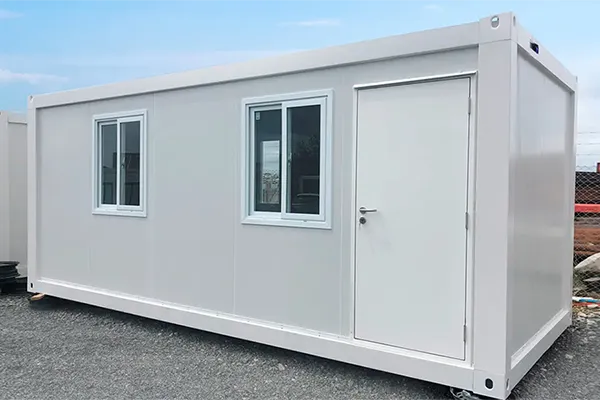
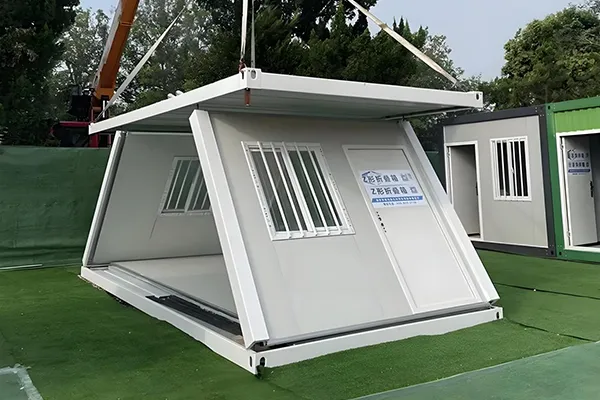
The need to align structural-system scope is particularly relevant in modular procurement. KUBO’s modular building systems comparison distinguishes Flat Pack, Detachable Flat Pack, Detachable Container, Expandable, Folding and Z-Type Folding systems because their transport forms and destination work profiles differ.
Comparing a freight-led knock-down configuration against a more pre-integrated configuration without acknowledging the different field-work boundary is not simply a price comparison. It is a scope comparison.
Use a Reconciliation Ledger to Count Every Charge Once
The working ledger should sit between the quotations and the management-level comparison total.
Its purpose is not merely to list costs. It should establish:
- whether the charge is already inside the quote;
- whether an omitted charge must be added;
- whether the value is confirmed or provisional;
- who is responsible for the activity;
- what measurement or quotation basis applies;
- which document supports the treatment;
- whether the row duplicates another charge.
A practical structure is:
| Charge or scope element | Reconciliation status | Party arranging / paying as applicable | Measurement or quotation basis | Supporting reference | Duplicate / omission test |
|---|---|---|---|---|---|
| Contracted modular supply | Included / excluded / unclear | Supplier / buyer as contracted | Quoted package, module or building schedule | Supplier quotation | Does it match the normalized technical scope? |
| Loose supplied items | Included / excluded / provisional | Assigned party | Item or schedule basis | Included-items schedule | Already inside module price? |
| Export packing | Included / excluded / unclear | Assigned party | Shipment / package basis | Quotation or packing scope | Already included in Q? |
| Origin movement and handling | Included / omitted / provisional | Assigned party | Forwarder service basis | Logistics quotation | Duplicated by supplier delivery scope? |
| Main international carriage | Included / omitted / provisional | Assigned party | Shipment basis | Supplier or forwarder quotation | Already inside Q? |
| Transport insurance | Included / omitted / provisional | Assigned party | Policy / shipment basis | Relevant commercial document | Bundled with freight? |
| Destination terminal / receiving services | Included / omitted / provisional | Assigned party | Destination service basis | Agent / forwarder quotation | Already covered by bundled logistics? |
| Customs brokerage service | Included / omitted / provisional | Assigned party | Entry / service basis | Broker quotation | Separate from government charges? |
| Duty / import tax / government charge | Included / omitted / provisional | Contractually relevant party | Destination customs basis | Current customs/tax confirmation | Already included in a delivered-duty quote? |
| Inland transport to named site | Included / omitted / provisional | Assigned party | Vehicle / shipment / service basis | Inland-carrier quotation | Does “delivery” already include this leg? |
| Out-of-boundary activity | Included but separable / unseparable / not applicable | Assigned party | Documented basis only | Quotation / contract | Can it legitimately be deducted? |
Why blank should never mean zero
A blank cell can conceal several different commercial states:
- included elsewhere;
- excluded;
- not applicable;
- not yet quoted;
- pending confirmation;
- unknown;
- not yet investigated.
Converting all of those states into zero makes the total appear more complete than the evidence supports.
A procurement workbook should therefore use explicit statuses such as included, excluded, confirmed omitted, provisional, unresolved, not applicable or unseparable.
That treatment is especially important for taxes and government charges. Their treatment should be confirmed for the actual destination, importer, goods and current transaction. A blank tax row is not evidence that the tax is zero.
Do not force a bundled offer into artificial component values
Some delivered offers will remain bundled.
In that situation, procurement may know that Q_B reaches the required endpoint without knowing exactly how much of Q_B represents freight, brokerage or inland delivery.
That is acceptable if the commercial boundary is sufficiently clear.
The model needs to know whether a missing charge must be added, not necessarily the supplier’s internal cost composition.
Component-level decomposition becomes necessary only when the buyer needs to remove an out-of-boundary service, resolve an overlap, evaluate a change or understand a material scope uncertainty.
Taxes Need Both Cost Treatment and Cash-Flow Treatment
Import taxes can create another source of comparison error because “who pays” can mean several different things.
Procurement should distinguish:
- who is legally responsible under the applicable import structure;
- who advances or settles the amount at clearance;
- who receives the invoice or customs assessment;
- whether the seller’s quoted price already includes the amount;
- whether the buyer can recover, credit or otherwise treat a tax differently under applicable local rules.
A landed-cost schedule concerned with project cash requirements may therefore differ from an internal net-cost analysis used for accounting or financial evaluation.
The reconciliation should not make universal assumptions about recoverability, tax bases or rates.
Where destination treatment is unresolved, record it as a destination-confirmation item and obtain current input from the relevant customs, tax or importing specialist.
The Manufacturer-Side Handoff That Makes a Landed Estimate Possible
A reliable landed-cost model depends on information passing through several commercial interfaces. Procurement should control that handoff rather than asking each party for an isolated price.
Approved configuration and included items
The first input is the actual building scope.
The manufacturer and buyer need a sufficiently controlled basis covering, as relevant:
- selected modular system;
- building/module types;
- quantity;
- dimensions and layout basis;
- openings and partitions;
- materials and finishes in the contracted supply;
- agreed building-side MEP provisions;
- sanitary fixtures where specified;
- furniture or FF&E where specified;
- loose items and accessories;
- optional items accepted into the order;
- revision status.
This stage determines what is being transported.
The KUBO Flat Pack system page illustrates the interface by distinguishing configurable openings, partitions, finishes and MEP interfaces and by identifying packing and release information as part of the progression from approved configuration toward shipment.
Configuration to package dimensions, mass and packing list
A building schedule cannot be sent directly to a forwarder as if every configuration generated the same shipment.
Procurement should request project-appropriate logistics information when it becomes available, such as:
- package identification;
- package dimensions;
- package mass;
- item-to-package relationship;
- packing list;
- loading or packing sequence where applicable;
- handling information supplied for the shipment;
- document revision.
The detailed question of packing density belongs in a separate logistics analysis. KUBO’s flat pack loading and packing resource addresses that subject more directly.
For landed-cost reconciliation, the important principle is narrower: the freight basis should correspond to the approved supply configuration rather than to a generic catalogue assumption.
Packing information to the forwarder
The forwarder quotation should be tested for service boundaries, not accepted merely as a freight total.
Procurement may need to confirm:
- origin collection point;
- origin handling included;
- main carriage included;
- insurance treatment;
- destination terminal or agent services;
- customs brokerage scope;
- whether government charges are excluded;
- destination inland transport endpoint;
- handling or access assumptions relevant to the service.
This is not an attempt to reproduce a full logistics execution plan. The KUBO last-mile logistics guide covers destination transport and handling questions in greater depth.
Here the objective is simply to establish which logistics services are already covered by the quotation that enters the ledger.
Cargo description to customs confirmation
The manufacturer can provide the agreed supplier documents and product information required by the transaction, but classification and destination treatment should not be invented from a generic modular-building label.
The importing party and its appointed customs specialist should confirm the appropriate current treatment for the actual goods and destination.
The landed-cost worksheet should record that confirmation basis rather than copying assumptions from another country or an earlier shipment.
Destination receiving cost
Once the shipment, customs and destination interfaces are defined, the buyer can reconcile the remaining costs required to reach the named-site endpoint.
These inputs may come from different parties. The workbook should therefore preserve the source of each amount rather than presenting all additions as if they originated from the modular manufacturer.
Build Change Control Into the Landed-Cost Model
A landed estimate can become obsolete even when the spreadsheet formulas remain correct.
Typical upstream changes include:
- module quantity changes;
- system selection changes;
- revised room configuration;
- added furniture or fixtures;
- revised loose-item schedule;
- changed packaging;
- changed destination;
- changed delivery condition;
- revised forwarder offer;
- customs-treatment change;
- different inland delivery arrangement.
The correct process is not to overwrite the old total without explanation.
A controlled revision should identify:
- the changed project input;
- the affected quotation, packing or logistics document;
- the cost rows that may need revalidation;
- any previously included charge that is no longer applicable;
- any new omission;
- whether provisional allowances need to be updated;
- the revision basis and comparison date.
This creates an audit trail between the technical definition and the commercial estimate.
It also prevents a common tender problem: comparing an updated supplier quotation against an old freight quotation that was prepared for a different configuration.
Evidence From KUBO Reference Images: What Procurement Can Actually Conclude
Visual evidence can help procurement identify questions, but it should not silently become contractual evidence.
KUBO’s manufacturer overview identifies factory manufacturing, inspection, shipment preparation and export packing preparation as parts of its modular-building supply process.
The following two KUBO reference images provide useful examples of clear visual project evidence.
Factory packing reference image

A KUBO factory reference photograph shows panels and steel members grouped and strapped, with protective wrapping visible around the grouped materials.
The image is a reference image, not current-date evidence of a particular shipment.
It supports only a limited procurement observation: actual package geometry and protection form part of the logistics interface and should eventually reconcile with the applicable packing information and freight basis.
The photograph does not prove:
- a released container quantity;
- a project-specific loading sequence;
- a certified safe-loading arrangement;
- a guaranteed packing density;
- a freight saving.
Those conclusions would require the relevant project-specific records.
The IMO/ILO/UNECE CTU Code information published by the International Maritime Organization is also relevant to the general context of cargo packing and handling. IMO describes the CTU Code as non-mandatory global guidance covering packing, securing, receiving and unpacking across the intermodal transport chain. It is not a KUBO certification and should not be represented as one.
Interior reference image

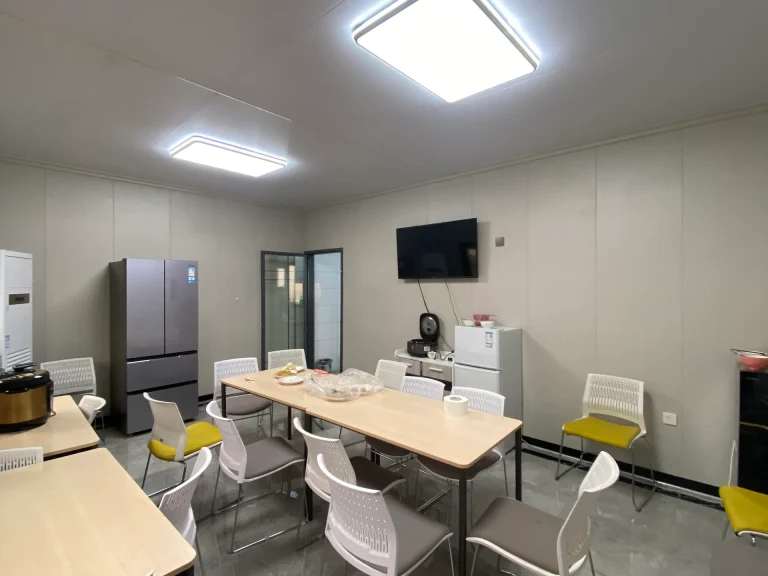
A KUBO sample interior reference image shows kitchen cabinets and a sink, dining furniture, partitions and a bedroom arrangement.
Again, the image is evidence of what appears in that reference configuration, not evidence that those items are automatically included in a new quotation.
A buyer should reconcile photographed items against the actual:
- quotation;
- room or building schedule;
- fixture schedule;
- furniture / FF&E schedule;
- loose-item schedule;
- packing list when issued.
This is particularly important because KUBO’s published supply-scope matrix states that furniture is included only where listed in the quotation.
A sales image can generate an inclusion question. The signed commercial documents answer it.
Separate the Landed Estimate From the Site Work Package
Once the final transport vehicle reaches the defined site endpoint, the landed-cost model in this article stops.
The remaining project scope can include, depending on the project:
- unloading;
- cranes and rigging;
- staging;
- positioning;
- foundations;
- grading and drainage;
- site roads;
- module assembly;
- local labor;
- external electrical networks;
- water and wastewater infrastructure;
- external utility connections;
- field testing;
- commissioning;
- local engineering;
- inspections;
- permits and approvals.
These activities may be commercially significant, but including them inside a landed-cost comparison can make the supplier quotations less transparent.
A better structure is to maintain separate commercial layers:
Layer A — Modular building landed cost
Quoted supply normalized to the named-site, ready-for-unloading endpoint.
Layer B — Site completion package
Unloading, lifting, civil works, assembly, external connections and other defined construction activities.
Layer C — Operational / authority completion
Testing, commissioning, local professional services, submissions, inspections and acceptance activities where applicable.
This structure also helps when comparing modular systems with different factory/site work splits. The landed-cost winner may not necessarily be the lowest installed-cost option, and an installed-cost comparison should be performed deliberately rather than by stretching the definition of “landed.”
Responsibility Boundaries Across the Procurement Chain
A usable reconciliation should name the party responsible for producing or confirming each input without assuming that one party owns every international-project obligation.
Manufacturer
The manufacturer should define the contracted modular-building scope and provide the supplier-side documents required by the order. Depending on the contract, that may extend to packing information, shipment preparation or agreed logistics coordination.
The manufacturer should not automatically be treated as responsible for destination taxes, local foundations, external networks, unloading, permits or local professional approvals unless those activities are expressly contracted.
Buyer or importer
The buyer should define the commercial comparison basis, destination and required delivery endpoint and should coordinate importer-side obligations where applicable.
The buyer also owns an important analytical responsibility: a missing supplier price for an external activity must not silently become zero.
EPC contractor
The EPC contractor may need to integrate modular supply, international logistics and site execution into a wider project responsibility matrix.
Its principal landed-cost task is interface control: ensuring that an activity excluded by the modular supplier is actually captured by another contracted package where the EPC scope requires it.
Freight forwarder and logistics provider
The logistics provider should quote against the cargo information and service request it receives and should identify its own service inclusions and exclusions sufficiently for commercial reconciliation.
Its quotation does not determine what the modular-building manufacturer supplied, nor does it establish local building-code compliance.
Customs broker or import specialist
The broker or specialist can support classification, clearance and destination-charge analysis within the scope of its appointment.
Brokerage fees, duties, taxes and other government charges should not be collapsed into one undefined “customs” row if their commercial treatment differs.
Site contractor
The site contractor may own unloading, cranes, assembly, local connections or civil works where the project assigns those responsibilities locally.
Those activities should remain outside the landed model unless the selected endpoint deliberately includes them.
Local engineer
The local engineer may be required to address site-specific engineering, local submissions, structural interfaces or code requirements within the jurisdiction.
Manufacturer drawings should not automatically be treated as completing jurisdiction-specific professional or approval obligations.
Authority having jurisdiction
The competent authority determines the statutory matters within its jurisdiction.
A manufacturer, EPC contractor, customs broker or commercial estimator cannot replace that authority’s decision through an assumption in a landed-cost spreadsheet.
A Practical Decision Table for Procurement Review
After normalization, the commercial team should focus on unresolved decisions rather than repeatedly reviewing every line of the workbook.
| Review finding | Procurement meaning | Decision action |
|---|---|---|
| Both quotations reach the same endpoint and omissions are confirmed | Comparison basis is substantially aligned | Compare normalized confirmed totals and remaining commercial differences |
| One quotation contains provisional destination costs | Final comparison retains uncertainty | Keep provisional subtotal visible and identify the confirmation owner |
| Freight may already be inside the quoted total | Double-counting risk | Confirm inclusion before adding a logistics quotation |
| Tax treatment is unclear | Landed total is incomplete | Obtain destination-specific confirmation; do not enter zero |
| Quote includes out-of-boundary work with a separate value | Scope can be normalized | Deduct only the documented comparable amount |
| Quote includes out-of-boundary work but the amount is inseparable | Perfect normalization is not possible | Flag bundled scope instead of inventing a deduction |
| Technical configuration differs | Price difference may be product-scope driven | Resolve specification deviation before commercial ranking |
| Loose items are shown in imagery but not in the quotation | Inclusion remains unproven | Request the applicable included-items schedule |
| Freight quote was prepared from an outdated packing basis | Logistics number may no longer correspond to the goods | Revalidate against the current configuration |
| Named destination changes | Inland and destination cost basis may change | Reprice affected omitted/provisional charges |
| Site work has been mixed into one offer | Landed and installed comparisons are being conflated | Separate post-arrival scope into the appropriate project layer |
This table is intentionally decision-oriented. The charge ledger determines what is counted; the decision table determines what procurement still has to resolve.
Using Break-Even Analysis Without Claiming a Saving
A symbolic reconciliation can also answer a conditional commercial question.
Suppose Offer A has the lower normalized confirmed landed total, but some buyer-arranged destination cost remains provisional.
Let:
X = the unresolved omitted cost associated with Offer A.
The break-even condition with Offer B is:
N_A_confirmed + X = N_B_confirmed
Solving for X identifies the value at which the two offers become equal on the chosen comparison basis.
That threshold can support a procurement decision, but it does not prove a saving.
The conclusion remains conditional on the assumptions used in the model. A different quantity, destination, configuration, tax treatment, shipment basis, currency basis or delivery boundary can change the comparison.
Break-even analysis is therefore most useful as a decision trigger:
- below the threshold, one commercial structure may remain lower;
- at the threshold, the normalized totals are equal;
- above the threshold, the other structure may become lower.
It should not be converted into a marketing claim before the underlying inputs are sufficiently confirmed.
Frequently Asked Questions
1. How should quotations in different currencies be compared?
Select a common reporting currency and record both the conversion basis and comparison date used internally.
Do not rewrite the supplier’s original quotation as if it were issued in the reporting currency. Preserve Q_A and Q_B in their contractual currencies and maintain the conversion as a separate analytical layer.
This is especially important when one quotation remains valid for a different period from another. Currency normalization helps commercial comparison but does not eliminate foreign-exchange exposure under the eventual payment terms.
2. What if a delivered supplier quotation does not disclose its freight component?
Do not invent one.
If the quotation clearly reaches the common endpoint and the freight component does not need to be removed or reconciled against another service, the bundled price can remain Q.
A component breakdown becomes necessary when procurement needs to identify an overlap, exclude an out-of-boundary service or analyze a change. If the supplier does not provide a separable value, record the relevant scope as bundled or unseparable.
3. What if the buyer can recover an import tax later?
Separate the project cash-out analysis from any net accounting or tax-recovery analysis.
The amount may still affect clearance cash requirements even if the buyer later expects a credit or recovery under local rules. The treatment depends on the actual destination and tax position, so procurement should not automatically subtract recoverable taxes from landed cost without an agreed internal accounting convention and appropriate specialist confirmation.
4. Can a buyer use a destination-port landed cost instead of a site-delivered landed cost?
Yes.
The endpoint is a management choice, not a universal formula. A destination-port boundary may be appropriate where inland transport is separately tendered or controlled centrally by the EPC contractor.
The key requirement is consistency: every offer must be normalized to the same destination-port boundary, and post-port costs must not be selectively included in only one supplier comparison.
5. How should a staging warehouse or inland consolidation point be handled?
Treat it as an explicit logistics node.
If the common endpoint is the final project site, costs required to move goods through the staging point and onward to the site remain part of the path to that endpoint unless already included.
If the commercial comparison intentionally stops at the staging point, redefine the endpoint accordingly.
Do not call both destinations “site delivered” if they represent different receiving points.
6. What if furniture or accessories ship separately from the main modular packages?
Keep them connected to the approved supply scope but reconcile their logistics separately where necessary.
Separate shipment can affect freight, destination handling, customs documentation and final receiving activities. The important question is whether those charges are already covered by Q or need to enter O or P.
The buyer should also verify that separately shipped loose items remain traceable to the contracted included-items schedule.
7. How should procurement handle temporary-import or re-export projects?
Do not assume that the ordinary permanent-import tax treatment applies, but do not assume an exemption either.
Temporary-import, bonded, re-export or similar treatment depends on the destination regime, actual use of the goods, documentation and authority requirements.
The landed-cost model should carry the customs treatment as unresolved until the importer or qualified destination specialist confirms the applicable process for that project.
8. Can locally purchased materials be added to modular building landed cost?
Only if they are genuinely required to bring the contracted modular supply to the chosen landed endpoint.
Materials used after arrival for foundations, assembly, external utilities or site finishing normally belong to the site-completion layer rather than the landed-cost layer used here.
Locally sourced items should also not be added simply to make two suppliers’ building scopes appear identical without first deciding whether the comparison is intended to be landed supply cost or a wider installed package.
9. What happens if the order changes after the forwarder has quoted?
Revalidate the logistics inputs affected by the change.
A change to quantity, dimensions, loose items or packing may alter the shipment basis even if the supplier’s unit price changes only slightly.
The commercial team should link the freight quotation to the configuration revision on which it was based. A technically correct forwarder quote can still be commercially obsolete if it prices an earlier cargo definition.
10. When should procurement stop using landed cost and move to installed-cost analysis?
Move to a wider comparison when the commercial decision materially depends on work after the goods reach site.
That can occur when competing systems shift different amounts of work between factory production and destination assembly, or when unloading, civil works, utilities and local installation make the post-arrival scope decisive.
Keep the landed subtotal intact and add the installed-cost layer separately. That preserves visibility into whether a cost difference originates in manufacturing, international logistics or site execution.
Request a Project-Specific Budget Reconciliation
A useful review begins with the commercial basis that already exists rather than with a generic request for the lowest unit price.
For a project-specific comparison, provide the available information on:
- application and required building functions;
- selected or candidate modular configuration;
- quantity or building schedule;
- exact destination;
- required delivery condition and handover point;
- shipment basis where known;
- supplied and loose items;
- current forwarder inputs;
- current customs or import inputs;
- buyer/EPC logistics responsibilities;
- relevant site-scope boundaries.
KUBO can review the manufacturer-side quotation basis against the defined procurement endpoint while keeping external and unresolved destination costs distinguishable from confirmed supplier scope.
Request a project-specific modular building budget review.
Related Procurement Guides
- Modular Building Cost Factors: What Determines the Cost of a Project?
- Flat Pack Container House 40HQ Loading Quantity: What Changes the Number of Units per 40HQ?
- Port-to-Site Logistics for Remote Modular Projects: The Last-Mile Risks Buyers Underestimate
Sources and References
- U.S. International Trade Administration — Determine Total Export Price
- ICC Academy — Incoterms 2020: EXW or DDP?
- ICC Academy — Incoterms 2020: New Rules, Old Problems
- International Maritime Organization — IMO/ILO/UNECE Code of Practice for Packing of Cargo Transport Units