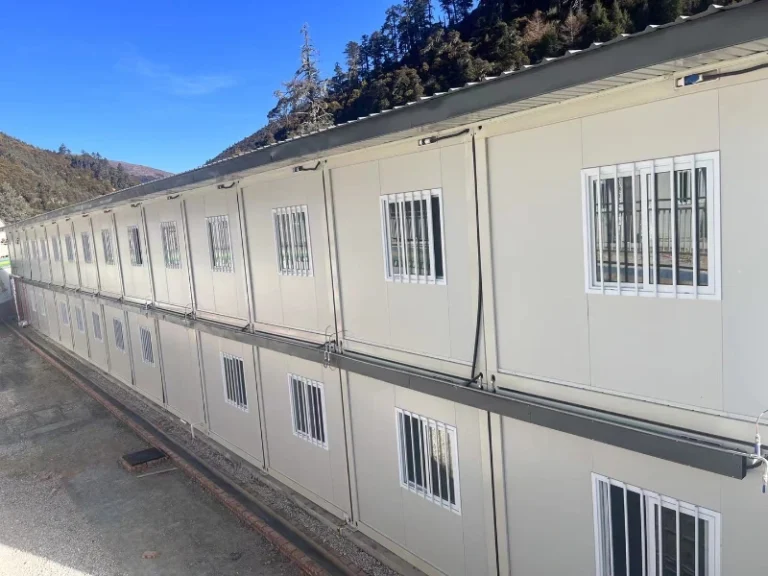
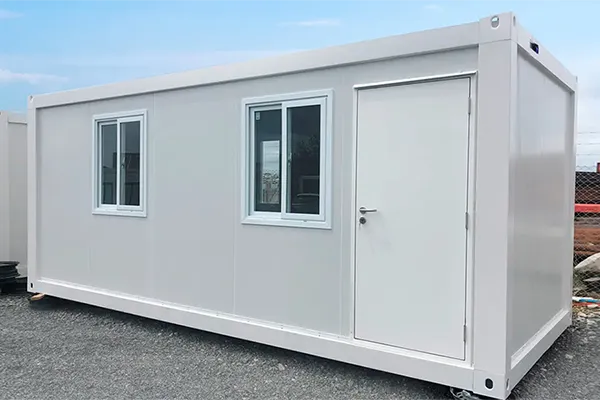


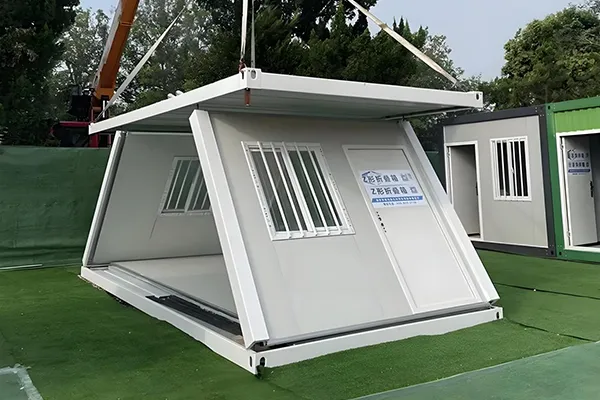

Summary
A flat pack container house 40HQ loading quantity should be treated as a configuration-dependent planning value, not as a fixed product specification. KUBO currently publishes 6–8 units per 40HQ for selected standard flat-pack configurations, while its Detachable Flat Pack system has a separate 15–17 units per 40HQ planning reference. These figures describe different packing architectures and should not be interchanged. KUBO also states that the final standard flat-pack quantity changes with module dimensions, panel thickness, openings, accessories, packing method and local container limits, and that the approved packing plan determines the final count.
For a project buyer, the practical question is therefore not simply, “How many houses fit in one 40HQ?” The better question is: How many complete, protected and correctly allocated project units can be packed into the booked equipment without exceeding geometry, payload, securing or route constraints?
That answer emerges only after the building configuration is sufficiently frozen to produce a packing layout, itemized packing list, mass check, securing review and shipment-release quantity. A preliminary loading reference can support budgeting. It should not be used as the final container count for procurement, freight booking or site mobilization.
Why “Units per 40HQ” Is a Planning Reference, Not a Fixed Product Number
Supplier pages often reduce shipping density to one attractive number. That is useful for early commercial comparison, but it hides the engineering work behind the number.
KUBO’s current Flat Pack Container House page publishes 6–8 units per 40HQ as a reference for selected configurations. The same page explains that the loading drawing and packing list are prepared for the confirmed configuration and that doors, windows and project options can change the count. Its FAQ goes further: module dimensions, panel thickness, openings, accessories, packing method and local container limits all affect loading, while the final count comes from the approved packing plan.
That distinction matters because a “unit” is not merely one steel frame.
For shipment planning, a complete flat-pack unit can include structural frame components, floor and roof assemblies, insulated wall panels, doors, windows, trims, fasteners, seals, electrical items, plumbing items, sanitary fixtures, accessories and protective packing. Some components nest efficiently. Others consume awkward pockets of usable container volume. Some primarily add mass. Others need separation or protection that prevents theoretical empty space from being used.
A current KUBO first-party catalog provides one useful illustration: for a specific standard flat-pack configuration, the reference is 6 units with 75 mm wall panels and 8 units with 50 mm wall panels in a 40HQ. This is a KUBO configuration example rather than a formula that can be generalized to every module.
The commercial lesson is important: even when the assembled footprint appears unchanged, a change to the component stack can change the transport result.
KUBO’s separate Detachable Flat Pack Container House page publishes 15–17 units per 40HQ for selected configurations and states that the final loading drawing controls the actual quantity and weight distribution. That figure must not be substituted for the standard flat-pack 6–8 reference.
The two values answer different product-configuration questions. This article therefore does not compare which system is commercially “better”; KUBO’s existing cross-system article already covers that broader selection intent. The narrower purpose here is to show how a project-specific loading quantity is established and released.
Three Independent Limits Control Flat Pack Shipping Density
Most loading discussions focus on cubic volume. In practice, a shipment can stop being feasible for at least three different reasons:
- the component packages no longer fit within usable container geometry;
- the allowable cargo mass is reached before the cube is full;
- the booked equipment, route or handling chain imposes an additional constraint.
The final container house loading quantity must satisfy all three.
1. Geometry: can the complete package arrangement physically fit?
A 40HQ is a standardized freight-container category, but a shipping calculation is not simply assembled building volume divided by nominal container volume.
ISO 668:2020 establishes the classification of Series 1 freight containers based on external dimensions and specifies associated ratings and, where applicable, certain minimum internal and door-opening dimensions. ISO also notes that the detailed internal dimensions for each container type are covered by the applicable part of ISO 1496.
For a modular-building supplier, this means packing must be based on the actual packages and the equipment being booked—not a generic cubic-metre division.
A package may be constrained by:
- its total stack height;
- the height or width of the container opening;
- the orientation required for loading;
- the ability of a forklift or other loading equipment to manipulate it;
- protective spacers between finished surfaces;
- dunnage beneath structural packs;
- projections that prevent close nesting;
- irregular packages for doors, windows, sanitary items or accessories;
- access space required during loading and securing.
A container can therefore have theoretical unused volume and still be “full” for a specific packing arrangement.
2. Mass: can the arrangement stay within permitted payload?
The opposite condition is also possible. A configuration may occupy less than the available cube but reach the applicable mass limit first.
Maersk, for example, currently lists a 28,690 kg maximum payload for one 40-foot high-cube steel dry-container reference, while explicitly stating that maximum cargo weight varies by container type and size and that specific limits can also vary by country. That carrier value is therefore a useful illustration, not a universal project limit. The booked equipment and route need to be confirmed for the actual shipment.
This is especially relevant where the project configuration introduces heavier components without an equivalent increase in physical pack height. Examples can include structural changes, additional fixtures, denser fit-out, bundled MEP items, spare parts or accessory packages.
The correct question is not:
“There is still empty space, so can another house fit?”
It is:
“Does another complete unit fit geometrically and remain within the permitted cargo and verified gross mass conditions for this booked equipment?”
3. Equipment and route: is the theoretically valid loading plan acceptable for the actual transport chain?
Container type alone does not settle the issue.
Country-specific weight restrictions, the carrier’s equipment limits, inland transport restrictions, terminal handling, loading equipment and route conditions may affect the practical shipment release. Maersk’s published guidance itself warns that specific cargo-weight limits can vary by country.
A manufacturer can calculate the physical packing arrangement, but freight assumptions should still be confirmed against the actual carrier, origin, destination and inland route before the quantity is treated as firm.
That is why “40HQ” should be understood as the beginning of the logistics definition—not the end.
Configuration-to-Loading Constraint Matrix
The following matrix converts common building options into the logistics questions they create.
| Configuration variable | How it can affect packing | Primary constraint | What should be frozen or checked |
|---|---|---|---|
| Wall panel thickness | Changes stacked panel-pack height and sometimes total mass | Cube + mass | Exact panel specification and quantity by module |
| Roof panel / roof build-up | Can alter roof-package depth, nesting and package weight | Cube + mass | Final roof build-up and loose roof components |
| Module dimensions | Changes frame, floor, roof and panel package geometry | Cube | Approved module dimensions |
| Door schedule | Frames, leaves and hardware may require protected or separate packing | Cube + protection | Door types, quantities and module allocation |
| Window schedule | Glazed openings need controlled protection and may reduce usable nesting space | Cube + damage risk | Window types, quantities and packaging method |
| Partitions | Adds panel volume and potentially additional trims or framing | Cube + mass | Internal room layouts and partition schedule |
| Sanitary fixtures | Toilets, basins, shower items and related components can create irregular packages | Cube + damage risk | Sanitary module schedule and supply boundary |
| Electrical / plumbing items | May add compact mass or separate protected cartons | Mass + allocation | MEP supply scope and module assignment |
| Loose accessories | Stairs, canopies, rails, trims, spare parts and hardware consume residual cube | Cube + mass | Complete accessory and spare-parts list |
| Protection and dunnage | Uses space that does not appear in the building BOM but is necessary for transport | Cube + mass | Protection standard and securing concept |
| Package geometry | Determines whether components can nest or stack efficiently | Cube | Draft package dimensions and orientation |
| Package weight | Can make an otherwise compact stack mass-limited | Mass + handling | Per-package and total cargo mass |
| Mixed module types | Reduces repetition and may create inefficient residual spaces or sorting complexity | Cube + control | Final module-type schedule and shipment sequence |
| Loading equipment | May restrict package orientation or maximum practical package mass | Handling | Factory loading method and available equipment |
| Destination route limits | May impose country-, carrier- or inland-specific restrictions | Route + mass | Forwarder/carrier confirmation |
| Securing arrangement | Dunnage and securing material add space and mass and must suit the packed cargo | Safety + mass | Container packing and securing review |
The practical value of this matrix is not that every change reduces the loading quantity. Some changes may have no effect at all because the affected component still fits inside existing residual space.
The key point is that the effect cannot be known from the assembled building drawing alone.
A loading calculation needs the packed configuration.
What KUBO Packing Photographs Can—and Cannot—Tell a Buyer
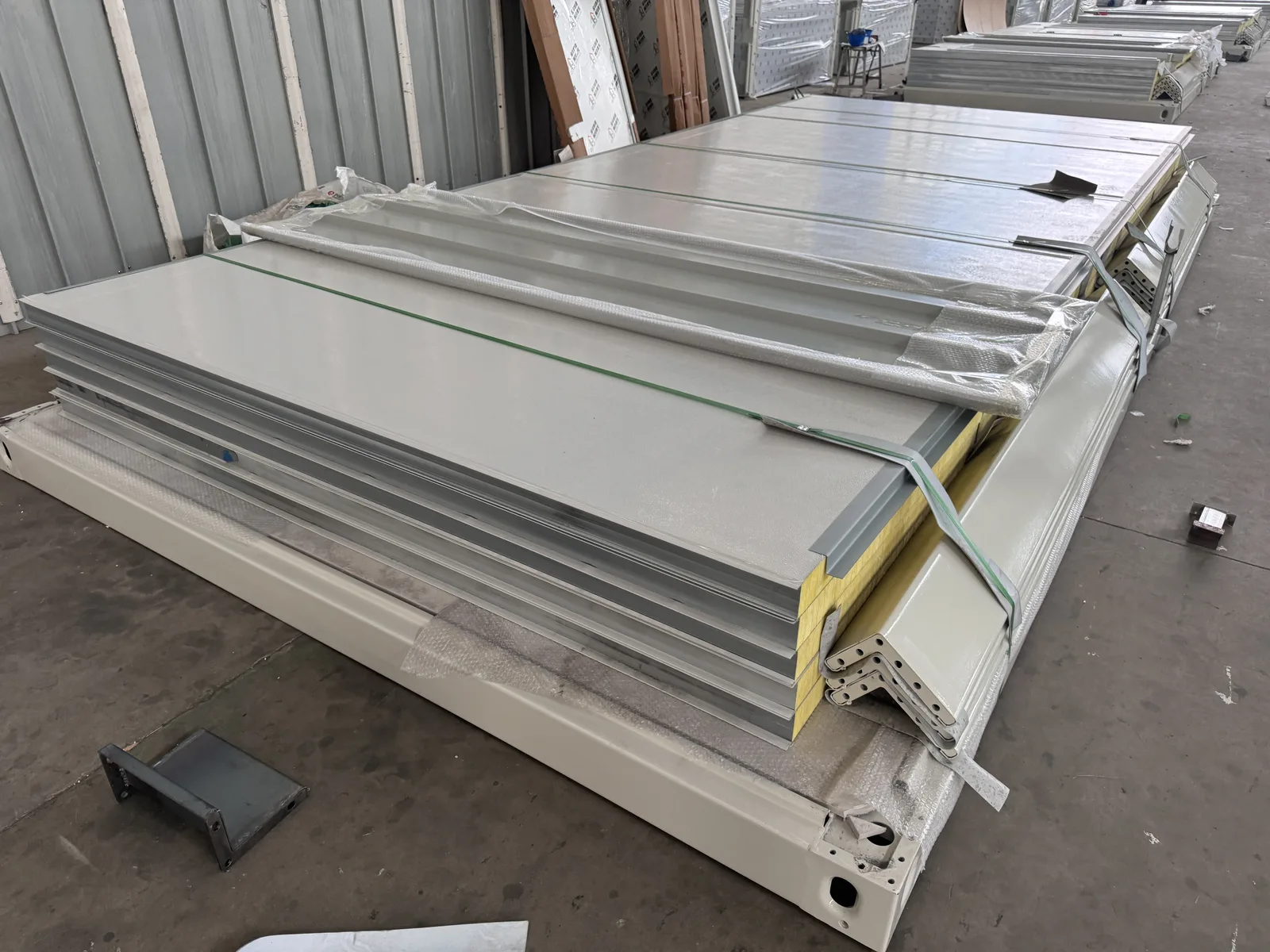
Factory photographs are useful when interpreted as logistics evidence rather than marketing decoration.
KUBO’s current first-party material includes photographs showing flat floor or frame packs, stacked insulated panels, wrapped trims and opening components staged by package. It also includes component-anatomy and assembly-sequence visual material.
These records help explain several practical characteristics of flat-pack logistics.
Thick panels consume stack height repeatedly
A small dimensional change applied to one component may be insignificant. The same change multiplied through many panels in a stacked pack can materially change the total package height.
This is why the KUBO catalog example of 50 mm versus 75 mm wall panels is useful. It demonstrates the mechanism: the wall-envelope specification can affect the shipping arrangement even when the completed module has broadly the same use.
It does not establish a rule that every 50 mm configuration loads eight units or every 75 mm configuration loads six.
Nested steel geometry behaves differently from rectangular cartons
Structural members, floor assemblies and roof assemblies are not interchangeable blocks of volume. Some shapes can nest. Others contain voids that cannot necessarily be filled safely with unrelated components.
The objective is therefore not simply maximum geometric occupation. Packing also has to preserve component condition, module identification, unloading sequence and safe handling.
Protection is part of the loading calculation
Wrapped trims, glazing protection, separators, dunnage and protected finished components consume real space.
Removing protection merely to reach a headline loading number can create a false economy if scratches, bent trims, broken glazing, mixed accessories or water exposure later disrupt site installation.
An assembly illustration is not a container loading drawing
A component-anatomy diagram can help a buyer understand which parts make up the modular system and which components may need to be packed separately.
It should not be interpreted as proof that a specific number of modules can fit into a particular container.
For procurement purposes, the decision-grade document is the project-specific loading drawing and packing list.
From Reference Quantity to Shipment-Release Quantity
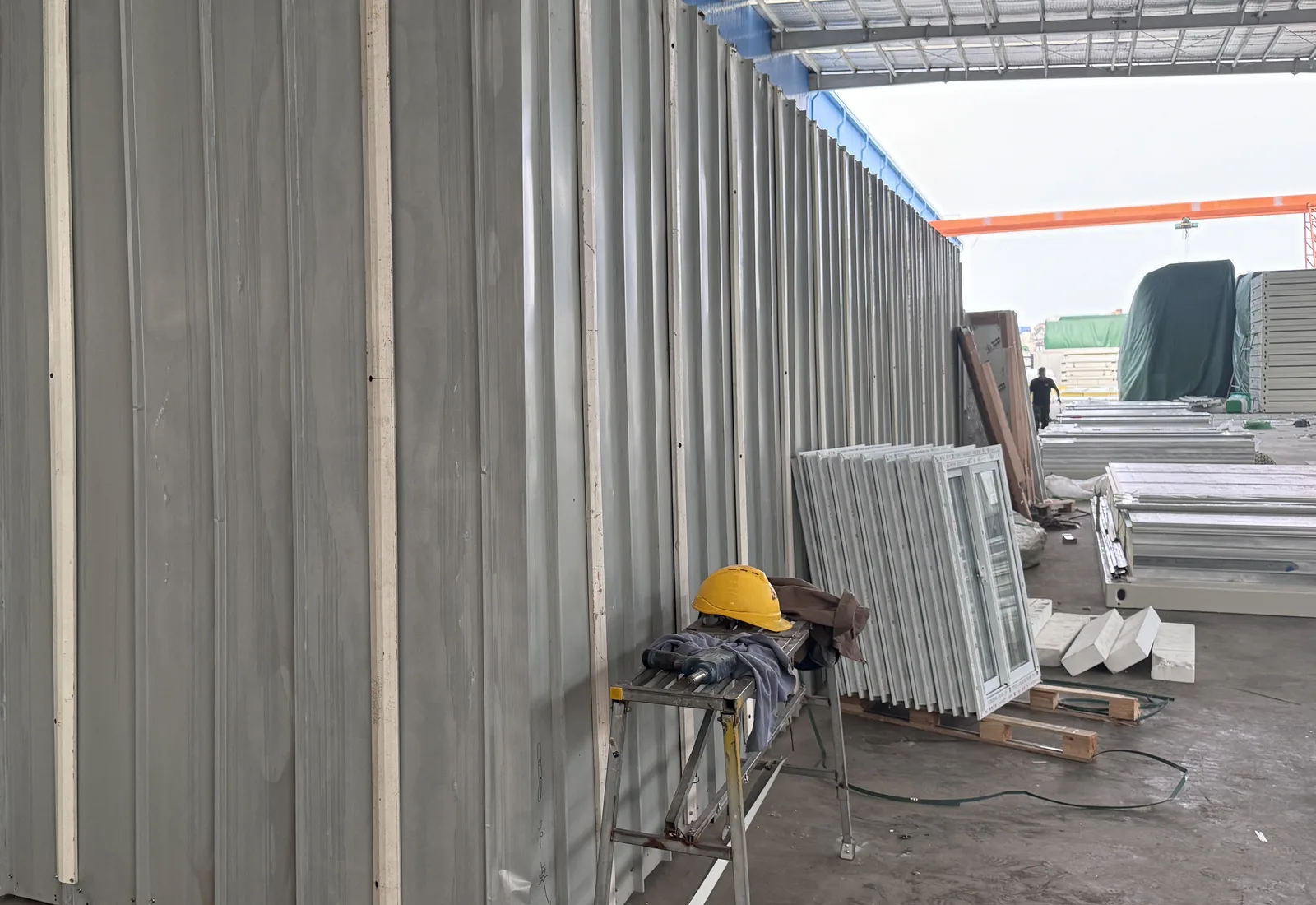
A reliable flat pack container house 40HQ loading quantity should pass through a controlled sequence rather than moving directly from a website reference into a freight booking.
Stage 1: establish the preliminary loading reference
During early inquiry, the supplier can use the selected system and a known reference configuration to provide a planning range.
For KUBO’s selected standard flat-pack configurations, that early reference is 6–8 units per 40HQ.
At this stage the number is useful for:
- preliminary freight budgeting;
- comparing broad procurement options;
- estimating shipment batches;
- discussing port and inland-logistics requirements.
It should remain clearly marked as preliminary.
Stage 2: freeze the module schedule
The buyer/EPC and manufacturer need to resolve the unit types that will actually be purchased.
A camp order may not contain one identical module repeated hundreds of times. It can contain accommodation rooms, offices, sanitary units, meeting rooms, stores or other module variants, each with different openings and fit-out.
The module schedule should establish at least:
- module type or code;
- quantity by type;
- panel specification;
- door and window schedule;
- internal partitions;
- sanitary configuration;
- manufacturer-supplied MEP scope;
- external accessories;
- spare parts where included.
KUBO’s current flat-pack page states that approved drawings, module schedule, opening positions, finishes, panel specification, MEP interfaces, labels, packing sequence and inspection requirements should be frozen before batch production.
Stage 3: convert the approved configuration into pack groups
The manufacturer’s logistics or production team then stops thinking in terms of rooms and starts thinking in terms of physical packages.
Typical groups can include:
- frame or floor packs;
- roof packs;
- wall-panel stacks;
- door and window packages;
- sanitary or MEP packages;
- trim and hardware bundles;
- accessory packages.
Each group needs defined dimensions, mass, protection and module allocation.
The reason for this conversion is simple: containers carry packages, not BIM concepts or rendered buildings.
Stage 4: prepare the draft packing layout
The project packages can now be arranged against the usable geometry of the intended freight equipment.
This is where nested shapes, panel-stack heights, openings, accessory boxes and protective spacing become visible.
The layout should answer:
- which package is loaded where;
- how packages are oriented;
- whether door-opening clearance is adequate;
- whether the container remains practically loadable;
- how components are protected;
- how the cargo will be unloaded;
- whether the sequence supports site staging.
A mathematically dense arrangement that cannot be loaded or unloaded safely is not a valid packing plan.
Stage 5: perform the mass check
Every proposed container arrangement also needs a mass review.
The check should account for all cargo included in that container, not merely the principal structural package. Depending on the method used for VGM, pallets, dunnage and securing materials can also form part of the relevant mass calculation.
The International Maritime Organization states that SOLAS requires the shipper to provide the verified gross mass and that VGM must be available sufficiently in advance for the vessel stowage plan. IMO describes two verification methods: weighing the packed container, or—under the certified method approved by the relevant competent authority—weighing the individual packages and cargo items, including pallets, dunnage and securing material, and adding the container tare mass.
The design-stage packing calculation and the legally required VGM should therefore be connected, but they are not the same document or responsibility.
Stage 6: review packing and securing
High density is only useful when the cargo remains suitable for transport.
IMO identifies SOLAS requirements concerning cargo stowage and securing and points to the IMO/ILO/UNECE CTU Code as global guidance for packing cargo transport units. The CTU Code is non-mandatory guidance and, according to IMO’s current page, is under revision.
For a modular-building shipment, the review should consider the actual package shapes, contact surfaces, restraint method, protection and anticipated handling—not merely the total unit count.
Stage 7: issue the container-by-container packing list and loading drawing
At this stage, “6–8 units” should give way to a real document set.
The shipment documents should show the actual allocation by container, including the mixed-module situation where relevant.
For example, the commercial concept of “eight units per container” is incomplete if accessories required to finish those eight modules are displaced into another container without being reflected in the overall shipment calculation.
The meaningful measure is the number of complete project units represented by the total released shipment package.
Stage 8: confirm booked equipment, carrier and route
The forwarder or carrier should confirm that the intended equipment and applicable transport assumptions remain valid.
A carrier’s published maximum payload should not be copied into every project spreadsheet as a universal 40HQ limit. Current Maersk guidance explicitly notes variations by container type, size and country.
Stage 9: complete VGM and shipment release
Only when the actual cargo is packed can the VGM requirement be completed through the applicable accepted method.
The named shipper retains the SOLAS responsibility described by IMO.
The shipment-release quantity is therefore the end of a document-control process—not a sales-page number.
Preliminary, Calculated and Released Quantities Should Not Be Confused
Procurement teams can avoid many freight disputes by assigning a status to every loading number.
| Quantity status | What it means | Suitable use | Not suitable for |
|---|---|---|---|
| Reference quantity | Based on a known product/configuration range | Early budgeting and feasibility | Final freight booking |
| Configuration estimate | Adjusted after major options are known | Updated commercial planning | Shipment release |
| Calculated packing quantity | Based on actual package arrangement and mass assumptions | Detailed logistics planning | Final VGM |
| Released shipment quantity | Approved against final packing list/loading plan and shipment conditions | Container allocation and release | Automatic reuse on another project |
| VGM | Verified gross mass for the packed container under applicable SOLAS process | Vessel/terminal requirement | Predicting how many future modules fit |
This language also improves tender comparisons.
If Supplier A quotes “8 units/40HQ” as a website reference while Supplier B quotes “7 units/40HQ” after incorporating thicker panels, sanitary fixtures and the project’s accessory package, Supplier A has not necessarily demonstrated better packing efficiency.
The estimates may simply be at different levels of design maturity.
Volume-Limited and Mass-Limited Shipments Behave Differently
A useful loading review should identify which constraint controls each container.
Volume-limited case
A volume-limited arrangement runs out of usable geometry before reaching the applicable mass limit.
This can occur where the project includes:
- thicker wall or roof panel stacks;
- more internal partitions;
- large opening packages;
- irregular sanitary fixtures;
- extensive trims or external accessories;
- additional protective packaging;
- package shapes that do not nest efficiently.
In such a case, reducing one package dimension may release enough usable geometry to change the number of complete units.
That is the mechanism illustrated by KUBO’s catalog example comparing specific 50 mm and 75 mm wall-panel configurations.
Mass-limited case
A mass-limited arrangement reaches its allowable cargo condition while physical space remains.
A buyer should be particularly cautious about looking at a container drawing and asking the factory to “fill the remaining space” simply because visible cube remains.
Additional cargo must still be acceptable for the booked equipment and route, and the packed container must ultimately meet the applicable VGM process.
Mixed-limited case
Some projects are controlled by neither one variable nor one container.
One shipment may be volume-limited because of panel packs. Another may become mass-limited because it carries more structural or accessory components. A third may be deliberately loaded below either theoretical limit to preserve shipment sequence.
For a multi-container project, the goal is therefore not to maximize every individual box in isolation. It is to optimize the complete project shipment against configuration, sequence, condition and transport constraints.
Why Standard Flat Pack and Detachable Flat Pack Numbers Must Stay Separate
KUBO currently publishes:
- 6–8 units per 40HQ for selected standard Flat Pack configurations; and
- 15–17 units per 40HQ for selected Detachable Flat Pack configurations.
These values should never be merged into a generic statement such as “KUBO flat-pack houses load up to 17 units per 40HQ.”
That wording would erase the system distinction.
The Detachable Flat Pack page describes packing engineering in which the approved module schedule is converted into nested component groups, unit codes and container-by-container packing lists. It explicitly states that 15–17 units is a selected-configuration reference and that the final loading drawing controls actual quantity and weight distribution.
A procurement schedule should therefore identify at least:
system → module code → configuration revision → loading-plan revision → released quantity
Without those identifiers, the number is easy to detach from the product configuration that created it.
Responsibility and Shipment-Release Matrix
A strong logistics plan also separates technical calculation from contractual and regulatory responsibility.
| Party | What it should calculate, freeze or confirm | Typical release responsibility |
|---|---|---|
| Manufacturer | Translate approved modules into BOM/package groups; define package dimensions and mass; prepare packing list and loading layout; identify protection and loading sequence | Release factory packing records against approved configuration |
| Buyer / EPC | Freeze module schedule, specifications, openings, sanitary/MEP scope, accessories, shipment phases and destination requirements | Approve commercial/technical configuration and required delivery sequence |
| Site contractor | Confirm receiving area, unloading method, staging, lifting access, storage and installation sequence where within its scope | Confirm destination handling plan where required |
| Freight forwarder / carrier | Confirm booked equipment, applicable cargo restrictions, route assumptions, operational acceptance and shipping instructions | Accept shipment according to carrier/booking requirements |
| Named shipper | Obtain and communicate VGM under the applicable SOLAS requirements | VGM responsibility rests with the shipper identified in the transport documentation |
| Local engineer / authority / transport parties | Confirm locally applicable requirements where route, transport, permitting or site conditions require them | Local approvals remain jurisdiction- and scope-specific |
IMO defines the “shipper” for VGM purposes by reference to the legal entity or person named as shipper on the bill of lading, sea waybill or equivalent multimodal transport document, or the party on whose behalf the carriage contract has been concluded.
That creates an important contractual distinction.
A manufacturer may provide package weights, packing drawings and supporting documentation without necessarily being the named shipper. Conversely, assigning freight coordination to another party does not remove the SOLAS responsibility from whoever is legally identified as the shipper.
The quotation and logistics responsibility matrix should make that explicit.
What Can Go Wrong When the Loading Quantity Is Frozen Too Early?
A change from eight planned units per 40HQ to seven—or from one assumed shipment grouping to another—does more than change ocean freight arithmetic.
Container bookings can change
A total order may require a different number of containers, different shipment batches or revised booking space.
For projects with phased mobilization, this can affect which buildings arrive in each batch.
Site installation sequencing can be disrupted
If module frames arrive but the matching panels, windows, sanitary packages or hardware are allocated to a later container, a nominally “efficient” loading plan can create an installation bottleneck.
Pack density should therefore be coordinated with site sequence.
Staging requirements can increase
Highly nested packs require controlled unloading, sorting and identification.
KUBO’s Detachable Flat Pack guidance specifically notes the importance of module codes, container-by-container packing lists and disciplined unloading and sorting.
The higher the part count, the more valuable traceable package identification becomes.
Protection can be compromised by late densification
A request to “fit one more unit” after packaging has already been engineered can lead to pressure to reduce dunnage, combine incompatible components or alter package orientation.
Any such change should be reviewed as a packing revision, not treated as a harmless commercial adjustment.
Quotation comparisons can become misleading
A supplier offering the highest headline number is not necessarily quoting the same scope.
The comparison needs to normalize:
- wall and roof specification;
- doors and windows;
- partitions;
- sanitary items;
- MEP content;
- accessories and spares;
- protective packaging;
- whether loose project items are counted inside the same freight calculation.
Otherwise the buyer may be comparing a complete shipment with a stripped transport configuration.
A Better Freight Comparison: Compare Complete Project Scope, Not One Container
For an EPC contractor, mining company, renewable-energy project owner or infrastructure contractor, the commercially useful metric is rarely the maximum number that can be physically pushed into one box.
A stronger comparison asks:
How many containers are required to deliver the complete approved scope, in the required sequence, with all module-specific parts and agreed accessories?
That approach prevents several distortions.
A nominal eight-unit container followed by separate accessory shipments may not outperform a seven-unit arrangement that includes the entire unit scope.
Likewise, reducing panel thickness merely to increase packing density would be the wrong decision if the thicker envelope specification is required by the building brief. Logistics optimization should occur after the project performance requirements are defined, not at their expense.
The shipping plan supports the building specification. It should not quietly redesign it.
Documents Buyers Should Request Before Treating the Count as Firm
Before supplier award—or at least before final freight commitment—procurement teams should request evidence that connects the quoted number to the actual project configuration.
A decision-grade package should normally identify:
1. System and module codes
The documentation should clearly distinguish standard Flat Pack from Detachable Flat Pack and identify the exact module variants.
2. Approved configuration basis
The relevant drawings and schedules should identify the wall/roof specification, openings, partitions, sanitary scope, module-side MEP and accessories used in the calculation.
3. Itemized packing list
A buyer should be able to determine what is inside each container and whether all components required for each module are represented somewhere in the shipment.
4. Packing or loading layout
The drawing should show how the project packages are arranged for the confirmed configuration.
KUBO’s standard Flat Pack page already identifies the packing list and container loading plan among its project documents and states that packing and release include verification of labels, quantities, protection, packing list, loading plan and release documentation.
5. Package and container mass information
The logistics record should support the mass review for the planned container allocation.
6. Protection and securing concept
The loading number should not depend on eliminating required protection or creating an impractical securing condition.
7. Shipment sequence
For phased camps or multi-building projects, the packing allocation should support the construction sequence rather than simply maximize average density.
8. Revision status
Packing plans need document control.
If an opening schedule, panel specification or accessory scope changes after the loading drawing is issued, the shipment calculation may need to be rerun.
A packing drawing without configuration revision control is weaker evidence than it appears.
A Practical Shipment Freeze Checklist
Before issuing the final container count, the project team should be able to answer yes to the following:
If several of these items remain open, the “units per 40HQ” figure should still be marked as preliminary.
What This Means for Procurement
The best supplier response to a shipping-density question is not necessarily the supplier that gives the largest number fastest.
A technically stronger answer may sound more conditional:
The current reference is based on this system and this configuration. Once the module schedule, panels, openings, sanitary/MEP scope and accessories are frozen, we will issue the packing layout, mass check and final container allocation.
For commercial investigation, that conditionality is useful. It shows that the manufacturer understands the difference between a catalogue reference and a shipment-release quantity.
The procurement team can then compare suppliers on a normalized basis:
| Procurement question | Weak evidence | Stronger evidence |
|---|---|---|
| How many units fit? | One number on a product page | Configuration-linked loading range |
| What is included? | “Standard accessories” | Itemized module and accessory schedule |
| How was density calculated? | Generic claim | Packing layout based on project packages |
| Has weight been checked? | No separate evidence | Package/container mass review |
| Is the quantity final? | Sales confirmation | Revision-controlled loading plan |
| Can the shipment be received efficiently? | Not addressed | Container sequence, module codes and unloading logic |
| Who handles VGM? | Undefined | Named shipper responsibility identified |
| What happens after a design change? | Number remains unchanged | Packing calculation is reviewed and reissued |
This is especially important for remote projects, where a missing package or disrupted shipment phase can affect installation well beyond the port.
Calculate Shipping for Your Configuration
If you are evaluating the flat pack container house 40HQ loading quantity for a real project, start with the building configuration rather than a universal loading number.
Prepare:
- project destination and intended port or freight route;
- required flat-pack system;
- quantity by module type;
- module dimensions;
- wall and roof panel specifications;
- door and window schedules;
- sanitary configurations;
- manufacturer-supplied electrical and plumbing scope;
- stairs, canopies, rails or other loose accessories;
- spare-parts requirements;
- preferred shipment batches and site installation sequence.
KUBO can then relate the project configuration to the relevant packing method and move from an early reference toward a project-specific packing and loading plan. Review the standard Flat Pack Container House system or the Detachable Flat Pack system first if the product category still needs to be confirmed.
For a project-specific review, submit the configuration for shipping and quotation planning.
Frequently Asked Questions
What is the typical flat pack container house 40HQ loading quantity?
KUBO currently publishes 6–8 units per 40HQ as an early planning reference for selected standard Flat Pack configurations. The final quantity is not fixed: module dimensions, panel thickness, openings, accessories, packing method and local container limits can change the count, and KUBO states that the approved packing plan determines the final quantity.
Why can wall-panel thickness change the number of units per 40HQ?
Wall panels are normally stacked as part of the transport package, so additional thickness can accumulate across many panels and increase total pack height or mass. In one current KUBO catalog example, a specific standard flat-pack configuration is referenced at six units with 75 mm wall panels and eight with 50 mm panels. That example demonstrates configuration sensitivity; it is not a universal loading rule.
Does the KUBO 15–17 units per 40HQ figure apply to standard Flat Pack?
No. KUBO publishes 15–17 units per 40HQ for selected Detachable Flat Pack configurations. The standard Flat Pack page separately publishes 6–8 units per 40HQ. The systems should be identified correctly in quotations and logistics calculations.
Can extra doors and windows reduce container house loading quantity?
They can. Additional doors, windows and related frames or hardware can require protected packages, alter the panel mix and consume residual container space. KUBO’s current Flat Pack page explicitly identifies doors, windows and project options as variables that can change the loading count.
Should sanitary fixtures and MEP items be included in the loading calculation?
Yes, when they are part of the manufacturer’s shipment. A freight calculation should cover the complete agreed supply scope rather than only the main structural package. Sanitary fixtures may consume irregular cube, while some MEP items may add substantial mass relative to their volume. Their allocation should appear in the packing list.
What is the difference between a volume-limited and mass-limited 40HQ shipment?
A volume-limited shipment cannot accept another complete package because usable packing geometry has been consumed, even if additional payload capacity remains. A mass-limited shipment reaches the applicable cargo-weight condition while some physical space is still available. The final loading quantity must satisfy both conditions as well as carrier, route, handling and securing requirements.
When should the final loading quantity be frozen?
It should be frozen after the project configuration is sufficiently stable to produce the actual packing layout and mass check. Module types, panels, openings, sanitary/MEP content, accessories, protection and shipment sequence should no longer be moving independently. If any of those inputs changes later, the packing calculation may need revision.
Who is responsible for the VGM of the packed container?
Under the IMO’s description of SOLAS requirements, the shipper is responsible for providing the verified gross mass. IMO defines the shipper by reference to the entity or person named on the bill of lading, sea waybill or equivalent multimodal transport document, or the party on whose behalf the contract of carriage is concluded.
Can a freight forwarder provide a final container count before the packing plan exists?
A forwarder can support early freight assumptions and confirm equipment or route restrictions, but the manufacturer normally needs the actual project package geometry and mass data to establish how the building components will fit. A freight rate or equipment booking does not replace a configuration-specific loading layout.
What documents provide the strongest evidence for a quoted loading quantity?
The most useful evidence is a consistent set consisting of the approved module/configuration schedule, itemized packing list, package information, container loading drawing, mass review, protection/securing plan and revision-controlled shipment allocation. A product-page number on its own is appropriate for early planning, not final shipment release.
Can different module types be mixed in the same 40HQ?
They can be if the packing plan supports it. However, mixed module types can change nesting efficiency, accessory allocation and unloading complexity. KUBO’s Detachable Flat Pack guidance notes that standardized module repetition supports nesting and that each unique combination should be coded and packed as a controlled module type.
Sources and References
- KUBO Flat Pack Container House and KUBO Detachable Flat Pack Container House — first-party references for KUBO’s 6–8 and 15–17 units-per-40HQ planning ranges, packing-plan boundaries and project-specific loading logic.
- International Maritime Organization — Verification of the Gross Mass of a Packed Container — supports the shipper’s VGM responsibility, the requirement for VGM before loading and the two verification methods described by IMO.
- International Maritime Organization — Safe Transport of Containers — supports SOLAS cargo stowage/securing context and the status of the IMO/ILO/UNECE CTU Code as non-mandatory global guidance currently under revision.
- ISO 668:2020 — Series 1 Freight Containers: Classification, Dimensions and Ratings — supports the standard’s scope covering external dimensions, ratings and certain minimum internal and door-opening dimensions.
- Maersk — Cargo Weight Limit Guidance — provides one carrier’s current 40-foot high-cube dry-container payload reference and confirms that cargo-weight limits can vary by container type, size and country.