


Summary
A shared construction camp can use fewer installed beds when rooms are genuinely interchangeable across contractors. That condition matters more than the arithmetic. If different crews cannot share accommodation because of privacy, sex, shift, security, health, access or contractual restrictions, the apparently spare beds in one block cannot absorb another contractor’s peak.
Contractor-dedicated accommodation blocks take the opposite approach. Each contractor receives a defined building allocation, simplifying separation, accountability and access control. The trade-off is that capacity reserved for an early-phase contractor may remain unused while another contractor reaches its peak elsewhere in the camp.
A hybrid arrangement often provides the most practical middle ground: stable or non-shareable crews retain dedicated core blocks, while compatible short-duration or overlapping crews use a controlled swing inventory. This arrangement does not automatically produce the lowest cost, but it can reduce stranded capacity without forcing every resident into a fully pooled system.
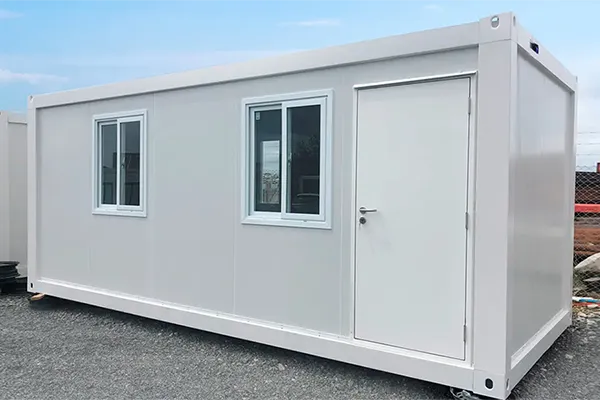
The decision should be made before the modular building schedule and camp operating arrangements are frozen. Procurement teams need a contractor-by-phase resident curve, clear room-sharing eligibility rules, a release and turnover process, responsibility for resident records, and an agreed method for charging common facilities. KUBO can map the selected policy into repeatable dormitory modules, contractor-coded blocks, dining and kitchen buildings, sanitary or ablution buildings, and camp administration space.
The Real Procurement Decision Is Whether Beds Are Interchangeable
For an owner, EPC contractor or project-controls team, the question is not simply whether several contractors will occupy the same site. The more useful question is: when one contractor releases a room, can another contractor use it within the required time and under the project’s operating rules?
That question separates three workable models:
- Pooled camp accommodation: rooms form one managed inventory and are assigned according to current eligible demand rather than permanent contractor ownership.
- Contractor-dedicated accommodation blocks: a defined block or group of rooms remains allocated to one contractor, even when its actual occupancy falls below the reserved capacity.
- Hybrid core-plus-swing accommodation: dedicated core blocks protect crews that require stable separation, while a smaller shared inventory accommodates compatible peaks, mobilization teams or short-duration overlap.
The pooled model can reduce installed capacity when contractor peaks occur in different months. Dedicated blocks can make responsibility clearer when contractors have different security controls, working hours, workforce categories or welfare arrangements. The hybrid model separates the part of demand that should remain stable from the part that can be reassigned.
This decision sits beside, rather than replaces, the overall camp-sizing exercise. A separate KUBO guide explains how to plan temporary housing for a large construction project. Room occupancy, privacy and role-based arrangements are covered in the guide to workforce camp room standards. Here, the focus is narrower: how the same contractor demand curve produces different building requirements under different allocation policies.
One Six-Month Workforce Curve, Two Capacity Results
The following worked scenario shows why the allocation rule must be fixed before procurement. It represents a hypothetical multi-contractor workforce camp, not a customer project, quotation or industry benchmark. One bed is counted for each simultaneous resident. A 10% planning reserve and a 20-bed planning increment are used solely to make the comparison transparent; neither assumption is a universal recommendation.
| Contractor resident demand | M1 | M2 | M3 | M4 | M5 | M6 | Own peak |
|---|---|---|---|---|---|---|---|
| Civil A | 120 | 160 | 120 | 60 | 20 | 0 | 160 |
| Mechanical B | 0 | 60 | 160 | 180 | 100 | 40 | 180 |
| Electrical C | 0 | 0 | 40 | 120 | 180 | 100 | 180 |
| Concurrent residents | 120 | 220 | 320 | 360 | 300 | 140 | 360 |
Contractor-dedicated capacity
If each contractor receives a fixed block sized to its own peak, including the stated reserve and planning increment, the calculations are:
- Civil A: ceiling of 160 × 1.10 to the next 20-bed increment = 180 beds.
- Mechanical B: ceiling of 180 × 1.10 to the next 20-bed increment = 200 beds.
- Electrical C: ceiling of 180 × 1.10 to the next 20-bed increment = 200 beds.
- Total fixed dedicated capacity: 580 beds.
This approach protects each contractor’s peak independently. It does not depend on Civil A releasing accommodation before Mechanical B or Electrical C mobilizes. It also supports clearer contractor-level access control and makes it easier to identify which party occupies, inspects and returns a particular block.
The consequence is visible in the demand curve. Civil A declines sharply after Month 2, but its reserved capacity does not automatically move to the later contractors. Mechanical B and Electrical C therefore retain their own peak-sized allocations even though the combined project peak is much lower than the sum of the three individual peaks.
Pooled capacity
Under a fully pooled model, capacity is based on the highest concurrent camp population rather than the sum of each contractor’s separate peak:
Ceiling of maximum concurrent demand, 360 residents, × 1.10 to the next 20-bed increment = 400 beds.
The same resident curve therefore produces an installed-capacity difference of 180 beds: 580 dedicated beds compared with 400 pooled beds. That result is only usable if the residents represented by the curve can actually be assigned to the available rooms.
Unused capacity across the six-month window
Total demand in the scenario is 1,460 bed-months. A bed-month means one installed bed available for one month; it is a planning unit, not a financial value.
- Dedicated unused capacity: 580 × 6 − 1,460 = 2,020 bed-months.
- Pooled unused capacity: 400 × 6 − 1,460 = 940 bed-months.
- Difference in unused capacity: 1,080 bed-months.
These outputs do not equal price savings. Building cost, site preparation, utilities, furniture, transport, installation interfaces, cleaning, maintenance and operating controls do not necessarily move in direct proportion to the bed count. A pooled room may also require more frequent cleaning, reassignment administration and condition inspection.
The comparison changes if dedicated blocks are mobilized later, closed when a contractor demobilizes, transferred to another approved group or redeployed elsewhere. It also changes when the actual resident curve moves. If Mechanical B arrives one month early, for example, the concurrent peak and required turnover sequence may no longer match the planning case. Procurement should therefore compare the building schedule and allocation policy together, rather than treating headcount as a single static number.
When Pooled Camp Accommodation Works
Pooling works best when a bed released by one group becomes an acceptable bed for the next eligible resident. Achieving that condition requires more than an empty-room report.
The resident register must identify who occupies each room, under which contractor, during which shift and for what expected period. The room must be released through an agreed process, inspected for damage or maintenance holds, cleaned to the project’s turnover standard and approved for reassignment. The next resident must also be eligible for that room under the camp’s privacy, security and access rules.
Project-wide accommodation management is consistent with established worker-accommodation guidance. The IFC and EBRD describe worker accommodation as a matter of planning, construction and management involving clients, contractors and subcontractors, with reporting and monitoring needed where contractors provide or manage accommodation. The applicable national and local requirements remain part of the project assessment. The IFC and EBRD worker-accommodation guidance does not prescribe a universal pooled-bed arrangement, but it supports the need for clear management and oversight.
Pooling is most credible when:
- contractor peaks occur at meaningfully different times;
- room standards are compatible across the groups that may exchange rooms;
- resident categories can share the same zone without undermining privacy, welfare or security;
- arrival and departure information is reliable enough to plan turnover;
- the operating team has authority to release, hold and reassign rooms;
- maintenance and cleaning capacity can complete the handover within the required window;
- commercial terms define who pays for reserved, occupied, unavailable and no-show capacity;
- common facilities can support the combined peak by time of use, not merely by daily average.
Each resident still requires a separate bed. Pooling changes which eligible resident uses the bed over time; it does not justify double-counting a bed, lowering the agreed room standard or trading away welfare requirements to improve utilization. The Millennium Challenge Corporation guidance on accommodation and welfare reinforces the need for accommodation quality and management policies and for each resident to have a separate bed.
When Contractor-Dedicated Blocks Are the Better Control
Dedicated blocks become operationally stronger when separation is not merely a preference. A contractor may have controlled-access personnel, a different shift pattern, a distinct room standard, a workforce category requiring privacy separation, or an internal welfare and grievance process tied to its own supervisors. In those circumstances, moving residents through a common room pool can create more risk than the apparent capacity reduction is worth.
Dedicated allocation can also improve accountability at demobilization. The contractor and camp team can inspect a defined group of rooms, identify damage or maintenance requirements, reconcile furniture and keys, and formally return the block. With a fully pooled inventory, the same tasks remain necessary, but the condition history may be distributed across many occupants and contractor groups.
A dedicated model is particularly useful when:
- site security requires contractor-specific access zones;
- workforce composition requires stable privacy or sex-based separation;
- night-shift and day-shift residents need controlled quiet zones;
- contractors use materially different room or welfare standards;
- health controls require a group or building to remain separated;
- the commercial agreement reserves capacity for a contractor regardless of actual occupancy;
- arrival and departure schedules are too uncertain for dependable room turnover;
- responsibility for room condition must remain clearly attached to one contractor.
The drawback is not simply “more empty beds.” Dedicated blocks can also create utility, cleaning, inspection and maintenance obligations across a larger installed estate. Conversely, they may allow an unused block to be closed, isolated or demobilized if the project schedule and service design support that action. A fair comparison must therefore examine how the blocks will be operated over time, not only how many are shown on the initial layout.
A Hybrid Core-Plus-Swing Arrangement
Many projects do not need to choose between complete pooling and complete dedication. A hybrid arrangement begins by identifying the non-shareable core: crews or resident categories that need stable rooms, controlled access, consistent room standards or separation throughout their stay. Those residents receive dedicated core accommodation.
The remaining compatible demand is combined into a smaller swing inventory. That inventory can absorb mobilization teams, commissioning specialists, short-duration subcontractors or overlap between phases, provided each assignment meets the project’s eligibility rules.
For example, Civil A might retain a dedicated core for supervisors and a stable long-duration crew while releasing compatible general-worker rooms into the swing inventory as its workfront closes. Mechanical B and Electrical C could draw from the swing inventory during approved overlap periods without changing the protected accommodation for crews that must remain separated.
The hybrid model is useful because it makes the trade-off explicit. Instead of assuming all beds are interchangeable, the procurement team defines which demand can move and which cannot. The modular schedule can then distinguish:
- core buildings intended to remain assigned to named contractor groups;
- swing buildings managed as a common inventory;
- shared central facilities sized around the combined operating pattern;
- zoned sanitary or welfare facilities where separation is needed;
- administration space for resident control, keys, inspections and issue handling.
This model still requires disciplined governance. If the project gradually treats every contractor request as non-shareable, the swing pool loses its purpose. If it forces non-compatible residents into the pool to protect a capacity target, the operating model becomes unsafe or unworkable. Eligibility decisions therefore need named authority and recorded reasons.
Decision Matrix: Pooled, Dedicated or Hybrid?
| Decision factor | Pooled inventory | Dedicated blocks | Hybrid core plus swing |
|---|---|---|---|
| Installed capacity | Can follow the combined concurrent peak when beds are interchangeable | Usually follows each contractor’s reserved peak unless blocks are phased or transferred | Protects non-shareable demand while pooling only compatible peaks |
| Lifecycle utilization | Potentially higher, but dependent on reliable release and reassignment | Lower when individual contractor peaks occur at different times | Targets higher utilization in the swing portion without destabilizing core crews |
| Scalability | Flexible within the approved room pool and operating capacity | Additional demand is easier to attribute but may require another contractor-specific block | Core and swing capacity can be reviewed separately as phases change |
| Schedule certainty | Sensitive to late departures, early arrivals and slow turnover | Less dependent on another contractor releasing rooms | Core demand is protected; swing demand remains schedule-sensitive |
| Privacy, shifts and security | Requires detailed eligibility rules and zoning | Supports stable separation and access control | Uses dedicated zones where necessary and pooling where compatible |
| Local-labor and operating dependency | Higher administrative, cleaning and inspection coordination | Simpler contractor-level handover, although each block still needs operation and maintenance | Moderate; the swing pool needs strong controls while core blocks remain stable |
| Site readiness and utilities | May reduce the number of dormitory beds, but common-facility and utility peaks still require checking | Larger installed capacity can increase serviced-area requirements | Allows selective sharing, but interfaces must match the actual building schedule |
| Maintenance | A maintenance hold immediately reduces assignable shared capacity | A hold affects the contractor’s reserved block unless substitute rooms are agreed | Swing rooms may provide temporary cover if eligibility and capacity permit |
| Relocation or phased removal | Removing part of the pool requires rechecking total concurrent demand | A contractor block may be easier to isolate after formal release | Core and swing buildings can have separate phase triggers |
| Commercial charging | Needs agreed treatment of occupied, reserved, unavailable and no-show capacity | Reserved capacity can be attributed more directly to one contractor | Core charges and swing-use charges need distinct rules |
| Interface risk | Concentrated in resident data, turnover, access and operating authority | Concentrated in over-reservation, duplicated capacity and block handback | Requires accurate classification of core versus shareable demand |
| Total project risk | Lowest when data and governance are strong and residents are compatible | Lowest when separation and accountability outweigh utilization | Often balanced where only part of the population can be shared |
The Minimum Controls Needed Before Beds Can Be Pooled
A pooled room schedule is only as reliable as the controls behind it. The following fields create a practical bridge between the workforce forecast, the camp register and commercial reconciliation.
| Control field | Minimum decision it supports | What can fail without it |
|---|---|---|
| Resident register | Confirms the named resident, contractor, room, arrival, departure and current status | Double assignment, unrecorded occupants or inaccurate availability |
| Room-release authority | Identifies who may return a room to the assignable pool | A contractor reports demobilization while belongings or occupants remain |
| Eligibility category | Records privacy, sex, shift, security, room-standard and access constraints | An empty room is assigned to an incompatible resident |
| Maintenance hold | Removes an unserviceable room from available capacity and records release status | Planning counts a bed that cannot be occupied |
| Cleaning turnover | Records departure inspection, cleaning status and readiness time | Arrival is scheduled before the room is ready |
| Reserved-bed rule | Defines which capacity remains protected and for how long | Operational staff reassign a bed that procurement has contractually reserved |
| Occupied bed-nights | Supports actual-use reporting and operating analysis | Invoices or internal charges rely on incompatible records |
| No-show and late-departure status | Defines when a booking can be cancelled or extended | Nominal vacancies cannot be trusted during mobilization peaks |
| Grievance ownership | Directs accommodation issues to the responsible party while preserving project access to the process | Residents receive conflicting instructions or unresolved welfare issues |
| Common-facility recharge | Defines how dining, sanitary, laundry, administration or other shared services are allocated | Bed allocation appears settled while service costs remain disputed |
A named camp manager or equivalent operating authority should control the process across contractor boundaries. A World Bank-hosted project camp-management procedure, for example, assigns a camp manager and calls for contractor and subcontractor responsibilities, resources, procedures, monitoring and communication. It does not prescribe a particular bed-allocation model, but it illustrates why a documented camp-management procedure matters when several organizations share accommodation.
Current major-project disclosure also shows the value of project-wide management. The IFC disclosure for the Tashkent Airport project describes simultaneous contractors and a single accommodation plan addressing management responsibilities, inspections, welfare, grievance access and corrective action across directly or contractor-provided facilities. It does not select pooled or dedicated beds, but it supports one coordinated management framework for a multi-contractor environment.
Shared Facilities Need Their Own Capacity and Recharge Logic
A dormitory decision cannot be copied directly onto dining, kitchen, sanitary, laundry or administration facilities. Bedrooms are occupied over long periods, while common facilities experience short peaks driven by shift release, meal waves and travel time between workfronts and camp.
A 400-bed pooled accommodation plan does not prove that one dining arrangement can serve 400 residents within the permitted meal window. Nor does a 580-bed dedicated layout mean every support function must be duplicated three times. The project should test each shared service against its own operating pattern.
Questions for the common-facility schedule include:
- Which contractors finish shifts at the same time?
- Will dining be organized by assigned sittings, open access or contractor windows?
- Do privacy or security rules require separate sanitary zones?
- Can a central administration point manage residents from all contractors?
- Which facilities continue operating when one accommodation block is closed?
- How will cleaning, consumables, maintenance and utilities be charged?
- Does a contractor pay according to reserved beds, occupied bed-nights, resident headcount or another agreed driver?
The remote camp facilities checklist can help teams build the broader schedule of sleeping, welfare, service and administration spaces. For a shared construction camp, that schedule should show which facilities are central, which are zoned, and which remain contractor-specific.
Translating the Allocation Policy into a KUBO Building Schedule
Once the owner or EPC team defines the allocation model, KUBO can translate it into a modular building configuration for discussion.

Configuration for a pooled inventory
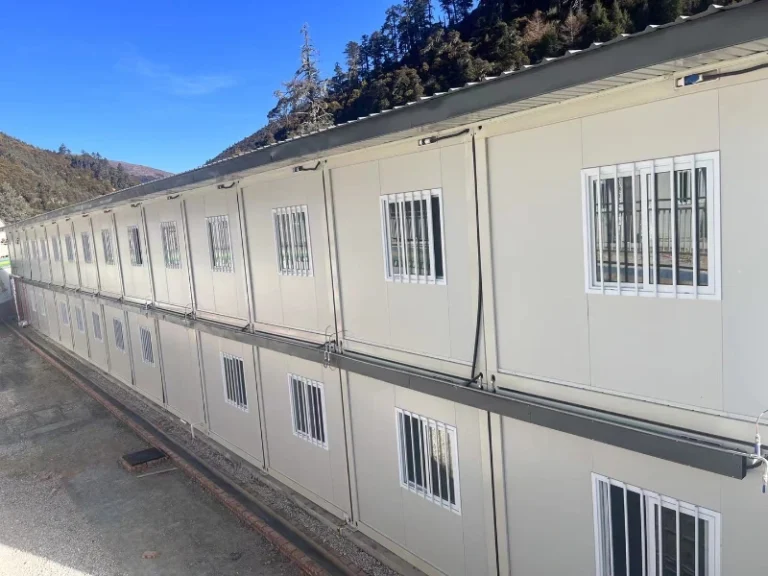
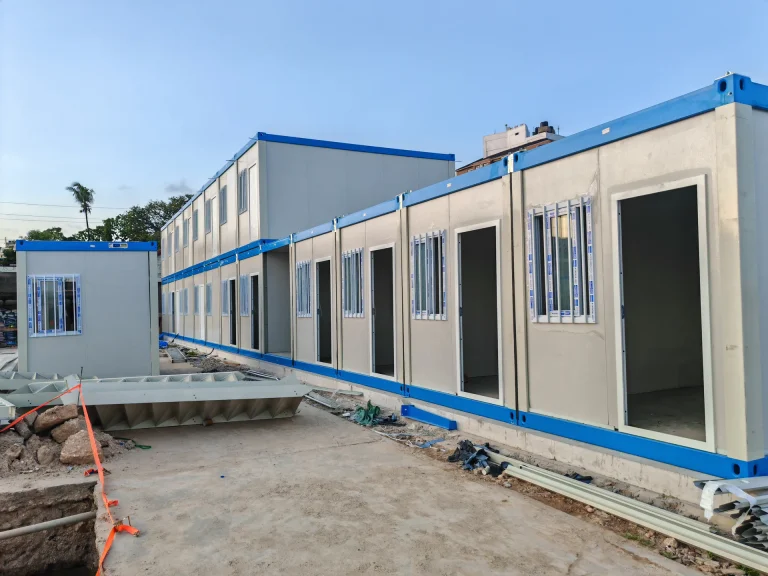
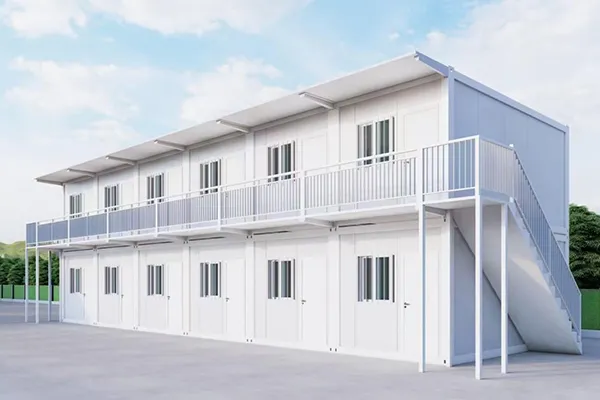
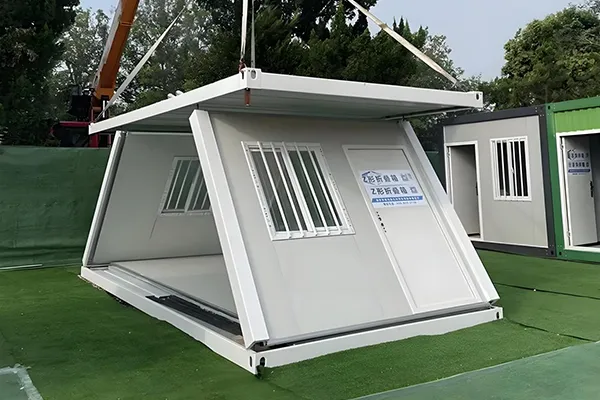
A pooled arrangement can use repeatable Flat Pack Worker Dormitory Modules organized as one managed room inventory. The accommodation can be paired with central modular dining and kitchen buildings, modular sanitary and ablution buildings, and camp administration space.
The room schedule should identify total rooms, planned occupancy per room, resident categories, accessible or special-use rooms where required, and the zones that may exchange residents. Central facilities should be checked against the concurrent population and shift pattern rather than assumed to follow the dormitory count automatically.
Configuration for dedicated contractor blocks
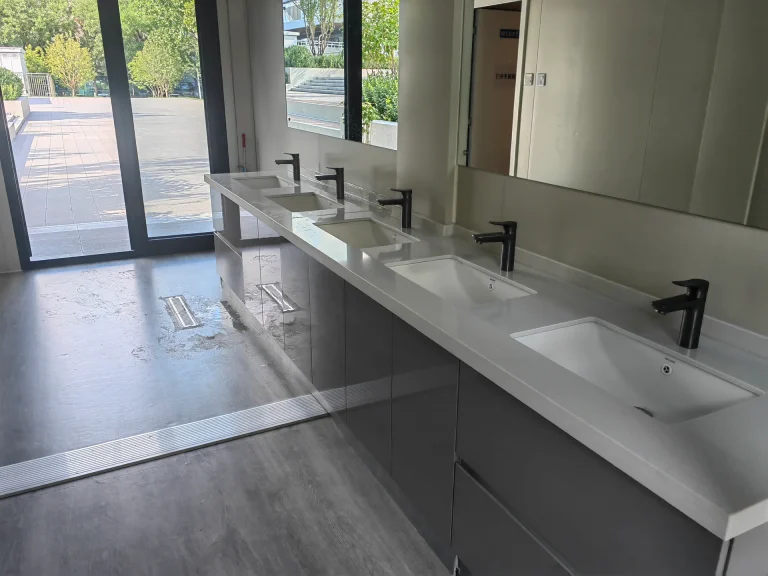
A dedicated model can use Detachable Dormitory Modules coded by contractor or accommodation zone. Central dining and administration facilities may still be shared. Sanitary buildings can be centralized or divided into zones according to the actual privacy, access and operating brief.
Building codes should be carried consistently through the room schedule, layout, equipment schedule, utility interfaces and handover records. This gives procurement and operations a common reference when confirming which contractor controls a block, which facilities remain shared and when a released building can change use.
Configuration for a hybrid camp
A hybrid schedule separates core and swing accommodation on the drawing and in the room register. Dedicated core blocks receive stable identifiers and operating rules. Swing blocks are identified as shared inventory, with the eligible resident categories and turnover authority documented alongside them.
The project can then compare several practical options without redesigning the decision from scratch:
- a larger dedicated core with a small swing block;
- a smaller core with more pooled accommodation;
- shared dining and administration with zoned sanitary facilities;
- phased swing capacity aligned with the expected contractor overlap;
- future reassignment of a contractor block, subject to room standards and operating approval.
Room mix, bed and locker fit-out, bathrooms, storeys, foundations, utilities, lifting arrangements and local project requirements remain specific to the final brief. KUBO’s role can cover modular building configuration, manufacture and agreed documentation. The buyer or EPC team can define the operating policy and contract structure, while site works, local engineering, statutory processes and camp operation are assigned through the project’s contractual responsibility matrix.
The broader KUBO Construction and EPC solution provides the commercial route for discussing the building package and project interfaces.
Procurement Sequence Before Freezing the Modular Schedule
A useful procurement process starts with the workforce curve, but it should not end there.
- List simultaneous residents by contractor and phase. Use expected residents on site, not total contract headcount. Record mobilization, peak, decline and demobilization periods.
- Separate shareable and non-shareable demand. Apply privacy, sex, shift, security, health, access and room-standard constraints before calculating pooled capacity.
- Select the capacity logic. Compare combined concurrent demand with the sum of contractor-specific peaks. State any reserve and planning increment as project assumptions.
- Test turnover timing. Identify the gap between one contractor’s departure and another’s arrival, including inspection, maintenance, cleaning and reassignment.
- Check common-facility peaks. Model meal, shower, laundry and administration demand by shift wave and operating window.
- Assign commercial responsibility. Define charges for dedicated reservations, pooled occupancy, no-shows, late departures, maintenance holds and shared services.
- Map the decision into buildings. Convert core, swing and common-facility requirements into a phased modular schedule and site layout.
- Keep open interfaces visible. Record unresolved utility, site, foundation, lifting, access, local engineering and operating inputs before quotation alignment.
This sequence gives project controls an auditable link between the resident forecast and the buildings being purchased. It also reduces the risk of comparing quotations based on different assumptions—one supplier may be pricing the combined project peak, while another may be adding every contractor’s independent reserve.
Procurement FAQs
Should every contractor receive some guaranteed rooms in a pooled camp?
Only when the project’s mobilization risk or contract structure requires it. Guaranteed rooms become reserved capacity and should therefore be visible in the calculation. If 40 rooms are protected for a contractor but rarely occupied, they cannot simultaneously be counted as freely pooled capacity. A hybrid schedule can show guaranteed core accommodation separately from the shared swing inventory.
Can an empty dedicated block be transferred to another contractor?
Potentially, but vacancy alone is insufficient. The project should confirm that the original contractor has formally released the block, the room standard and resident category are compatible, access permissions can be changed, condition and inventory checks are complete, and the operating contract permits reassignment. If those conditions are planned in advance, transferable dedicated blocks can narrow the difference between the two capacity models.
How should maintenance holds affect EPC camp bed allocation?
A room under maintenance should be removed from assignable capacity until an authorized release is recorded. In a pooled camp, the hold reduces the common inventory. In a dedicated camp, it reduces the affected contractor’s usable allocation unless substitute rooms are available. Procurement should decide whether the planning reserve is intended to cover routine holds, workforce uncertainty, emergency accommodation or another specific purpose rather than allowing one reserve to be counted several times.
What happens if the workforce forecast changes after buildings are ordered?
Recalculate concurrent demand by month and reapply the same eligibility rules. Do not simply add the revised headcount to the old peak. The change may shift demand between core and swing accommodation, alter the required mobilization sequence or create a new common-facility peak. A modular schedule is most useful when building groups and interfaces are clearly coded, because the team can see which phase or zone is affected by the revision.
Should shared-facility costs follow bed allocation or actual use?
There is no single allocation method suitable for every contract. Reserved beds may be appropriate for accommodation availability, occupied bed-nights for some operating services, and resident or meal counts for selected common facilities. The important point is to define the charging driver, data source, reconciliation period and treatment of no-shows or contractor-caused delays before occupancy begins.
Compare Shared Camp Configurations
To start a focused comparison, prepare four inputs: the project country and site, the contractor groups with estimated simultaneous residents by phase, any separation, room-standard or shift constraints, and the target first-use month.
With those inputs, KUBO can compare pooled, dedicated and hybrid modular building schedules, map the selected policy into dormitory and shared-facility configurations, and identify the open site, utility and responsibility inputs needed for quotation discussion. Use the Compare Shared Camp Configurations enquiry route to submit the initial project information.
Sources and References
- IFC and EBRD: Workers’ Accommodation—Processes and Standards
- Millennium Challenge Corporation: Guidance on Accommodation and Welfare for Staff and Labor
- IFC project disclosure: Tashkent Airport environmental and social review summary
- World Bank-hosted KWSSIP-2 Labor Management Procedures and Camp Management Procedure