


Summary
A modular quotation should not be judged as technically compliant merely because the supplier has returned a specification sheet, marked “compliant” beside most requirements, or proposed something described as “equivalent.” The evaluation team needs to trace every meaningful difference from the governing tender requirement through supporting evidence, affected drawings and interfaces, technical disposition, price and schedule treatment, and finally into the contractual award baseline.
For EPC, consultant and owner teams, the objective is not to eliminate every deviation. It is to distinguish unacceptable nonconformities from evidence-backed alternatives, resolve conditional items before they become fabrication assumptions, commercialize accepted changes consistently, and ensure that whatever is approved actually reaches drawings, material schedules, production preparation, packing instructions and site-interface documents.
This article focuses specifically on that adjudication workflow. Broader supplier qualification belongs in a supplier due-diligence process such as KUBO’s Workforce Camp Buying Checklist; whole-project cost drivers and freight or landed-cost reconciliation are separate procurement exercises.
Why Modular Building Technical Deviations Need Their Own Evaluation Workflow
Technical comparison becomes difficult when two suppliers appear to quote the same building but have actually priced different technical baselines.
One supplier may follow the specified wall-panel construction but exclude final MEP terminations. Another may include more factory-installed services but propose different openings. A third may quote the required room arrangement while changing module width or packing form. None of those differences can be evaluated reliably through a single “Comply / Deviate” column.
The underlying problem is propagation.
A changed window is not only a window issue. It may alter the wall-panel cutout, framing around the opening, elevations, hardware schedule, internal finishing interfaces and installation sequence.
A different module width is more consequential. It can move structural grid lines, room dimensions, corridor geometry, roof and floor connections, foundation points, MEP routing, packing assumptions and possibly the local engineering basis.
A proposed material substitution can affect a specification, material schedule or bill of materials, purchasing documentation, fabrication information and any evidence used to demonstrate compliance.
Modular procurement adds another complication: the selected structural system itself influences what “the same building” means. KUBO’s modular building systems overview distinguishes systems whose manufacturing form, packing and transport form, site assembly, connections, degree of factory completion, relocation characteristics, layout possibilities and local engineering interfaces differ. A quotation therefore needs to identify the selected or shortlisted system and configuration before detailed technical deviations can be compared.
The central procurement question is not:
“Which supplier has fewer deviations?”
It is:
“After every relevant deviation has been adjudicated, what exactly is each supplier committing to provide, on what evidence, at what commercial and schedule consequence, and what document set will govern after award?”
That is a much higher standard.
Establish One Controlled Basis Before Comparing Deviations
A deviation can exist only relative to an identified requirement.
“Panel differs from specification” is not sufficiently controlled. The evaluator needs to know which specification, which revision, which clause and whether a subsequent tender clarification superseded it.
The basis of comparison should normally establish the employer’s requirement or technical specification revision, drawing revisions, building and room schedule, selected modular system where already defined, applicable project criteria, interface and responsibility documents, issued tender clarifications and the quotation revision under review.
The tender revision is particularly important when procurement develops over several clarification rounds. A supplier may correctly respond to Revision B while another is responding to Revision A plus an email clarification. Comparing their deviation schedules without reconciling the governing requirement can create false differences.
The same discipline applies to the quotation. A statement in a deviation schedule may conflict with a supplier drawing or general quotation note. Unless the evaluation team identifies which document is authoritative, a technically “accepted” item can remain ambiguous.
KUBO’s Resources hub notes an important reality for modular projects: drawings, specifications, reports, tests and calculations may be configuration- or project-specific. Factory photographs can provide manufacturing context, but they do not replace project drawings, calculations, tests or approvals. That distinction matters during deviation review because visual similarity is not technical evidence.
A public photograph of frame welding can show visible welding activity. It cannot prove that a particular project frame section, connection, material, welding requirement or engineering criterion has been satisfied. Likewise, a photograph showing workers fitting wall panels demonstrates visible assembly activity, not the panel specification accepted for a particular tender.
Build a Deviation Register That Can Actually Be Adjudicated
A useful deviation schedule is not a supplier marketing document. It is a controlled engineering-procurement register.
Each line should be specific enough that a reviewer can determine what requirement is being changed, what is being offered instead, whether the evidence supports the offer, what other documents will change if it is accepted, and who has authority to decide.
A practical deviation record should therefore connect eight issues:
| Field | What the evaluator needs to capture | Why it matters |
|---|---|---|
| Requirement and revision | Exact clause, drawing note, schedule item or interface requirement plus governing revision | Prevents evaluation against an obsolete or unidentified baseline |
| Offered value | What the supplier is actually proposing instead | Converts vague language such as “standard option” into an assessable offer |
| Supplier evidence | Marked drawing, data sheet, calculation, material information, test/report where applicable, technical explanation or other required evidence | Allows equivalence or compliance to be evaluated rather than assumed |
| Affected documents/interfaces | Drawings, material schedules/BOM, MEP, foundations, openings, packing, site work, local engineering or other interfaces | Exposes downstream consequences |
| Technical status | Nonconforming, equivalent under review, clarification required, accepted, rejected or other project-defined status | Separates technical disposition from commercial discussion |
| Cost/schedule treatment | Included, credit, addition, schedule effect, no effect confirmed, or unresolved | Prevents technical acceptance from hiding a later commercial condition |
| Decision owner | Discipline engineer, engineering manager, procurement, owner representative, consultant or other authorized role | Makes approval authority explicit |
| Decision deadline | Date required to avoid holding design, procurement, production or award | Stops unresolved deviations from silently becoming assumptions |
The register should be controlled by the buyer, EPC or evaluation team even when suppliers populate the original deviation schedule. Otherwise suppliers can use different levels of detail and different definitions of “compliance,” making bidder-to-bidder comparison unreliable.
Deviation-Adjudication Matrix: From Tender Requirement to Decision
The following example is deliberately hypothetical. It does not describe an actual KUBO quotation, project deviation or acceptance record.
| Requirement and revision | Offered value | Supplier evidence requested | Affected documents / interfaces | Technical status | Cost / schedule treatment | Decision owner | Deadline |
|---|---|---|---|---|---|---|---|
| Wall panel construction per technical specification Rev. C | Supplier proposes a different panel thickness | Panel build-up, material information, relevant performance evidence required by tender, updated wall details | Wall schedule, elevations, opening details, material schedule/BOM, production documents | Evidence-backed equivalence under review | Supplier to confirm whether quotation changes and whether production preparation is affected | Architectural/technical lead with local engineering input where required | Before technical bid freeze |
| Module width per issued layout Rev. B | Supplier proposes narrower module geometry | Marked GA, revised room dimensions, structural/interface explanation | GA, room schedule, foundation grid, structural connections, MEP routing, packing and site assembly | Conditional clarification | Price and schedule effect unresolved until revised layout is reviewed | EPC engineering manager / owner | Before commercial normalization |
| Door configuration per door schedule | Alternate glazed door configuration proposed | Door data, marked elevation and hardware/interface information required by project | Door schedule, elevations, wall openings, finishing details | Equivalent accepted subject to marked drawings | Included in revised quotation; no separate schedule effect unless stated | Architect / owner representative | Before award recommendation |
| MEP supply boundary requires internal distribution plus defined external interface | Supplier quotation excludes part of the internal MEP scope | Responsibility matrix, MEP schematic, revised scope statement | MEP drawings, site utility interface, electrical/plumbing responsibility matrix | Material nonconformity unless corrected or authorized | Commercial correction required if buyer permits correction under procurement rules | EPC MEP lead and procurement | Before final technical acceptance |
| Tender requires stated packing configuration | Supplier proposes alternate knock-down packing form | Packing description, affected assembly method, interface information | Packing plan, logistics assumptions, unloading/staging and assembly planning | Conditional clarification | Commercial treatment separated from wider freight analysis | Procurement/logistics with engineering review | Before award baseline |
| Specification permits evidence-backed equivalent material | Supplier proposes alternative material | Material specification and project-required supporting evidence | Material schedule/BOM, fabrication details, procurement records, applicable calculations | Equivalent under review | Price effect recorded only after technical acceptance | Discipline engineer | Before material release |
This matrix is useful because it prevents several decisions from being collapsed into one.
An engineer can determine that an alternative is technically acceptable without having authority to accept a price increase. Procurement can agree commercial treatment without having authority to waive a technical requirement. A local engineer may confirm whether a change can be incorporated into jurisdiction-specific design work, but that does not necessarily constitute employer acceptance.
The status therefore belongs to the deviation record, not to an informal email thread.
Use a Decision Ladder Instead of Treating Every Difference the Same
Not every modular building technical deviation has the same significance. A practical evaluation team can use a decision ladder to distinguish what needs rejection, evidence, clarification or formal commercialization.
The following categories are a project-management framework, not universal legal classifications. Public procurement frameworks use their own defined terminology, and private projects must follow their contract, applicable law, tender rules and internal governance.
| Decision level | Practical meaning | Appropriate evaluation response |
|---|---|---|
| Material nonconformity | The offer departs from a requirement in a way the project considers fundamental to scope, performance, contractual responsibility, mandatory interface or another critical requirement | Do not normalize it as if it were compliant. Apply the procurement procedure governing nonresponsive or unacceptable offers |
| Acceptable evidence-backed equivalent | The offered solution differs from the reference basis but the tender permits equivalent solutions and the evaluator determines the supplied evidence demonstrates the required outcome | Record the technical reasoning, evidence reviewed and any affected documents; acceptance is by the authorized evaluator, not by supplier self-declaration |
| Conditional clarification | The offer may be acceptable, but the information supplied is insufficient or ambiguous | Ask a controlled clarification that does not improperly change the offer under the applicable procedure; keep the item open until resolved |
| Approved commercialized deviation | The authorized project team accepts the technical difference and has also agreed its price, schedule and responsibility consequences | Carry the accepted condition into the revised offer and award documents |
| Rejected deviation | The project has reviewed the proposed difference and does not accept it | Supplier must revert to the governing requirement if the procurement procedure permits revision, otherwise treat the offer according to the applicable evaluation rules |
This ladder prevents a common mistake: moving directly from “different” to “commercially acceptable.”
A difference should not be priced into a comparison as an accepted deviation until the appropriate technical authority has decided that the project can accept it.
“Equivalent” Is a Conclusion Reached by the Evaluator, Not a Supplier Label
The word equivalent frequently creates false certainty.
A supplier may write “equivalent material,” “equivalent panel,” or “equivalent window.” That is a proposal. It is not the evaluation result.
The evaluation question is whether the offered alternative satisfies the disclosed project requirement, including whatever evidence standard the tender establishes.
Several public-procurement systems illustrate this principle, although their rules apply within their own legal and institutional frameworks rather than universally to private modular projects.
The World Bank’s procurement framework provides for stated technical requirements and, in relevant circumstances, substantially equivalent standards or alternatives. Its Rated Criteria guidance also stresses that evaluation criteria, methodology and required evidence should be disclosed rather than improvised after bids arrive.
The Asian Development Bank’s January 2026 bid-evaluation guidance distinguishes material and nonmaterial departures within its own procurement system, emphasizes evaluation against the issued bidding documents, and calls for documented conclusions and written clarifications.
U.S. Federal Acquisition Regulation 15.305 requires U.S. federal competitive proposals to be evaluated using the factors and subfactors specified in the solicitation, with supporting evaluation findings documented.
EU Directive 2014/24/EU allows technical specifications in performance or functional terms and addresses standards, evidence of conformity, equivalent solutions and authorized variants in Articles 42-45. Importantly, an alternative does not become acceptable merely because a supplier calls it equivalent; the contracting authority evaluates it against the procurement documents and applicable evidence rules.
These sources are useful process references, not a universal code for modular procurement. A private EPC project may use very different contractual procedures. A government project in another jurisdiction may have mandatory procurement rules of its own.
The transferable lesson is narrower: define the requirement, define the evidence needed, apply the disclosed evaluation method and document who accepted what.
Match Evidence to the Actual Question Being Decided
More evidence is not automatically better evidence.
If the deviation concerns a wall panel, a general company brochure does not resolve it. The evaluator needs evidence applicable to the proposed panel and to the criterion under review.
If the issue is a module-width change, the most useful evidence may be an updated general arrangement, room dimensions and interface drawings rather than a generic material certificate.
If the issue is MEP scope, the decisive document may be the responsibility matrix and marked schematic showing where factory supply stops and site work begins.
If the issue is a supplier-proposed material, material information may establish identity while calculations or other project-required evidence may be needed to establish suitability for the particular application.
Evidence should therefore answer four questions: What was required? What is offered? What demonstrates acceptability? What else changes if it is accepted?
That fourth question is where modular evaluation often becomes more demanding than component-by-component comparison.
The Modular-Specific Propagation Map
A deviation should never be closed only in the document where it was first discovered.
The evaluator should trace the decision into every downstream document or activity that relies on the changed parameter.
| Hypothetical change | Drawings | Material schedule / BOM | Production preparation | Packing | MEP / site work | Local engineering / authority interface | Commercial effect to resolve |
|---|---|---|---|---|---|---|---|
| Different wall-panel thickness | Wall details, elevations, jambs and interfaces may change | Panel designation and related materials may change | Cut lists, opening preparation or assembly instructions may change | Usually secondary, but verify package dimensions where relevant | Opening depths, penetrations and service interfaces may change | Thermal, fire, acoustic or other criteria must be checked where applicable to project requirements | Supplier confirms included/credit/addition and any schedule effect |
| Changed module width | GA, floor plan, elevations, structural grid and connections may change | Structural and finish quantities may change | Frame and floor/roof preparation changes | Packing/loading basis may change | Foundation points, corridor dimensions, service routing and site connections may move | Revised geometry may require local engineering or authority-document updates | Revised offer must identify price/schedule consequences |
| Alternate window or door configuration | Elevations, schedules, opening details and hardware notes may change | Window/door type and associated materials change | Opening framing and panel preparation may change | Usually limited but must be checked | Access, partitions, services or finishes around opening may be affected | Project accessibility, egress or other applicable requirements must be reviewed where relevant | Record accepted configuration and price treatment |
| Different MEP inclusion | Schematics, layouts and connection details change | Equipment/components within supply boundary change | Factory installation preparation changes | Loose-shipped versus installed components may alter packing | Site contractor’s work scope can increase or decrease substantially | Local design, utility and inspection responsibilities must be confirmed | Scope delta must be commercialized explicitly |
| Changed packing form | Usually little effect on architectural design | May alter loose-component packaging records | Disassembly/preparation sequence may change | Directly affected | Unloading, staging and field assembly planning may change | Normally indirect, but local logistics or site procedures may matter | Keep technical packing delta separate from full freight/landed-cost comparison |
| Supplier-proposed material | Details that identify the material may require revision | Direct BOM/material schedule change | Procurement and fabrication instructions change | May or may not change | Interfaces depend on application | Applicable engineering criteria and evidence need review | Price effect follows technical disposition, not the reverse |
This propagation map explains why an accepted deviation cannot remain only on a procurement spreadsheet.
A reference photograph of a worker welding a steel frame inside a factory can illustrate the point: once a frame, material or connection basis is approved, that basis needs to reach fabrication documentation. The photograph itself proves only visible welding activity.
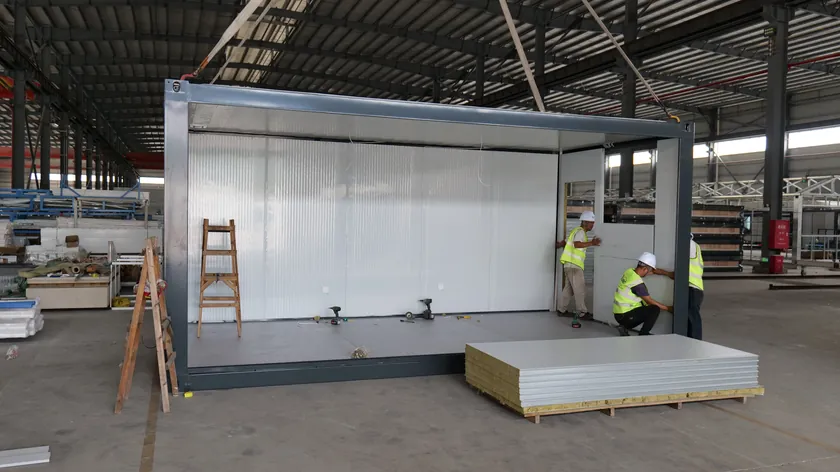
A separate reference image showing workers fitting panels into a frame similarly demonstrates why panel type, thickness and openings must reach assembly information. It does not demonstrate project compliance.
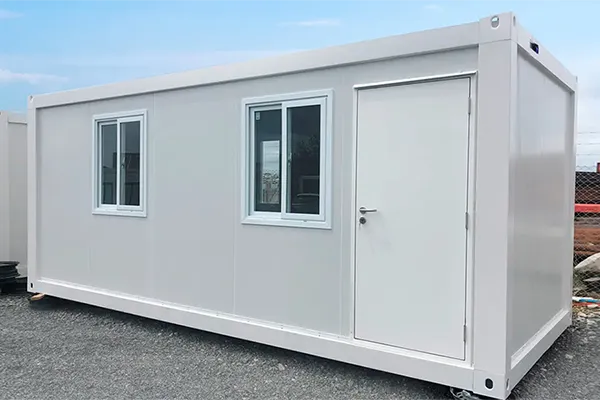
A sample showing glazed doors and exterior panels can make openings and finishes visible, but appearance should never substitute for the specified evidence or approval process.
Photographs are observations. They are not compliance evidence.
System Selection Is Part of the Technical Baseline
A modular building quotation should not be normalized while leaving the structural system ambiguous.
KUBO’s current system categories illustrate why: distinct modular systems use different manufacturing and packing forms and can involve different levels of site assembly, connection logic, factory completion, relocation characteristics and layout constraints.
A buyer who issues a general requirement for “prefabricated modular buildings” but receives offers based on materially different structural systems may be comparing configuration alternatives rather than minor deviations.
That distinction should be made before detailed adjudication.
If the employer intentionally allows several systems, the tender should establish how they will be compared and what minimum functional, performance, dimensional and interface conditions they must satisfy.
If one system has already been selected, the basis of quotation should say so.
For teams evaluating flat-pack solutions in particular, KUBO’s overview of flat-pack container house components can help procurement teams identify the types of frame, enclosure and component interfaces that need to be explicit in the project-specific technical baseline. It should not be treated as a substitute for the actual project’s drawings and specification.
Distinguish a Clarification from a Changed Offer
Clarification is one of the most dangerous stages in deviation evaluation because a seemingly simple question can change the competitive basis.
Suppose the tender requires internal electrical distribution within each module. Supplier A clearly includes it. Supplier B writes “electrical by others” without defining whether that means external site distribution or all internal works.
Asking Supplier B to identify its original intended boundary can be a clarification.
Allowing Supplier B to add an omitted internal electrical system after bid submission may be a change to the offer, depending on the applicable procurement procedure.
That distinction matters especially in regulated public procurement. The World Bank and ADB frameworks contain their own rules around responsiveness, clarifications and evaluation, while other jurisdictions use different procedures.
Private buyers have greater contractual flexibility in many situations, but they still benefit from disciplined change control. If one bidder is permitted to revise scope while another is held to its submitted offer, commercial comparison can become distorted.
A useful clarification response should therefore identify whether it confirms the submitted offer or revises it. If it revises the offer, the evaluator should process it according to the tender procedure rather than quietly replacing the original answer.
Commercial Normalization Should Follow Technical Disposition
Technical and commercial evaluation must communicate, but they should not be reversed.
A low-cost alternative is not automatically technically acceptable. A technically acceptable alternative is not automatically commercially neutral.
Once a deviation is technically accepted or approved subject to stated conditions, procurement needs to determine its commercial treatment.
That treatment should be specific to the deviation under review.
For example, if an alternate door configuration is approved, the supplier should state whether the revised configuration is already included in its quoted total, creates a credit, requires an addition or changes schedule.
If an accepted MEP boundary adds site-contractor work, the project should identify that responsibility consequence before declaring Supplier A and Supplier B commercially comparable.
If an alternate packing arrangement is accepted, the evaluator should record the technical and supplier-price consequence. Full freight, taxes, logistics and landed-cost reconciliation belong in the project’s separate landed-cost analysis rather than being recreated inside the deviation register.
Where a supplier cannot isolate the commercial effect of an accepted deviation, do not invent a precision that the quotation does not support. Mark the item as commercially unresolved or inseparable from the quoted configuration and manage that uncertainty explicitly before award.
A simple normalization rule
For each technically acceptable quotation, compare:
Normalized comparison basis
Submitted quoted basis
- plus accepted deviation additions;
- minus accepted deviation credits;
- plus specifically identified buyer-side scope created by accepted technical differences, where the procurement methodology requires that adjustment;
- equals the normalized technical-commercial comparison basis.
This is not a landed-cost formula. It exists only to stop different technical configurations from being compared as though they were identical.
The adjustment methodology itself must follow the procurement rules established for the project.
Who Controls Which Part of the Deviation Decision?
A manufacturer should not be expected to approve project requirements outside its authority, and an owner should not assume that an approved email automatically updates factory documents.
Clear role separation is therefore essential.
| Party | Typical control or contribution | What should not be assumed |
|---|---|---|
| Modular manufacturer | Defines offered configuration; provides supplier-controlled drawings and product information; identifies deviations; revises its supply documents after accepted decisions; carries approved requirements into manufacturing and packing information within its contracted scope | The manufacturer cannot unilaterally approve deviations from employer requirements or approve jurisdictional requirements on behalf of authorities |
| Buyer / EPC / owner | Establishes tender basis, project requirements, evaluation method, responsibility matrix and decision authority; issues or accepts controlled revisions | An engineering comment does not necessarily constitute commercial acceptance or contractual approval |
| Consultant / discipline engineer | Reviews technical compliance, evidence, calculations or interfaces within appointed scope and recommends or approves where formally authorized | Consultant review does not automatically transfer responsibility or override contractual approval procedures |
| Site contractor | Provides or confirms site-dependent works such as foundations, utility connections, access, staging and field interfaces according to its scope | Factory drawings alone do not establish actual site conditions |
| Local engineer | Addresses local engineering requirements, project-specific calculations, adaptation or professional review where required by law or contract | The exact role varies by jurisdiction and contract; it should not be assumed globally |
| Authority having jurisdiction | Reviews, permits, accepts or inspects whatever local law places under its jurisdiction | Supplier, buyer or consultant review cannot guarantee authority approval |
Project-specific local requirements govern. The evaluation team should identify the applicable codes, approval pathway and professional responsibilities rather than treating a supplier’s standard configuration as automatically suitable for every destination.
Do Not Let Interface Deviations Hide Inside Scope Notes
Many of the most commercially important deviations are not differences in physical components. They are differences in responsibility.
Consider the statement:
“Plumbing included.”
It is almost useless without boundaries.
Does it include sanitary fixtures? Internal pipework? Branch connections? Water heater? Venting? Connection through the module floor? Connection to an external site network? Testing? Local modifications? Final utility hookup?
A supplier can honestly describe “plumbing included” while the buyer assumes a wider scope.
The same problem appears with electrical distribution, HVAC interfaces, fire-related systems, foundations, access systems, external stairs, skirting, loose furniture, assembly labor and commissioning responsibilities.
These items should be adjudicated using a responsibility matrix rather than a vague compliance statement.
A deviation should therefore trigger interface review whenever it changes who designs, supplies, installs, connects, tests, submits or approves an item.
Hypothetical Example: Different Wall-Panel Thickness
Assume the employer’s specification defines a particular panel thickness and associated required criteria. A supplier proposes another thickness and labels it “equivalent.”
The team should not start with price.
The deviation record should identify the exact requirement and revision, the offered panel construction and the evidence required by the tender.
The technical reviewer then asks whether panel thickness itself is mandatory or whether the specification is really establishing performance requirements that an alternative may satisfy.
If alternative solutions are permitted, the evaluator examines the relevant project-required evidence. Depending on the specification, the evidence question might concern material composition, fire behavior, thermal performance, structural suitability, acoustic requirement, interface compatibility or another criterion. The applicable project documents determine which of these matters.
The propagation review then asks whether the change affects wall details, junctions, openings, trim dimensions, service penetrations or material schedules.
Only after the technical disposition is documented should procurement ask whether the offered panel was already included in the quotation and whether acceptance creates an addition, credit or schedule consequence.
If accepted, the revised panel basis must appear in the award package rather than remaining only in the clarification correspondence.
Hypothetical Example: Changed Module Width
A supplier may propose a different module width because its standard manufacturing or packing configuration differs from the tender geometry.
This is not merely a dimensional note.
Room sizes may change. Structural grid lines and module connections may move. Foundation interfaces may change. Corridor or circulation dimensions can be affected. MEP routing and service connection points may move. Packing form may change. Project drawings that were developed around the original grid may need revision.
The evaluator should therefore separate two questions.
Can the project technically accept the proposed geometry?
That belongs to engineering, architectural, interface and local-requirement review.
Should the project commercially accept the alternative?
That belongs to procurement and authorized commercial decision-makers after technical consequences have been understood.
A supplier should not be considered cheaper merely because its quotation achieves a lower total by changing the building geometry unless the project has intentionally accepted that geometry.
Hypothetical Example: Alternate Window or Door Configuration

Openings frequently look minor in a quotation comparison because they occupy only one schedule line.
Yet an alternate glazed door, window dimension, swing direction, frame type or hardware arrangement may affect elevations, wall openings, panel preparation, trim details, furniture interfaces, access routes and project-specific accessibility or egress requirements.
The correct evidence therefore depends on what has changed.
A product photograph may help a reviewer understand appearance. It cannot prove project compliance.
The accepted configuration should ultimately appear on the marked elevation, opening schedule and relevant details. If the supplier’s quotation description remains broader than those documents, the award package should resolve which document governs.
Hypothetical Example: Different MEP Inclusion
Suppose one supplier includes internal water and drainage piping up to defined module connection points while another supplies fixtures but leaves branch piping to site work.
Both may describe their offer as a “complete accommodation module.”
For technical deviation purposes, the issue is not whether both buildings can eventually operate. The issue is whether the supply boundaries are the same.
The evaluator should mark the MEP schematic and responsibility matrix so that each interface has a defined party.
Engineering decides whether the alternative boundary is workable.
The site contractor confirms the consequence for site work.
Procurement records the commercial effect.
The buyer decides whether the revised responsibility allocation is acceptable.
If accepted, the responsibility matrix becomes part of the award baseline.
Hypothetical Example: Changed Packing Form
Packing changes are easy to dismiss as logistics notes, but modular systems can have materially different relationships between factory completion and site assembly.
If a supplier proposes a more disassembled packing configuration, procurement needs to understand what has moved from factory work into site work.
Does assembly sequence change? Are additional components shipped loose? Does site staging become more important? Are more connections made in the field? Does the site contractor’s scope change?
These are technical-interface questions before they become freight questions.
A full comparison of ocean freight, duties, inland transport or landed cost belongs elsewhere. The deviation register only needs to establish the accepted packing configuration, the scope consequences and the supplier’s corresponding price or schedule treatment.
Hypothetical Example: Supplier-Proposed Material
A supplier may propose a material that differs from a tender reference because of availability, system design or its normal manufacturing method.
The evaluator should determine what the original specification was trying to control.
If the material itself is mandatory because of a project-specific requirement, an alternative may not be acceptable.
If the requirement allows alternatives that demonstrate equivalent characteristics, the supplier needs to provide the evidence required by the tender.
Acceptance should never be based on “we normally use this material” alone.
Once approved, the material designation should be updated in the relevant specification, drawing notes, material schedule/BOM and fabrication or procurement documents.
That last step is crucial. An approved substitution that never reaches purchasing and production records is not a controlled technical decision.
The Award-Freeze Package: Turn Decisions Into the Building That Will Be Supplied
Technical evaluation is not finished when the deviation register says “accepted.”
It is finished when the accepted condition has been transferred into a coherent award baseline.
A robust award-freeze package should reconcile at least the following documents:
| Award-freeze document | What should be frozen |
|---|---|
| Revised supplier offer | Final scope, selected system/configuration and incorporated accepted deviations |
| Final deviation schedule | Every deviation closed with status, evidence reference, approver and commercial treatment |
| Marked drawings | Accepted dimensions, layouts, openings, interfaces and configuration differences |
| Specifications / schedules | Accepted materials, components and technical requirements |
| Responsibility matrix | Design, supply, factory work, site installation, connections, testing and approval interfaces |
| Price treatment | Agreed addition, credit, included condition or clearly documented unresolved restriction if award governance permits it |
| Schedule treatment | Accepted time consequence or explicit confirmation of the schedule basis |
| Approval record | Who approved the technical and commercial disposition and when |
| Document hierarchy | Which document governs if the revised offer, drawing, specification or deviation schedule conflicts |
| Change-control baseline | Revision from which post-award changes must be processed |
The document hierarchy deserves particular attention.
Imagine that the final deviation schedule says an alternate door is accepted, the quotation still describes the original door, and the drawing shows the alternative. Which one governs?
Without a hierarchy or reconciled document set, the project has not truly frozen the requirement.
The safest objective is to remove conflicts before award. Where multiple documents necessarily remain, the contract should establish their relationship according to the project’s legal and contractual framework.
Carry Accepted Deviations Into Production Preparation
Modular procurement has a short path from drawings into repeated factory activities. That makes configuration control especially important.
An accepted frame change should reach the documents used to prepare frame fabrication.
An accepted wall-panel change should reach panel schedules, opening information and assembly instructions.
An approved door configuration should reach opening preparation and the applicable material schedule.
An accepted MEP scope change should reach factory installation drawings and the site-interface matrix.
An accepted packing change should reach packing documentation and the site assembly basis.
The KUBO Resources hub makes the broader point that project documentation can be configuration-specific. Procurement teams should therefore request the project-relevant drawings and technical documents rather than assuming that a generic catalog image, standard drawing or factory photograph is the final configuration.
Set Decision Deadlines Around Real Release Points
A deviation register without deadlines becomes a risk register rather than an adjudication tool.
The appropriate deadline depends on what the item controls.
A module-width decision may be needed before layout and foundation interfaces can freeze.
A panel decision may be needed before material procurement or assembly documents are released.
An opening decision may be needed before wall-panel preparation.
A packing decision may be required before packing lists and site logistics planning are finalized.
The buyer should therefore tie deviation deadlines to project release points rather than using one arbitrary “all comments due” date.
This also helps identify which unresolved items are genuinely award-critical.
Some projects can award while limited technical details remain subject to normal post-award submittal review. Others require those issues to be fully closed before contract execution. The contract and procurement procedure determine the acceptable approach.
What a Final Comparative Evaluation Should Show
A strong technical-comparison report should allow a decision-maker who did not attend every clarification meeting to understand the difference between bidders.
It should answer:
Which tender requirement governed?
What did each supplier actually offer?
Which differences were material to the project?
Which alternatives were supported by evidence and accepted?
Which items remain conditional?
What drawings, materials, interfaces or local engineering tasks changed?
Who owns the resulting work?
What price and schedule consequences have been incorporated?
What exact technical baseline will be awarded?
If the report cannot answer those questions without opening dozens of email threads, the evaluation is not sufficiently controlled.
Request a Tender Review Before Freezing the Modular Configuration
If your team is comparing modular quotations and the offers contain different systems, dimensions, materials, openings, MEP boundaries, packing forms or other technical qualifications, KUBO can review the tender basis and prepare a proposal against a more clearly controlled comparison set.
Before requesting a proposal or tender checklist, prepare the employer requirement or current technical specification revision, building and room schedule, selected or shortlisted modular system, supplier quotation, drawing list, compliance/deviation schedule, project destination, applicable project criteria, responsibility matrix and decision deadlines.
Request the proposal and tender checklist from KUBO.
Related Procurement Guides
- Workforce Camp Buying Checklist for Project Owners and EPC Contractors
- Flat Pack Container House Components: Inside a KUBO Module
- Modular Building Cost Factors: What Determines the Cost of a Project?
Frequently Asked Questions About Modular Building Technical Deviations
What is a technical deviation in a modular building quotation?
A technical deviation is a stated or discovered difference between the governing tender requirement and what the supplier has offered.
It can concern materials, dimensions, structural configuration, openings, finishes, MEP scope, interfaces, packing form, factory/site work allocation or another requirement.
The important point is that the deviation must be referenced to a controlled requirement. A difference from a previous drawing revision is not necessarily a deviation if a later tender document changed the requirement.
Should the supplier or the buyer maintain the final deviation register?
The supplier should clearly disclose its deviations, qualifications and assumptions, but the buyer, EPC or appointed evaluation team should normally control the comparison register used for adjudication.
That allows all suppliers to be evaluated against the same requirement references, statuses, evidence expectations and decision terminology.
If each supplier controls its own format, one may report every small difference while another simply writes “compliant except as noted,” creating a misleading comparison.
Is an equivalent product automatically compliant?
No.
“Equivalent” is not automatically an accepted status. It is a claim that must be evaluated against the project’s disclosed requirements and evidence expectations.
Where alternatives are permitted, the evaluator determines whether the offered solution satisfies the required technical or functional outcome. Applicable procurement rules may also prescribe how equivalents can be offered and evaluated.
Does a thicker wall panel automatically mean a better offer?
No.
Thickness alone does not establish whether a panel satisfies the project’s requirements. The relevant specification may control material build-up, thermal criteria, fire-related requirements, acoustics, durability, interfaces or other project-specific characteristics.
The evaluator needs to determine what the tender actually requires and whether the offered construction meets it.
The same principle applies if the offered panel is thinner than the reference panel. It should not be accepted or rejected on thickness alone unless thickness itself is a mandatory requirement.
Can a deviation be technically acceptable but commercially unacceptable?
Yes.
Engineering may determine that an alternative configuration is technically workable while procurement determines that its price, schedule or responsibility consequence is unacceptable.
The reverse sequence should be avoided. A commercial advantage should not be used to declare an alternative technically acceptable before engineering has completed the relevant review.
When should a deviation be sent to a local engineer?
When the proposed change affects an area that requires jurisdiction-specific engineering, professional review, local adaptation or another local responsibility under the project.
The exact boundary varies by location and contract.
A manufacturer can provide product and configuration information within its scope, but it should not be assumed that a manufacturer automatically performs every local engineering function or can guarantee authority approval.
How should MEP deviations be compared?
Compare MEP by defined supply and connection boundaries rather than broad labels such as “MEP included.”
The responsibility matrix should show who designs, supplies, installs, connects and tests each part of the system, including the transition from module-internal work to site utilities.
If two suppliers stop at different interface points, their quotations do not represent the same technical scope even if both describe their offer as a complete module.
Can a packing difference be treated only as a logistics issue?
Not always.
With modular systems, packing form can affect the degree of factory completion, loose-shipped components, site assembly sequence, staging needs and allocation of work between the manufacturer and site contractor.
Those technical consequences should be resolved before the project performs the wider freight and landed-cost comparison.
What happens if a technical deviation is accepted but never added to the drawings?
The project retains a configuration-control gap.
An acceptance recorded only in a meeting minute, email or deviation spreadsheet may not reach material procurement, production preparation or site installation.
The award-freeze process should therefore transfer the approved condition into the applicable drawings, specifications, schedules, BOM/material records, responsibility matrices and other execution documents.
Should the deviation schedule become part of the contract?
That depends on the contract and procurement approach, but accepted deviations need to be captured somewhere in the binding award baseline.
A project may incorporate a final deviation schedule directly, incorporate a revised technical offer that already contains the decisions, or reconcile the approved changes into final drawings and specifications.
Whichever approach is used, contradictory technical documents should not be left unresolved.
What is the biggest mistake when comparing modular building technical deviations?
Treating the deviation schedule as a checklist rather than a change-propagation system.
A technically accepted difference can alter drawings, materials, production preparation, factory assembly, packing, site work, local engineering responsibilities and price.
The strongest evaluation therefore follows the difference from tender requirement all the way to the frozen award and execution documents.
Sources and References
- World Bank Procurement Regulations for IPF Borrowers, Seventh Edition, September 2025 — referenced for principles concerning disclosed procurement requirements, technical specifications, substantially responsive offers and equivalent standards within World Bank-financed procurement.
- World Bank Rated Criteria Guidance — referenced for the use of disclosed evaluation criteria, methodologies, evidence requirements and non-price technical evaluation within the World Bank procurement framework.
- Asian Development Bank Bid Evaluation: Procurement Guidance Note, January 2026 — referenced for documented bid evaluation, responsiveness assessment, material and nonmaterial deviations, controlled clarifications and transparent evaluation records within ADB-financed procurement.
- U.S. Federal Acquisition Regulation 15.305 — Proposal Evaluation — referenced for the U.S. federal principle that competitive proposals are evaluated against solicitation factors and that supporting evaluation findings are documented.
- EU Directive 2014/24/EU on Public Procurement — referenced particularly for Articles 42-45 concerning technical specifications, performance or functional requirements, equivalent solutions, means of proof and authorized variants within EU public procurement.
These public-procurement sources illustrate principles from their respective frameworks. They are not universal rules for every private modular-building transaction. Private buyers and project teams must apply their own contract, applicable law, tender conditions, project governance and jurisdiction-specific requirements.