

Summary
A shared regional camp makes sense when several renewable projects create a credible overlapping resident demand, their active work fronts remain reachable under realistic journey conditions, and enough of the programme is committed to justify shared installed capacity. Do not size renewable energy zone workforce accommodation by adding each project’s individual peak. Build separate occupancy curves, remove projects that fail the route or schedule-confidence test, add camp operators and planned swing capacity, and release modular buildings in phases. Where one project sits outside the practical catchment, a central regional base can still work with a separate residential or satellite package. The decision belongs at portfolio feasibility and pre-procurement concept selection, before land selection and the accommodation package are frozen.
The decision is not simply “one camp or several”
For a developer managing several wind, solar, transmission, grid or BESS projects in one region, the accommodation question changes once the projects are viewed as a portfolio. A camp sized for one project answers a different problem. The regional question is whether separate workforce curves can be converted into one supportable accommodation asset without creating excessive commuting, schedule dependency or unused capacity.
That is why a regional worker camp should not be justified only because projects appear close together on a map. The portfolio team needs to know who is actually resident at the same time, which projects can genuinely use the proposed base, how certain each mobilisation window is, and what happens when one project moves six months while another remains on programme.
The same distinction separates this decision from the question of whether an individual renewable project needs a camp rather than local hotels or daily commuting. Teams still making that single-project choice can use KUBO’s guide to renewable energy workforce camp planning for remote projects. For a portfolio already considering regional accommodation, the analysis should move one level higher: concurrent demand, geographic catchment and phased asset commitment.
A practical feasibility study therefore asks three linked questions:
- How many residents from the portfolio are actually concurrent rather than merely part of separate project peaks?
- Which projects remain suitable for the regional base after realistic travel conditions and work-front access are tested?
- How much accommodation should be installed now, held as a conditional expansion, separated into another package or released later?
If those questions are answered before procurement, a developer can compare one regional base, separate project camps and sequential relocation on a common basis instead of choosing a concept first and trying to make the programme fit it later.
Start with cumulative regional demand, but keep every project curve separate
Regional renewable development can generate accommodation demand that moves between locations and years rather than rising and falling as one project. EnergyCo’s New England Renewable Energy Zone workforce accommodation study examined generation, network and other major projects together and modelled temporary accommodation demand by location and time. Under the study’s base case, renewable and transmission accommodation demand across the study area reached a modelled peak of 4,874 workers in July 2030. That is regional planning evidence, not a KUBO capacity ratio and not a number that should be transferred to another renewable energy zone.
The useful lesson is the method: maintain the underlying project curves. A regional total is only the final output of separate schedules, local-labour assumptions, accommodation requirements and geographic catchments.
Squadron Energy’s 2023 Uungula Wind Farm Accommodation and Employment Strategy shows why a project curve matters. Its estimated average monthly workforce rises to about 150 personnel by month 9, reaches about 216 around month 12, falls to about 100 by month 24 and reaches approximately 12 operational workers around month 39. Estimated peak non-local accommodation demand was 175-200 people. Another project in the same region can have a different ramp-up, peak and demobilisation period even if its headline construction workforce is similar.
For portfolio planning, that means the spreadsheet should not contain one column labelled “peak beds per project” and a total underneath. It should contain time periods across the top and resident demand for every project down the side. Where contractor-level mobilisation data is already available, KUBO’s discussion of renewable energy workforce mobilisation and project schedules provides the single-project schedule logic that can feed the regional model.
Worked model: calculate actual overlap before sizing the regional base
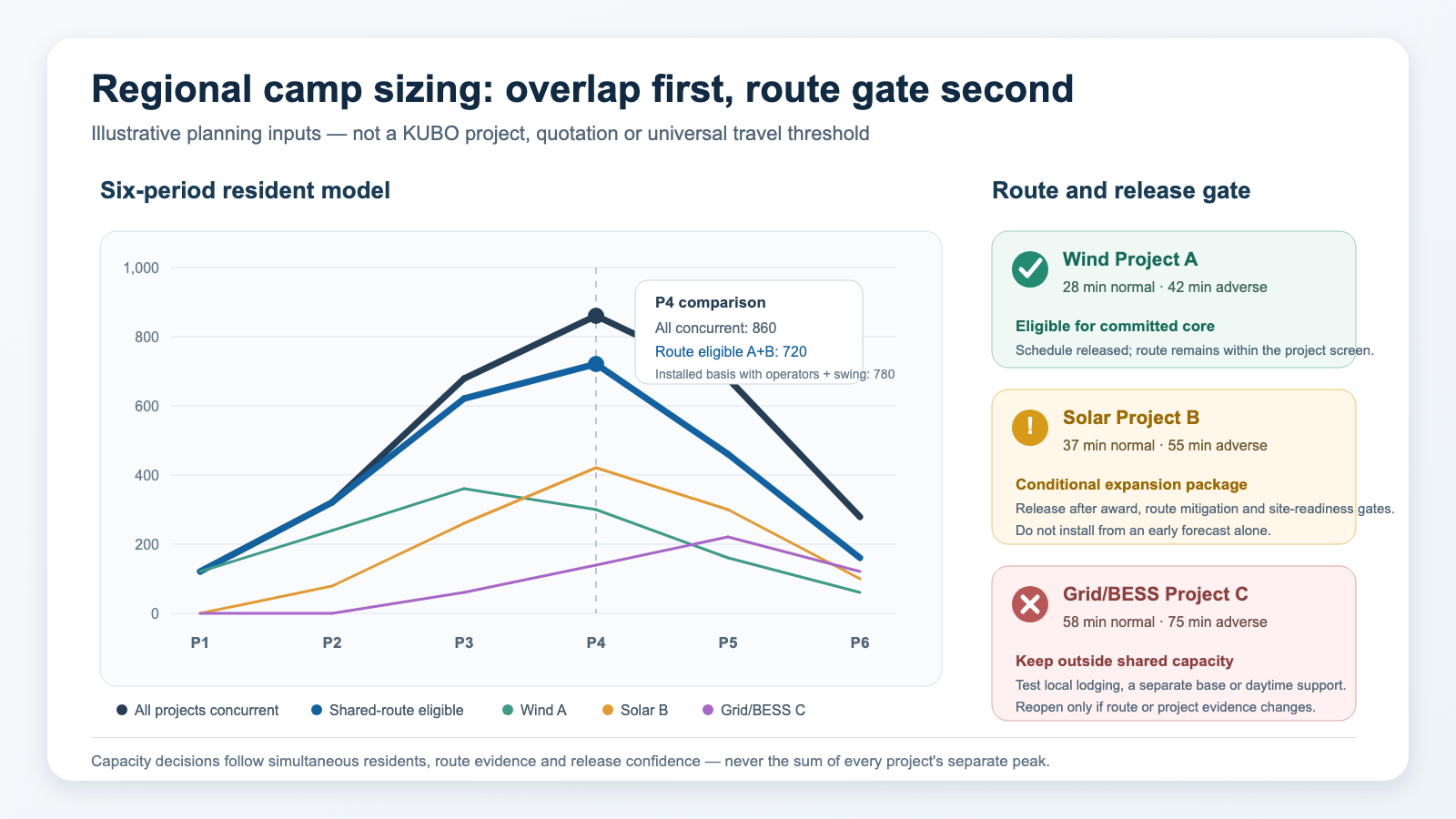
The following model is hypothetical and buyer-replaceable. Wind A, Solar B and Grid/BESS C are not real projects. The purpose is to show the arithmetic that a portfolio developer can use before deciding how much shared accommodation to procure.
| Period | Wind A | Solar B | Grid/BESS C | All concurrent | Shared-route eligible A+B | Operators | Swing | Shared installed basis |
|---|---|---|---|---|---|---|---|---|
| P1 | 120 | 0 | 0 | 120 | 120 | 18 | 22 | 160 |
| P2 | 240 | 80 | 0 | 320 | 320 | 18 | 22 | 360 |
| P3 | 360 | 260 | 60 | 680 | 620 | 24 | 36 | 680 |
| P4 | 300 | 420 | 140 | 860 | 720 | 24 | 36 | 780 |
| P5 | 160 | 300 | 220 | 680 | 460 | 20 | 30 | 510 |
| P6 | 60 | 100 | 120 | 280 | 160 | 16 | 24 | 200 |
The difference between the numbers is commercially important. The three separate project peaks are 360, 420 and 220 residents. Adding them produces 1,000. Yet those peaks do not occur together: the maximum concurrent portfolio requirement is 860 at P4.
Even 860 is not automatically the regional-camp requirement. In this example, Grid/BESS C fails the shared-route screen discussed below, leaving 720 route-eligible project residents at P4. Adding 24 camp-operating residents and 36 planned swing spaces produces a shared installed basis of 780.
The arithmetic is:
- Separate project peak sum: 360 + 420 + 220 = 1,000.
- Actual all-project concurrent peak: 860 at P4.
- Route-eligible shared residential peak: 720 at P4.
- Shared installed basis: 720 project residents + 24 operators + 36 swing = 780.
This distinction prevents two common errors. One is overbuilding by assuming that every project reaches its individual peak simultaneously. The other is under-testing the portfolio by calculating overlap correctly but including projects whose crews cannot practically use the same base.
The model should also stay editable. If Solar B moves from P4 to P5, or Grid/BESS C receives notice to proceed and a different accommodation site becomes available, the portfolio team should be able to change those inputs without rebuilding the entire concept.
A route gate can remove a project from shared capacity
Regional accommodation only works if the camp remains operationally connected to the projects it is supposed to serve. Distance alone is a weak test. The useful input is journey time under normal and adverse operating conditions, including the roads actually used by buses or crew vehicles, active gates, shift start times, weather exposure, road reliability and foreseeable congestion.
EnergyCo’s New England study used a 45-minute drive-time assumption for its accommodation-catchment modelling and tested 60- and 90-minute sensitivities. That 45-minute value is specific to the study method. It is not a universal safety limit, regulatory threshold or automatic criterion for another project.
Squadron Energy’s Uungula strategy also recorded real travel relationships rather than relying on straight-line distance. Its route table included Wellington at 18 km and about 15 minutes, Geurie at 35 km and 25 minutes, Dubbo at 60 km and 45 minutes, Gulgong at 80 km and one hour, Mudgee at 100 km and one hour ten minutes, and Orange at 120 km and one hour twenty-five minutes. Those figures belong to that project’s planning context; their value here is that they show the type of route evidence a portfolio team should collect.
A buyer-replaceable route and commitment screen
| Project | Normal journey | Adverse journey | Schedule status | Regional-camp result |
|---|---|---|---|---|
| Wind A | 28 min | 42 min | Committed / NTP released | Eligible |
| Solar B | 37 min | 55 min | Conditional award | Conditional; use mitigation and release gate |
| Grid/BESS C | 58 min | 75 min | Early development | Exclude from installed shared capacity; test separate base or local lodging |
These times are hypothetical. They are not taken from the EnergyCo study and do not describe actual projects.
The table shows why route and programme confidence should be evaluated together. Wind A is both operationally suitable and committed, so it can support the core accommodation decision. Solar B sits closer to the edge of the assumed operating envelope and is not yet fully committed. Its future rooms may still belong in the site master plan, utility allowance and expansion zone, but that does not mean every module has to be released for manufacture at the same time as the core package.
Grid/BESS C is different. Its travel exposure is already weak and its programme remains early. Including its 140 P4 residents in the installed regional base would make the accommodation concept depend on two uncertain assumptions at once. A separate project camp, local accommodation, or another satellite residential solution should therefore be tested instead.
Schedule confidence should become a capacity-release rule
Regional accommodation creates schedule cross-dependency. A single-project camp may be oversized if its project slips, but a shared camp can experience a more complicated outcome: one project delays, another accelerates, and the room blocks originally associated with one workforce become needed by another.
The solution is not to pretend the programme is fixed. It is to convert programme confidence into procurement stages.
| Capacity layer | Typical evidence | Procurement treatment | Purpose |
|---|---|---|---|
| Committed core | Released project, credible resident schedule, route passed | Configure and release the required modular package | Serve demand that already supports the regional-base decision |
| Conditional expansion | Likely project or award, acceptable route, timing still movable | Reserve expansion area and interfaces; hold final module release to an agreed gate | Avoid committing all uncertain future beds too early |
| Separate or satellite package | Route failure, persistent remote work front or materially different operating need | Configure outside the shared residential count | Protect the central base from an unsuitable catchment |
| Later release or reuse | Verified demobilisation or reduced resident requirement | Identify buildings that can be retained, reassigned, moved or otherwise dealt with under the project plan | Reduce stranded capacity after the construction peak |
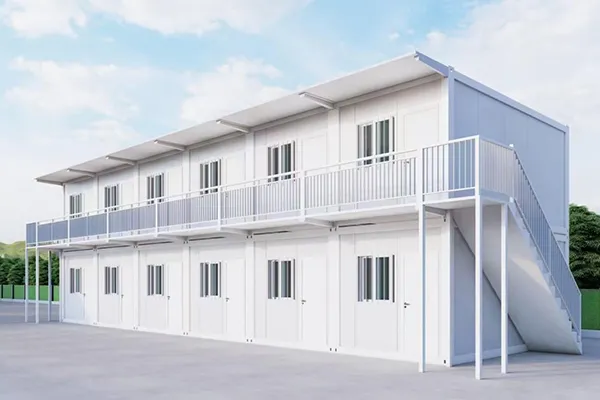
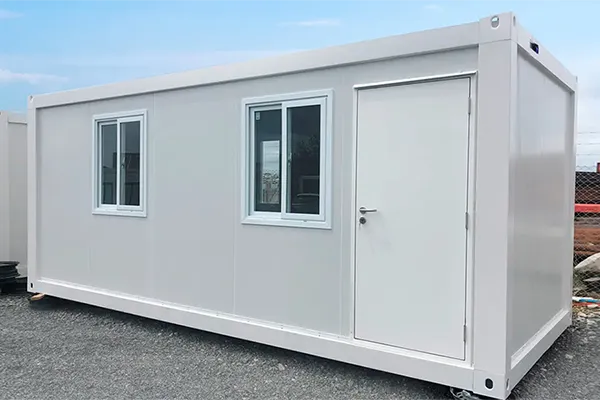
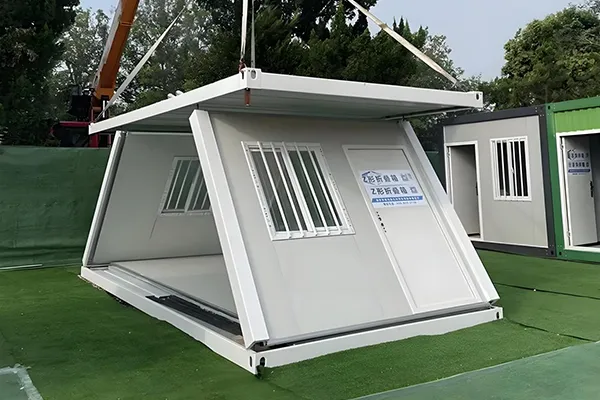
This is where modular procurement can support uncertainty rather than merely provide temporary buildings. KUBO can discuss phased modular packages covering accommodation and bathrooms, project offices and meeting or induction space, kitchen and dining facilities, laundry, recreation and rest buildings, medical or first-response functions, gatehouses, and selected stores, workshops or O&M support buildings within the agreed supply scope.
Drawings, material and fixture schedules, factory checks, batch identification, packing and installation information can be aligned with those release packages. Module-side connection points can also be coordinated with the project team so that expansion is considered before later buildings arrive rather than improvised after the core camp is occupied.
This phased logic is different from assuming that every possible future room must be purchased immediately. It also differs from post-construction relocation planning, which begins once the asset has already served its construction purpose. Teams evaluating that later decision can refer to KUBO’s separate guide on how to downsize or relocate a renewable energy project camp.
Compare one regional base, separate camps and sequential relocation on the same basis
No option wins universally. The choice depends on route geometry, project timing, local accommodation, land, services, management structure and the probability that planned projects actually enter construction when expected.
| Decision factor | One shared regional residential base | Separate project camps | Sequential relocation or reuse |
|---|---|---|---|
| Resident capacity | Based on actual overlapping route-eligible demand | Each project sized against its own demand and operating policy | Capacity can serve later projects if construction windows genuinely stagger |
| Travel | Must pass for every project included in shared capacity | Can usually be positioned closer to each project’s work fronts | Can improve travel after each move, but requires a new receiving site |
| Central services | Potential to reduce duplication of dining, laundry, management and other shared functions | Services and utilities may be duplicated across projects | Some assets may be reused, but each relocation creates another setup cycle |
| Schedule dependency | Higher: multiple project programmes affect one accommodation asset | Cleaner project ownership and fewer cross-project bed conflicts | Highly dependent on the first project releasing capacity before the next needs it |
| Site and utilities | Requires a regional site capable of supporting the combined staged facility | Requires separate land, services and site works for each camp | Requires receiving-site land, services and readiness for every move |
| Logistics | Can concentrate initial delivery but still benefits from phased batches | Delivery programmes follow individual projects | Adds dismantling, transport, receiving, reassembly and recommissioning interfaces where applicable |
| Expansion | Strong fit where an expansion zone and future interfaces are planned | Expansion stays within each project’s own site constraints | Expansion depends on both available modules and the next site’s readiness |
| Governance | Needs clear bed-allocation and operating rules across projects or contractors | Commercial and operating accountability is easier to isolate | Needs clear asset ownership and release conditions between projects |
| Main risk | Long routes or programme changes undermine the sharing logic | Duplicated infrastructure can remain underused as projects demobilise | Schedule gaps or overlaps can defeat the planned reuse sequence |
A regional camp tends to become stronger when two or more committed projects have material resident overlap, all included projects pass the route test, the site can support staged utilities and facilities, and the portfolio owner can manage room allocation across changing workforces. Separate camps become more attractive when projects are geographically dispersed, work-front access dominates daily operations, ownership needs to remain isolated or the shared base would create persistent long journeys.
Sequential relocation can be compelling on paper when projects follow one another neatly. Its weakness is the interface between schedules. If Project A demobilises in June and Project B needs rooms in July, the planning window must cover more than a simple subtraction of dates. The team must consider isolation and dismantling where relevant, transport, receiving-site readiness, utilities, local assembly or installation, inspection and the possibility that Project A releases rooms later than forecast while Project B mobilises earlier.
Do not compare the three options using different cost boundaries
A shared camp can reduce duplication of some central services, but that statement alone does not establish a lower total cost. Likewise, separate camps should not be dismissed merely because they repeat facilities. Procurement teams need a common scope before comparing commercial outcomes.
For each option, price the same categories:
- land preparation and project-specific site works;
- accommodation and bathroom buildings;
- project offices, meeting and induction facilities;
- kitchen, dining, laundry, recreation and other welfare buildings;
- medical, security, storage and selected workshop functions where required;
- external power, water, wastewater, communications and associated interfaces;
- roads, parking, bus circulation, laydown and access;
- freight and the planned shipment sequence;
- unloading, lifting, assembly or installation activities applicable to the selected building system;
- camp operations, cleaning, catering, security, maintenance and transport;
- future expansion, release, demobilisation and relocation activities where relevant.
The commercial comparison also needs a time dimension. A regional base may require more infrastructure early but serve several projects. Separate camps may require repeated setup. Sequential relocation may defer some replacement capacity but introduce additional mobilisation cycles. Because those relationships depend on project-specific prices, distances, labour and site conditions, there is no defensible universal cost percentage that can decide the concept.
Local accommodation still belongs in the regional model
A renewable energy zone workforce accommodation strategy should not treat the regional camp as the only available bed source. Verified local accommodation, permanent residents in the workforce and other suitable housing options can alter the number of people who need the camp.
At the same time, the portfolio team should examine the effects of temporary workforce demand on surrounding communities and services. IFC and EBRD guidance on workers’ accommodation highlights issues including community infrastructure, transport, health and safety, accommodation management and relationships with nearby communities. These are planning principles rather than local approvals or universal room formulas.
ACEN Australia’s 2023 material for the Central-West Orana Renewable Energy Zone provides a useful example of portfolio-scale thinking. ACEN described an early-stage proposal for one temporary workers accommodation facility to service its projects in the zone. The preferred location was stated to be approximately one kilometre south of EnergyCo’s Merotherie hub, with a likely capacity of 500 workers and potential maximum of 1,000. The document explicitly described the proposal as being in early planning, so it should not be presented as evidence that the facility was approved or built.
The procurement lesson is narrower: developers can evaluate shared accommodation at portfolio scale, but the concept still has to pass project-specific planning, site, community, transport and programme tests.
Room allocation becomes an operating rule when several projects share the base
Capacity planning does not end once the installed bed number is known. A shared camp needs an allocation mechanism that can absorb project delay without turning every schedule change into a room crisis.
The portfolio operator can begin by separating committed rooms, conditional rooms and swing capacity. Within those categories, the room matrix may also need to distinguish workforce groups, shifts, privacy requirements, retained management or O&M personnel and any project-specific accommodation constraints. A nominal 780-bed basis is not useful if the actual room types cannot be assigned to the people arriving.
The same rule applies to common facilities. Dining, laundry, bathrooms, recreation and project-control functions should be checked against occupancy waves rather than only total residents. A portfolio with two projects changing shifts at the same time can produce a very different operating peak from one in which the same number of residents use facilities at different hours.
Where several contractors share accommodation within a single project, bed-pooling governance is its own procurement question. KUBO addresses that separate decision in its guide to a shared construction camp and pooled accommodation. A regional multi-project camp adds another layer because the allocation rules must survive changes between distinct project programmes as well.
What happens when one project is delayed?
A schedule delay should trigger a defined response, not an automatic redesign of the whole camp.
If a committed project moves slightly but remains inside the same portfolio demand window, the existing swing capacity or revised room allocation may be enough. If a conditional project moves substantially, its expansion package can remain on hold while the core camp proceeds. If a delayed project no longer overlaps with the rest of the portfolio, the business case for its shared rooms should be recalculated rather than preserved simply because they appeared in the original concept.
The reverse case is equally important. An accelerated project can require rooms before a planned expansion batch is ready. That risk is one reason to define release gates early: project award, notice to proceed, approved resident curve, route confirmation, site expansion readiness or another project-specific milestone can be connected to the decision to release the next building package.
These rules keep a regional camp from becoming a speculative maximum-capacity asset. They also give procurement teams a clearer conversation with suppliers because the initial package, reserved future capacity and out-of-scope project demand are visible from the start.
How KUBO can configure a phased regional renewable-energy camp
KUBO’s renewable energy project camp solution can be used to discuss a modular supply strategy once the portfolio team has converted project schedules and routes into a preliminary accommodation concept.
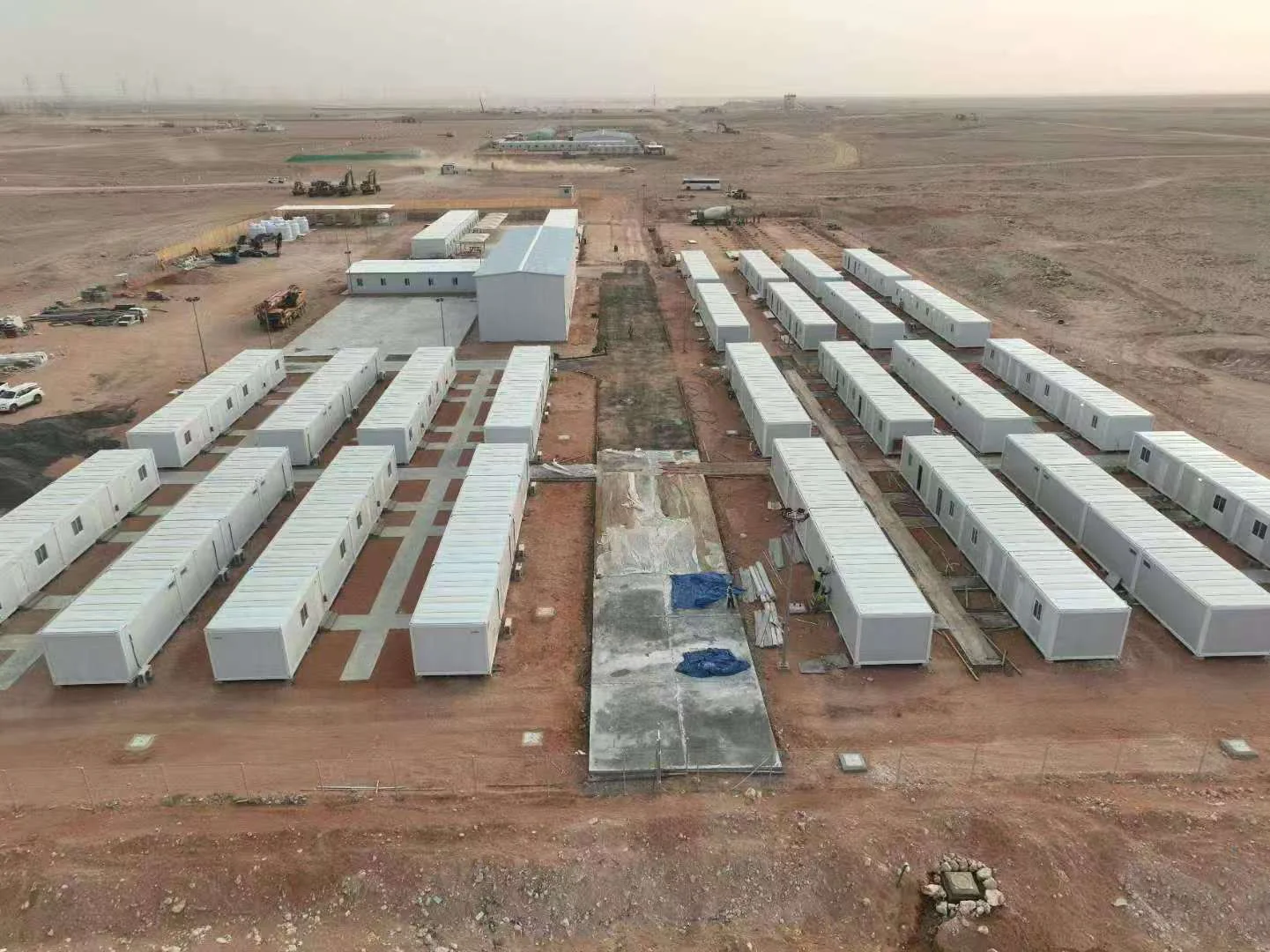
For a shared regional base, the configuration can combine accommodation and bathroom arrangements with project offices, meeting or induction rooms, kitchen and dining buildings, laundry, recreation and rest space, medical or first-response functions, security or gatehouse buildings and selected storage, workshop or O&M support facilities. The actual mix depends on the agreed project brief rather than a standard camp ratio.
The portfolio model can then be translated into release packages. A first package may establish the committed residential core and the service buildings needed for the initial operating population. Later packages can expand accommodation and supporting facilities when conditional projects cross their release gates. A remote project that fails the regional route test can be treated as a separate or satellite package instead of distorting the central capacity calculation.
Within the agreed modular-building supply scope, KUBO can coordinate phased drawings, materials and fixtures, factory checks, batch identification, packing and installation information. Module-side connection points can be coordinated with the project team so external utility and site interfaces are considered against the planned expansion sequence.
Land selection, statutory approvals, local design acceptance, roads, foundations, drainage, external utilities, customs and inland logistics, unloading and lifting, local assembly or testing, occupancy approval and camp operations depend on the contract, jurisdiction and project delivery structure. These interfaces should be assigned early because a regional base only works if the site and external systems can support the same phased capacity assumed in the accommodation model.
A practical pre-procurement decision sequence
Before choosing a site or asking suppliers to price a fixed camp, a portfolio developer can work through the decision in the following order:
- Map every project separately. Record project locations, gates and relevant work fronts rather than using one point for an entire wind or solar development.
- Build resident curves by period. Use people actually expected to require accommodation, not megawatts and not total employment.
- Identify local accommodation and resident workforce assumptions. Remove only capacity that is genuinely available and suitable.
- Calculate actual overlap. Find the maximum concurrent demand rather than adding the highest point of every project curve.
- Apply the route gate. Test normal and adverse journeys, shift timing, road reliability and operational access for each project.
- Apply the commitment gate. Separate released projects from conditional awards and early-stage developments.
- Add camp operators and approved swing capacity. Keep these inputs explicit so they can be changed later.
- Check room mix and facility peaks. Confirm that the accommodation types, dining, bathrooms, laundry and support functions fit the resident profile and shift waves.
- Compare regional, separate and sequential options on the same cost boundary. Include site, utilities, operations, logistics and later release or relocation.
- Convert the preferred concept into modular release packages. Define the committed core, conditional expansion, remote or satellite needs and later asset release.
If the shared concept survives all ten steps, it has a stronger basis for land and pre-procurement work. If it fails at route, timing or governance, the same analysis still has value because it shows exactly which projects should be separated from the regional base.
Procurement FAQs
Should we add the maximum workforce of every wind and solar project to size the regional camp?
No. Separate project peaks may occur in different months or years. Build time-based resident curves and calculate the actual concurrent demand. In the hypothetical model above, individual project peaks sum to 1,000, while the maximum all-project overlap is 860. After the route screen removes Grid/BESS C, the shared residential peak falls to 720 before operators and swing capacity are added. Peak-sum sizing can therefore produce a materially different answer from portfolio overlap analysis.
How certain should a project be before its workers are included in installed shared capacity?
There is no universal project-status rule, but schedule confidence should be visible in the capacity decision. A project with a released notice to proceed, credible resident curve and acceptable route can support the committed core more strongly than an early development project. Conditional capacity can still be planned in the site layout and interfaces while module release waits for an agreed commercial or programme milestone.
Can one remote project use a separate camp while the rest share a regional base?
Yes. A regional strategy does not have to be all-or-nothing. If Wind A and Solar B have acceptable routes but Grid/BESS C does not, the shared base can be sized around A and B while C is evaluated for local accommodation, its own residential package or another suitable arrangement. Removing an outlier can make the regional concept more robust rather than invalidate it.
Does sequential relocation always require less accommodation than a shared regional camp?
Only when project windows are sufficiently staggered and modules can be released, moved and made ready before the next demand period. Overlap between projects may still require simultaneous capacity. The comparison should also include dismantling where applicable, transport, receiving-site readiness, utility interfaces, local installation activities and the risk of the first project releasing rooms later than planned.
What information is enough to start a regional camp discussion with KUBO?
A complete engineered tender package is not required for the first discussion. Country or region, project locations, approximate resident ranges and expected occupancy windows are enough to start testing the portfolio concept. From those inputs, KUBO can discuss whether a preliminary shared core, phased expansion or separate modular package is the more useful direction for further development.
Related Planning Guides
- Remote Renewable Workforce Accommodation Planning — test whether one project needs dedicated accommodation.
- How Renewable Energy Workforce Mobilization Affects Project Schedules — build the resident curve that feeds the regional model.
- How to Downsize or Relocate a Renewable Energy Camp — plan later capacity release and reuse.
Discuss a Camp Supply Plan for Your Renewable Project Portfolio
If you are comparing a regional base with separate project camps or sequential reuse, send the country or region, the location of each project, expected resident ranges and the approximate occupancy windows. KUBO can use those inputs to discuss a preliminary shared-core, phased-expansion or separate-package modular building configuration before the accommodation concept is frozen.
Use the KUBO renewable energy project camp solution to continue the project discussion.
Sources and References
- EnergyCo, New England Renewable Energy Zone Workforce Accommodation Study, 2025
- ACEN Australia, Central-West Orana temporary workers accommodation facility proposal, 2023
- Squadron Energy, Uungula Wind Farm Accommodation and Employment Strategy, 2023
- IFC and EBRD, Workers’ Accommodation: Processes and Standards, 2009