

Introduction: Mining Accommodation Is Not Just a Place to Sleep
For a mining project, accommodation is often planned after the main project scope has already been discussed: mining rights, equipment, access roads, processing facilities, contractors, power supply, and logistics. However, once the project enters mobilization, accommodation quickly becomes one of the first practical bottlenecks.
A remote mining site cannot operate efficiently if the workforce has no stable place to live. Engineers cannot manage the project properly if there is no remote office. Contractors cannot bring in enough labor if the camp is not ready. Site managers cannot control safety, food service, sanitation, maintenance, and daily movement if the camp layout is poorly planned.
This is why mining accommodation should not be evaluated as a simple housing purchase. It is part of the project base infrastructure.
The real question is not only:
How much does one accommodation unit cost?
The more useful question is:
Which accommodation system can help the mining project site become operational faster, with lower total cost, lower installation risk, and better long-term flexibility?
For mining, oil and gas, infrastructure, power, railway, road, and large construction projects, accommodation is not only about bedrooms. It usually needs to work together with remote offices, sanitary units, dining halls, kitchens, laundries, storage rooms, security rooms, first-aid rooms, recreation areas, utility zones, and vehicle access routes.
In other words, a mining camp is a temporary operating base. The accommodation system must support people, workflow, safety, logistics, and future expansion.
As global demand for critical minerals continues to grow, many mining projects are being developed in remote or infrastructure-limited regions. The World Bank has estimated that production of minerals such as graphite, lithium, and cobalt could increase by nearly 500% by 2050 to meet demand for clean energy technologies. This does not only mean more mines. It also means more remote project bases, more construction camps, more workforce housing, and more pressure to deploy accommodation quickly and economically.
This article explains how to choose the most cost-effective and fastest mining accommodation solution by comparing different building types, project scenarios, transport conditions, workforce requirements, remote office needs, and total lifecycle cost.

1. Why Mining Accommodation Should Be Treated as a Project-Cost Decision
Mining projects are capital-intensive, schedule-sensitive, and often exposed to uncertainty. Poor early planning can create cost and schedule problems that become difficult to recover later.
Accommodation is one of the systems that affects early project readiness. If the camp is delayed, the project cannot bring in enough workers. If the camp is uncomfortable, worker retention becomes harder. If the camp is poorly laid out, daily operations become inefficient. If the buildings are difficult to maintain, the site team must spend more money and time on repairs.
A proper mining accommodation decision should therefore consider the total cost of ownership, not only the purchase price.
1.1 The visible cost is only part of the real cost
When comparing accommodation options, many buyers start with the unit price. That is understandable, but incomplete. For remote mining sites, the real cost usually includes:
- Building purchase cost
- International or domestic freight
- Port handling cost
- Inland transportation cost
- Road access limitations
- Site foundation preparation
- Crane and lifting equipment
- Installation labor
- Utility connection
- Water and wastewater systems
- Power and HVAC load
- Maintenance cost
- Spare parts replacement
- Camp management cost
- Expansion or relocation cost
- Downtime caused by delayed occupancy
A low-cost unit may become expensive if it requires too many shipments, heavy site work, frequent repairs, or specialized installation workers. In a remote project, every additional truck, crane, technician, and installation day can increase the total cost.
For this reason, mining accommodation should be evaluated by project efficiency rather than product price alone.
1.2 Camp readiness affects project mobilization
Accommodation is often needed before peak construction begins. Workers, engineers, supervisors, safety teams, catering teams, and security staff need a stable living and working environment before large-scale site work can proceed.
If the accommodation camp is not ready on time, the project may face:
- Delayed workforce mobilization
- Higher temporary hotel or rental costs
- Lower labor availability
- Inefficient daily transportation
- Poor worker rest conditions
- Higher safety risk
- Slower construction progress
- More pressure on project management teams
In remote mining areas, alternative accommodation may not exist nearby. Even when nearby towns have hotels or rental housing, daily transportation can become expensive, slow, and unsafe. A properly deployed camp reduces dependence on external accommodation and allows the project owner to control site operations more directly.
1.3 Worker accommodation affects productivity and retention
Mining work is physically demanding, and remote-site life can be stressful. Accommodation quality has a direct impact on rest, morale, hygiene, health, and worker stability.
A camp with poor insulation, weak ventilation, insufficient bathrooms, long walking distances, noisy sleeping areas, or unreliable water and power can create daily friction. These problems may not appear in the initial purchase price, but they affect workforce performance over time.
A cost-effective mining accommodation system should therefore support:
- Safe rest
- Reasonable privacy
- Clean sanitation
- Stable temperature control
- Easy access to dining and washing facilities
- Practical maintenance
- Clear separation between living, working, and service zones
The goal is not to build a luxury camp. The goal is to build a camp that is durable, efficient, and suitable for the real operating conditions of a remote mining project.
2. What Makes Mining Accommodation Different From Ordinary Worker Housing?
Mining accommodation has different requirements from urban dormitories, temporary rental housing, or standard construction-site cabins. The project location, workforce model, climate exposure, logistics conditions, and safety requirements are usually much more demanding.
2.1 Remote location changes the cost structure
In a city, construction materials, labor, spare parts, cranes, maintenance teams, and utilities are easier to access. In a remote mining site, the situation is very different.
A missing component may need to be shipped from far away. A repair team may take days to arrive. Heavy rain may block roads. A crane may not be available locally. A small installation error may delay the entire phase of the camp.
This makes standardization extremely important.
The more standardized the accommodation system is, the easier it is to:
- Estimate shipping volume
- Plan installation sequence
- Train local installation workers
- Replace damaged parts
- Expand the camp
- Relocate buildings after project completion
2.2 Mining camps must support shift-based life
Mining operations often work in shifts. Workers may sleep during the day, eat at different times, shower after heavy-duty work, or move between site areas under strict safety procedures.
This means the camp should not be designed like a normal residential block. It must consider operational flow.
For example:
- Bathrooms must match peak usage after shift changes.
- Dining facilities must handle concentrated meal times.
- Laundry capacity must match workwear cleaning needs.
- Sleeping areas should be separated from noisy vehicle routes.
- Office areas should allow management teams to work without disturbing accommodation zones.
- Emergency assembly areas must be accessible from dormitories and offices.
If these issues are ignored, the camp may appear acceptable on paper but become inefficient in daily use.
2.3 Climate conditions are often harsher
Mining sites may be located in deserts, mountains, tropical islands, coastal regions, high-rainfall areas, cold regions, or remote inland zones. Accommodation must be designed according to local environmental conditions.
Important technical factors include:
- Wind resistance
- Roof drainage
- Snow load
- Wall and roof insulation
- Corrosion protection
- Door and window sealing
- Bathroom waterproofing
- Floor durability
- Air-conditioning or heating load
- Dust control
- Ventilation
- Fire safety
A container accommodation unit used in a mild climate may not be suitable for a coastal, cyclone-prone, tropical, or high-altitude mining site without technical upgrades.
2.4 Camp facilities are interconnected
A mining camp is a system. Bedrooms depend on bathrooms. Bathrooms depend on water and wastewater. Dining halls depend on kitchen capacity, storage, and waste flow. Remote offices depend on power, communication, and meeting space. Security rooms depend on entrance planning and traffic control.
When accommodation is purchased as separate units without layout thinking, problems usually appear later:
- Too many dormitories but not enough toilets
- Office too far from the main work area
- Dining hall too small for peak workforce
- Poor drainage around bathroom units
- No reserved area for future expansion
- Generator placed too close to sleeping areas
- Storage blocking emergency access
- Vehicle route crossing pedestrian paths
The most economical camp is usually not the one with the fewest buildings. It is the one with the least operational friction.
3. Main Types of Mining Accommodation for Remote Project Sites
Different mining projects require different accommodation solutions. The right option depends on project duration, workforce scale, transport route, climate, expansion plan, and site operating model.
3.1 Traditional on-site construction
Traditional construction can work for permanent mine towns, long-life production bases, or projects with strong local construction resources. It allows high customization and can provide long-term durability.
However, for remote mining accommodation, traditional construction often creates challenges:
- Longer construction period
- More dependence on local labor
- More material deliveries
- Greater exposure to weather delays
- Higher site management complexity
- Less flexibility for relocation
- Harder phased expansion
Traditional construction may be suitable for a permanent facility, but it is rarely the fastest or most flexible choice for early-stage mining camps, construction-phase camps, or remote offices that need rapid deployment.
3.2 Tents and light-duty shelters
Temporary tents and light-duty shelters are easy to deploy and may have lower upfront cost. They can be useful for exploration teams, emergency situations, short-duration field work, and temporary site support.
Their limitation is long-term performance. In harsh environments, light shelters may struggle with:
- Strong wind
- Heavy rainfall
- Dust
- Heat
- Cold
- Noise
- Privacy
- Fire safety
- Long-term sanitation
- Worker comfort
For short exploration work, tents may be acceptable. For a mining camp that needs to support a stable workforce for months or years, they are usually not the most cost-effective solution over the full project lifecycle.
3.3 Prefabricated modular buildings
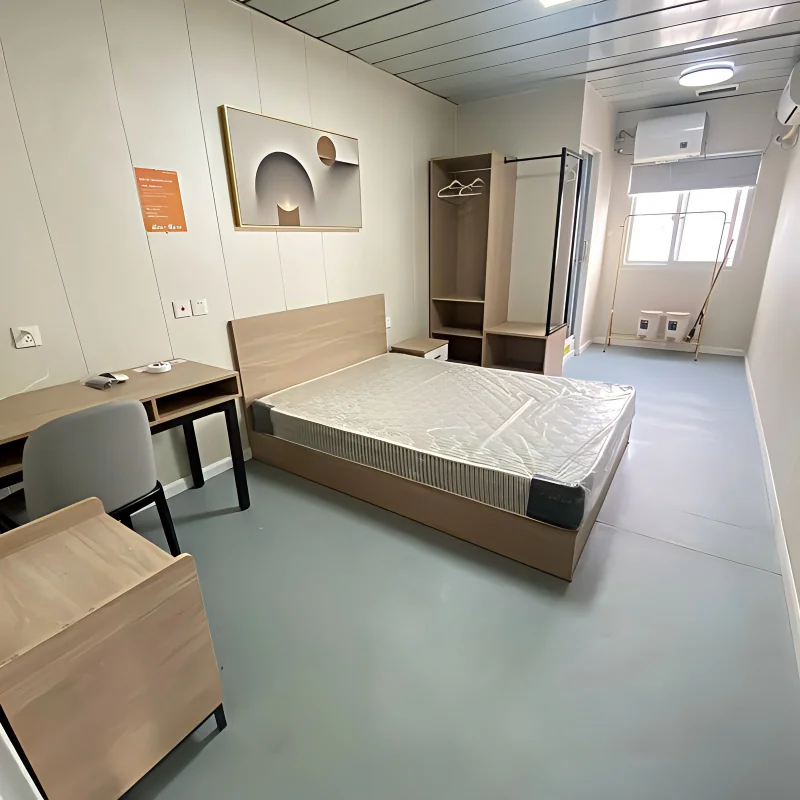
Prefabricated modular buildings are produced in a factory and assembled on site. This reduces site work and improves quality consistency. Modular buildings can be used for dormitories, offices, dining halls, sanitary units, laundries, clinics, storage, and recreation rooms.
The advantage is that many construction activities are moved from the remote site to the factory. This can reduce weather exposure, labor uncertainty, and site congestion.
Modular construction is especially valuable when:
- The site is remote
- Local construction labor is limited
- Schedule control is important
- Standardized room types are acceptable
- The project requires repeated units
- Future expansion is expected
3.4 Container-based accommodation
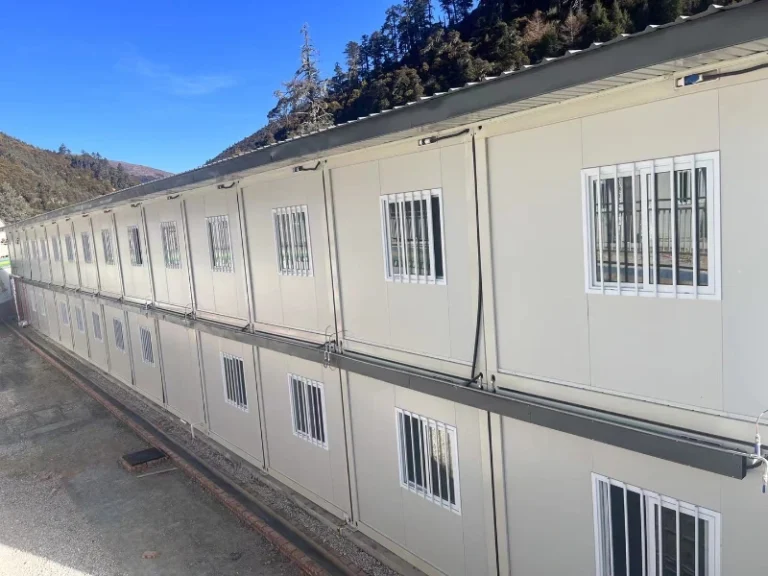
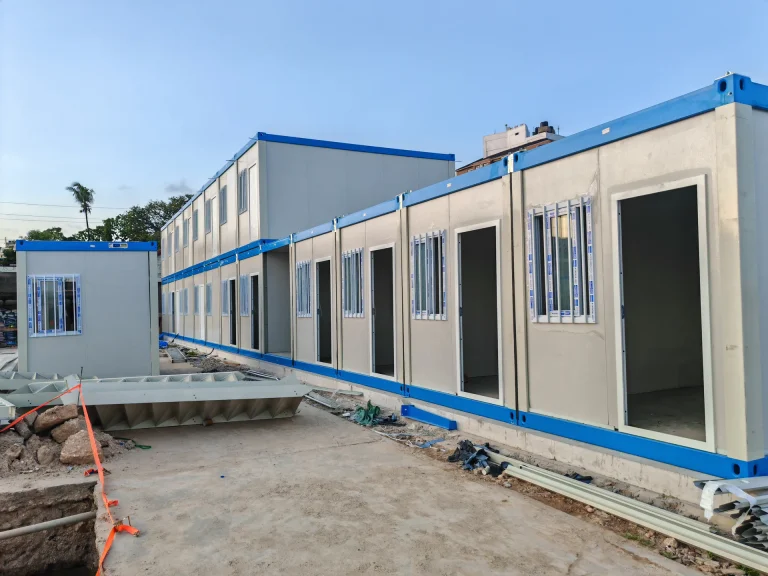
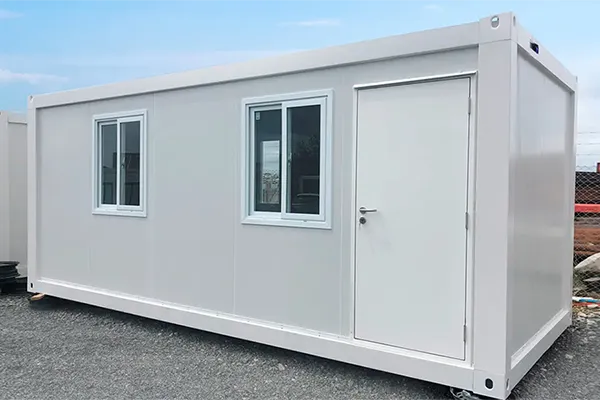
Container-based accommodation uses steel-frame modular units that can be transported, assembled, connected, stacked in some configurations, and arranged into larger camp layouts.
It is widely used for:
- Mining camps
- Construction camps
- Oil and gas camps
- Remote offices
- Temporary project bases
- Emergency accommodation
- Infrastructure projects
- Military and disaster-relief support
The main advantage is repeatability. Container accommodation can be designed by module, shipped predictably, installed faster than traditional construction, and expanded in phases.
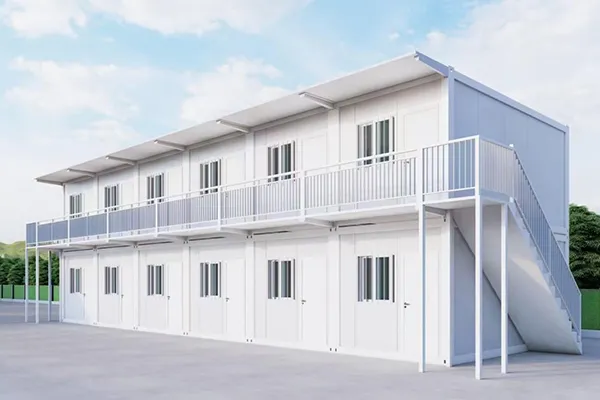
3.5 Flat pack container accommodation
Flat pack container accommodation is designed to be packed flat during transport and assembled on site. This makes it highly suitable for projects where shipping efficiency matters.
For large mining camps, transport volume can strongly influence total cost. A flat pack system allows more units to be delivered in a smaller shipping volume compared with fully assembled units. It also supports phased delivery, which is useful when the workforce grows over time.
Flat pack container accommodation is usually suitable for:
- Large worker dormitories
- Remote office blocks
- Construction-phase camps
- Mining contractor camps
- Engineering project bases
- Multi-phase camp expansion
- Export projects requiring containerized shipping
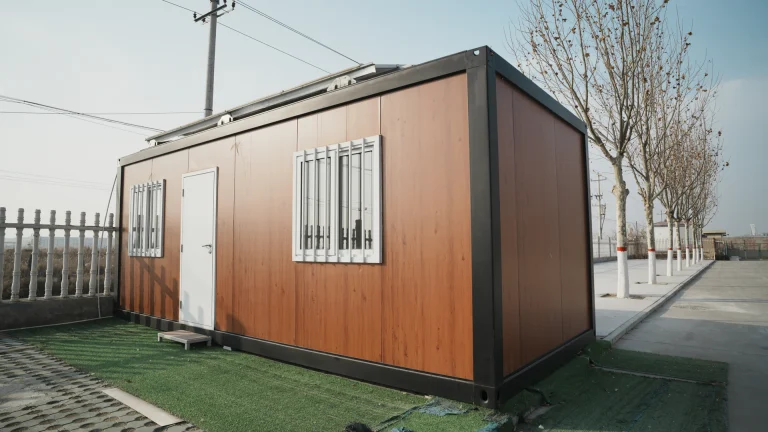
3.6 Detachable container houses
Detachable container houses are suitable for semi-permanent camps and longer project cycles. They can be disassembled, transported, reassembled, and reused. Compared with light temporary units, they can provide better durability and a stronger long-term use profile.
They are suitable for:
- Long-term mining operation bases
- Engineering camps
- Staff accommodation
- Office buildings
- Dining halls
- Sanitary facilities
- Service buildings
For projects that require several years of use, detachable container houses may provide better lifecycle value than the cheapest temporary options.
3.7 Expandable container houses
Expandable container houses are useful when the project needs space quickly. They can create a larger internal area after deployment and are often used for site offices, small accommodation units, management rooms, first-aid rooms, or temporary camp support.
They are not always the best choice for very large accommodation blocks, but they can be effective for early-stage deployment or small remote teams.
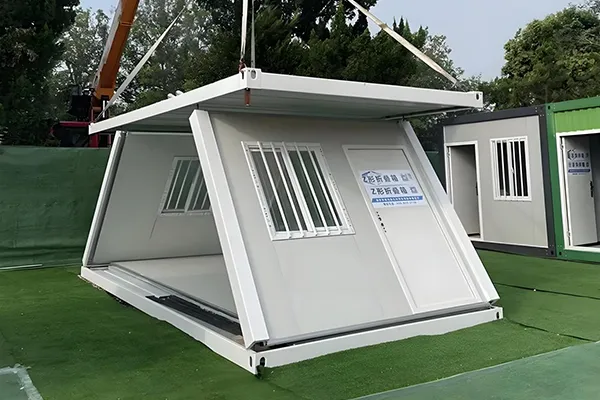
3.8 Folding container houses
Folding container houses are often selected for speed. They can be deployed quickly and used for temporary accommodation, emergency housing, temporary offices, security rooms, or short-term project support.
For mining projects, folding units are useful when immediate occupancy matters more than long-term comfort or large-scale layout efficiency.
4. Comparison Table: Which Mining Accommodation Type Fits Your Project?
| Accommodation Type | Best For | Deployment Speed | Transport Efficiency | Durability | Expansion Flexibility | Relocation Potential | Cost Logic |
|---|---|---|---|---|---|---|---|
| Traditional On-Site Construction | Permanent mining towns, long-life fixed facilities | Low | Low | High | Medium | Low | High upfront cost, long construction cycle, suitable for permanent use |
| Tents / Light Shelters | Exploration, emergency, short-term field teams | Very High | High | Low | Medium | High | Low initial cost, but weak lifecycle value for long-term camps |
| Prefab Modular Buildings | Medium to large camps, offices, service buildings | High | Medium | Medium to High | High | Medium | Good schedule control, suitable for standardized facilities |
| Flat Pack Container Accommodation | Large workforce camps, export projects, phased camps | High | High | Medium to High | High | High | Strong balance of shipping efficiency, installation speed, and scalability |
| Detachable Container House | Semi-permanent camps, long-term mining bases | Medium to High | Medium to High | High | High | High | Better lifecycle value for longer project duration |
| Expandable Container House | Small camps, remote offices, early-stage projects | Very High | Medium | Medium | Medium | High | Fast usable space, suitable for small or urgent deployment |
| Folding Container House | Emergency use, temporary support, quick site setup | Very High | High | Medium | Medium | High | Very fast deployment, better for short-term or supplementary use |
This comparison shows why there is no single best product for every mining project. The most economical solution depends on how the camp will be used.
For a small exploration camp, folding or expandable units may be the most practical. For a large construction-phase mining camp, flat pack container accommodation usually offers a stronger balance of cost, speed, and transport efficiency. For a long-term mining operation base, detachable or reinforced modular container buildings may provide better lifecycle value.
5. Which Mining Accommodation Is the Most Cost-Effective?
The most cost-effective mining accommodation is the solution that creates the lowest total project cost while still meeting site requirements. It should reduce deployment time, transport burden, installation complexity, maintenance cost, and future expansion risk.
5.1 For large workforce camps, flat pack container accommodation is usually more efficient
Large mining and engineering camps often require dozens, hundreds, or even thousands of beds. In this case, transport efficiency and repeatable installation become critical.
Flat pack container accommodation is often more economical because it can be shipped more efficiently than fully assembled units. This matters especially for overseas projects, remote inland sites, island mining projects, and areas with limited local building resources.
The economic logic is simple:
- More compact shipping reduces freight pressure.
- Standardized modules reduce installation uncertainty.
- Repeated room types simplify procurement.
- Modular layouts make future expansion easier.
- Factory production reduces site construction work.
- Components can be replaced more easily during maintenance.
For large workforce camps, the accommodation system must be planned as a repeatable product platform, not as a collection of separate rooms.
5.2 For long-term camps, detachable container buildings may provide better lifecycle value
If a mining camp will operate for several years, durability and maintenance become more important. A cheaper temporary unit may save money at the beginning but generate higher costs later through repairs, replacements, energy loss, or worker dissatisfaction.
Detachable container houses are useful for semi-permanent mining bases because they provide stronger structure, better long-term usability, and future relocation potential.
For long-term use, the buyer should evaluate:
- Structural frame quality
- Wall panel thickness and insulation
- Roof drainage
- Door and window quality
- Anti-corrosion protection
- Bathroom waterproofing
- Electrical safety
- Floor durability
- Ease of disassembly
- Availability of replacement parts
A durable accommodation system is especially important where climate conditions are harsh or maintenance access is difficult.
5.3 For early-stage projects, expandable or folding units may reduce mobilization pressure
During exploration or early construction, the project may not need a complete camp immediately. It may only need a small number of rooms, temporary offices, guard rooms, first-aid rooms, and basic sanitary facilities.
Expandable and folding container houses can help the project team create usable space quickly. They are practical when speed matters more than large-scale efficiency.
However, they should be used carefully in large projects. A fast temporary solution may not be the best long-term camp system. For this reason, many project owners use expandable or folding units for the first phase and later add flat pack or detachable container buildings when workforce scale increases.
5.4 The lowest unit price can create a higher project cost
Mining accommodation should not be selected only through unit price comparison. The lowest-priced unit may create higher total cost if it has problems such as:
- Poor insulation and high energy consumption
- Weak roof waterproofing
- Low wind resistance
- Short service life
- Poor bathroom sealing
- Complicated installation process
- Non-standard spare parts
- Low shipping efficiency
- Poor compatibility with future expansion
- Uncomfortable room design
- High maintenance frequency
A mining camp is used every day. Small defects become repeated operational problems. A cost-effective solution must be evaluated from procurement to transport, installation, use, maintenance, and relocation.
6. Key Factors to Consider Before Choosing Mining Accommodation
A professional mining accommodation decision should start from the project condition, not from the product catalog.
6.1 Project duration
Project duration determines how much durability and comfort are needed.
For a short exploration camp, the main priority is fast deployment. For a construction-phase camp, the priority is batch accommodation and quick installation. For a long-term mining operation base, durability, maintenance, insulation, and living quality become more important.
A common mistake is using a short-term product for a long-term project. This may reduce initial cost, but it often increases maintenance and replacement cost later.
6.2 Workforce size and camp phasing
Mining workforce size usually changes by project phase. A site may start with a small exploration team, grow quickly during construction, then stabilize during operation.
The accommodation plan should match this workforce curve.
Important questions include:
- How many workers will stay on site during each phase?
- How many engineers and managers need separate rooms?
- Will workers stay in single rooms, double rooms, or shared dormitories?
- Will the camp need separate areas for contractors and management teams?
- Will the workforce increase later?
- Can new accommodation blocks be added without disrupting existing operations?
A scalable accommodation system allows the project to avoid overbuilding at the beginning while still preparing for future growth.
6.3 Transport route and logistics restrictions
Transport can be one of the largest hidden costs in remote mining accommodation.
Before choosing a product, the project team should understand:
- Nearest port
- Inland distance
- Road width
- Bridge load limits
- Mountain or desert access
- Rainy-season restrictions
- Crane availability
- Local customs process
- Container unloading conditions
- Final-mile delivery challenges
Flat pack container accommodation is often attractive because it improves transport efficiency. For sites with difficult logistics, fewer shipments and easier handling can make a major difference.
6.4 Climate and environmental exposure
Mining accommodation must be designed for the local environment.
In hot climates, insulation and ventilation reduce air-conditioning load. In cold regions, wall and roof insulation protect comfort and reduce heating energy. In coastal or humid areas, anti-corrosion protection and waterproofing are important. In high-wind areas, the structure and anchoring method must be carefully considered.
Technical specifications should not be copied from one country to another without review. A camp used in a mild inland climate may not be suitable for a tropical island, desert mine, or snow region.
6.5 Installation method and local labor availability
A good remote camp solution should reduce dependence on complex site work.
If local labor is limited, the accommodation system should use standardized components, clear installation drawings, repeatable connection details, and practical assembly steps. The easier the system is to install, the lower the risk of delay.
This is one of the main advantages of prefab and modular container buildings. More work is completed in the factory, while the site team focuses on assembly, connection, and layout completion.
6.6 Sanitation and worker welfare standards
Worker accommodation is not only a building issue. It also involves health, safety, hygiene, management, and welfare. International guidance from IFC and EBRD emphasizes that employer-provided worker accommodation should consider the planning, construction, and management of accommodation facilities, including living conditions and appropriate standards.
For mining camps, this means the project should plan:
- Adequate room space
- Sufficient toilets and showers
- Clean water supply
- Wastewater treatment
- Proper ventilation
- Fire safety
- Safe electrical systems
- Regular cleaning
- Waste management
- Medical support
- Food service
- Security
- Recreation space where appropriate
These standards help reduce health risk and improve workforce stability.
6.7 Remote office requirements
Remote offices should be planned together with accommodation. A mining camp without a proper office area may struggle with project coordination.
A remote office may include:
- Site manager office
- Engineering office
- Meeting room
- Document control room
- Safety office
- Contractor coordination room
- First-aid room
- IT and communication room
- Visitor reception room
- Security control room
Office units should be close enough to the work area for management efficiency, but separated from noisy or high-risk zones. They should also have reliable power, lighting, air conditioning, internet, and emergency access.
6.8 Maintenance and spare parts
Remote camps must be easy to maintain. When a door, window, wall panel, floor board, bathroom fitting, or electrical component fails, replacement should be practical.
Standardized container accommodation helps because parts can be planned and stocked more easily. For large camps, it is useful to keep a small spare-parts inventory on site.
Maintenance planning should include:
- Door and window hardware
- Electrical fittings
- Plumbing parts
- Bathroom accessories
- Wall and ceiling panels
- Flooring materials
- HVAC components
- Sealants and waterproofing materials
A camp that is difficult to repair can become expensive even if the initial cost is low.
7. Large Engineering Camps Need More Than Accommodation
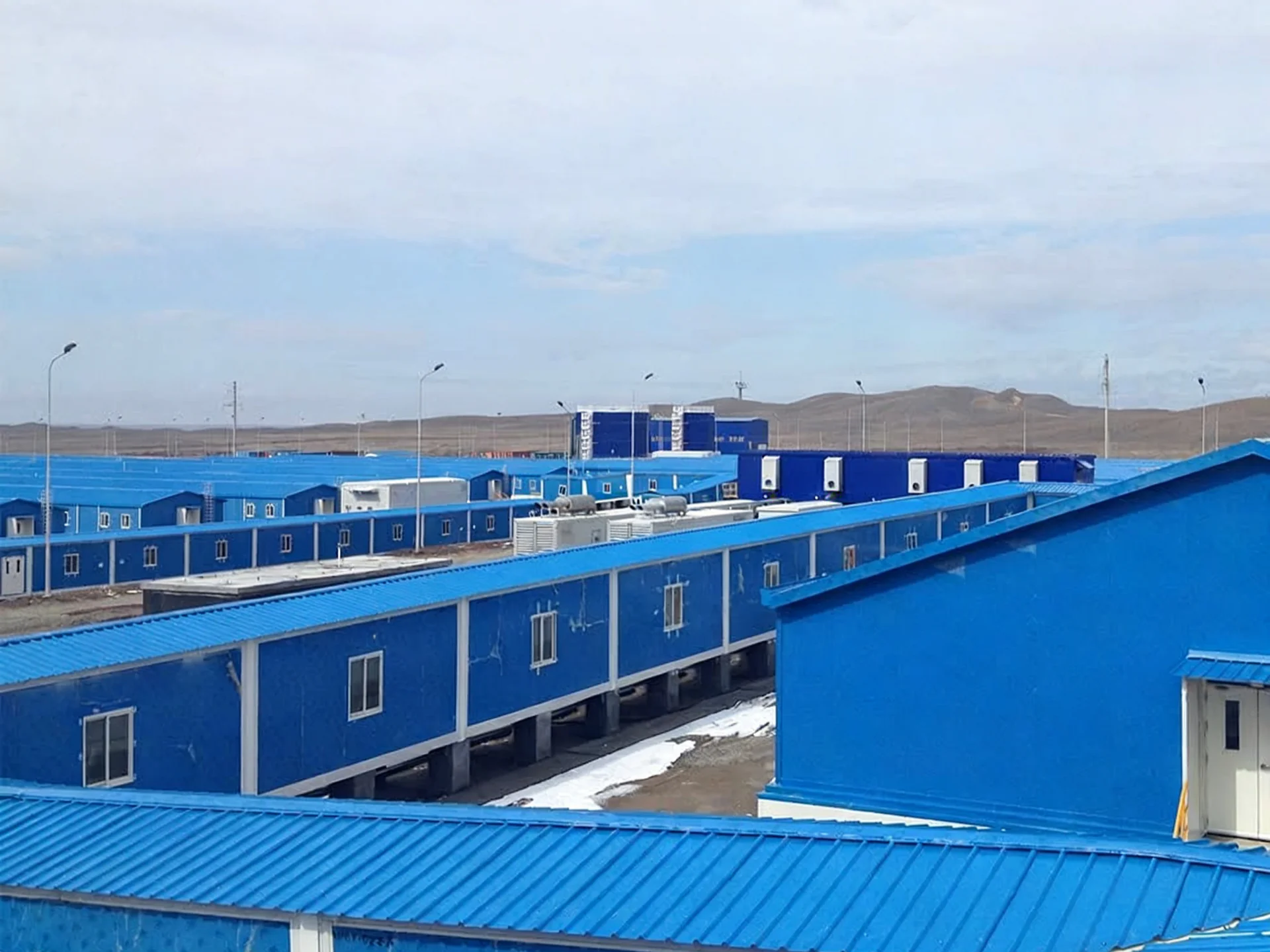
For large engineering camp projects, the accommodation area is only one part of the project base. Mining, road, railway, port, power plant, oil and gas, and infrastructure projects often require an integrated temporary city that can support hundreds or thousands of people.
This type of camp should not be planned as “rooms plus toilets.” It should be planned as a complete operating system.
7.1 A large engineering camp is a temporary project headquarters
In a large project, the camp becomes the physical center for workforce management, contractor coordination, safety control, documentation, food service, maintenance, and daily logistics.
A complete large engineering camp may include:
- Worker accommodation
- Supervisor accommodation
- Engineer accommodation
- Remote offices
- Meeting rooms
- Safety training rooms
- Dining halls
- Central kitchens
- Bathrooms and shower blocks
- Laundry rooms
- Warehouses
- Maintenance rooms
- First-aid rooms or clinics
- Security offices
- Recreation rooms
- Prayer rooms, depending on local requirements
- Generator areas
- Water treatment systems
- Sewage treatment systems
- Waste collection areas
- Parking and vehicle routes
- Emergency assembly points
The economic value of a large camp comes from coordination. If each facility is purchased separately without an integrated plan, the project may face layout conflicts, insufficient capacity, repeated changes, and unnecessary installation work.
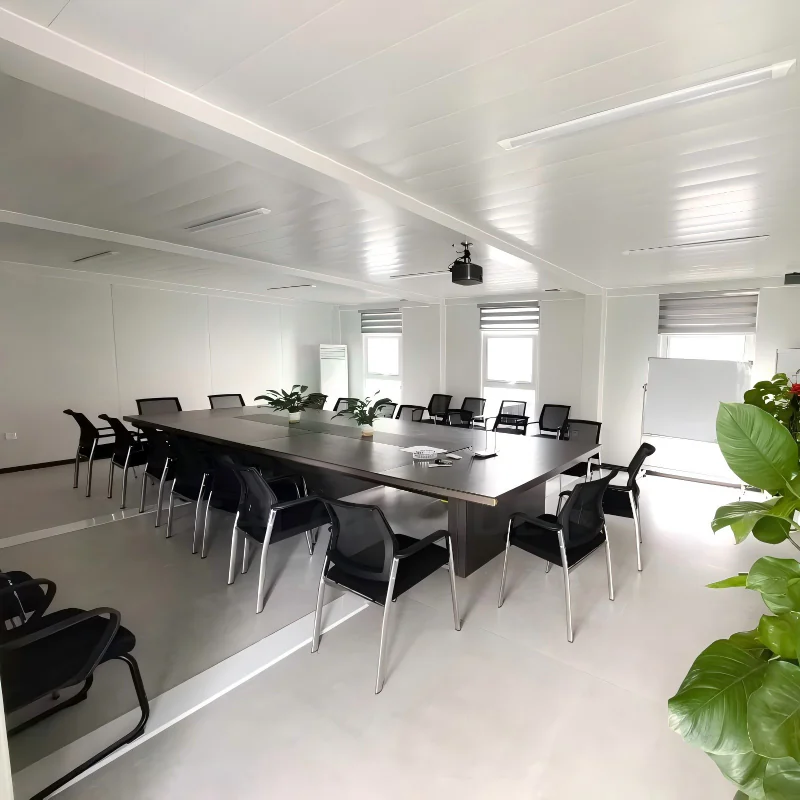
7.2 Accommodation and remote office should be planned together
In many project bases, accommodation and office buildings are treated as separate procurement packages. This can create problems later.
For example, if the remote office is too far from the accommodation area, managers lose time moving between zones. If the office is too close to dormitories, noise and visitor movement may affect rest. If the office does not have enough meeting rooms, contractor coordination becomes inefficient. If the document control room has poor power or internet, project management slows down.
A better approach is to plan the camp by functional zones:
- Living zone
- Office and management zone
- Dining and service zone
- Sanitary zone
- Storage and maintenance zone
- Utility zone
- Vehicle circulation zone
- Emergency and safety zone
This zoning method helps the project team control movement, reduce interference, and improve daily efficiency.
7.3 Camp capacity should match workforce peaks, not only average numbers
Large engineering projects often have fluctuating workforce numbers. During peak construction, the number of workers may be much higher than during early preparation or later operation.
If the camp is planned only for the average workforce, it may become overloaded during peak periods. Overloaded camps create problems such as:
- Crowded rooms
- Long bathroom waiting times
- Insufficient dining capacity
- Laundry delays
- Poor sanitation
- Higher maintenance pressure
- Worker dissatisfaction
- Safety management difficulty
The camp should be planned with a phase-based capacity model. Essential facilities can be built in the first phase, while expansion areas are reserved for later workforce growth.
7.4 Modular camp planning supports phased investment
For large engineering camps, modular container buildings allow project owners to control investment by phase.
A typical phased plan may look like this:
Phase 1: Early mobilization
Remote office, management accommodation, security room, basic worker rooms, bathrooms, and temporary dining area.
Phase 2: Construction peak
Additional dormitories, larger dining hall, kitchen, laundry, storage, first-aid room, and more sanitary units.
Phase 3: Long-term operation
Reduced worker accommodation, upgraded staff rooms, permanent office, recreation space, and maintenance-friendly service buildings.
Phase 4: Relocation or reuse
Some container buildings are dismantled and moved to another site, while others remain for operation support.
This approach reduces the risk of overbuilding too early while still allowing fast expansion when the project needs it.
7.5 The most economical large camp is the one with fewer operational conflicts
For large camps, cost-effectiveness comes from more than product selection. It comes from reducing operational conflicts.
A well-planned camp can reduce:
- Walking distance
- Food service congestion
- Bathroom bottlenecks
- Utility conflicts
- Vehicle and pedestrian crossing risk
- Noise disturbance
- Maintenance interruption
- Future relocation work
- Repeated layout changes
This is why large engineering camp planning should begin before final procurement. Once the site plan is clear, product selection becomes more accurate.
8. Remote Office Planning for Mining and Engineering Sites
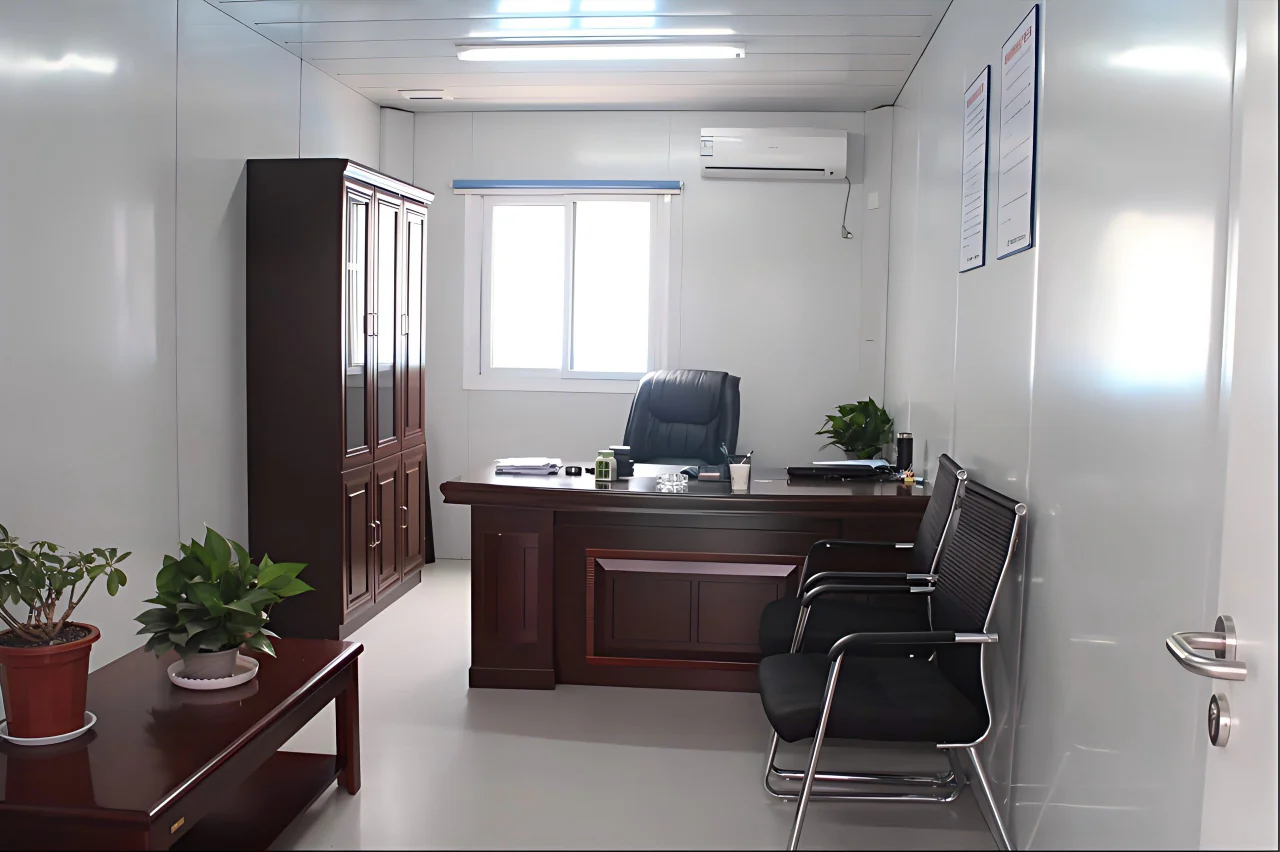
Remote offices are critical for project execution. They provide the workspace for the teams who control schedule, safety, procurement, engineering, contractor coordination, and documentation.
8.1 Remote office functions
A mining remote office may include:
- Site management office
- Engineering office
- HSE office
- Meeting room
- Document control room
- Contractor coordination room
- Procurement office
- First-aid room
- Communication room
- Visitor reception
- Security room
The office should be designed according to work functions, not only square meters. A small but well-organized office can support daily management better than a larger but poorly planned building.
8.2 Location of remote office in the camp
The office should usually be placed between the living area and the work access route, while still maintaining separation from sleeping zones. It should be easy for managers and contractors to reach but should not create unnecessary traffic through worker accommodation areas.
The office zone should consider:
- Vehicle access
- Visitor control
- Meeting room access
- Emergency access
- Internet and power stability
- Noise control
- Proximity to safety training areas
- Separation from high-risk utility zones
8.3 Container office advantages
Container office buildings are suitable for mining and engineering sites because they can be deployed quickly, expanded easily, and relocated when the project changes.
Common options include:
- Single container office
- Combined modular office
- Two-story office block
- Office and meeting room combination
- Office with sanitary unit
- Office with accommodation unit
For early-stage projects, expandable container offices can be useful. For larger sites, flat pack or detachable modular office buildings are usually better for structured office layouts.
9. How to Plan a Mining Accommodation Camp Layout
A good camp layout improves safety, comfort, and operating efficiency.

9.1 Separate living, working, dining, and service zones
Living areas should be protected from heavy vehicle routes, generator noise, fuel storage, waste handling, and high-risk work areas. Office zones should be convenient for management but not disruptive to worker rest. Dining halls should be easy to access but located where food delivery, waste removal, and crowd flow can be managed.
Basic zoning should include:
- Accommodation zone
- Office zone
- Dining and kitchen zone
- Sanitary and laundry zone
- Storage zone
- Utility zone
- Security entrance
- Parking and vehicle circulation
- Emergency assembly area
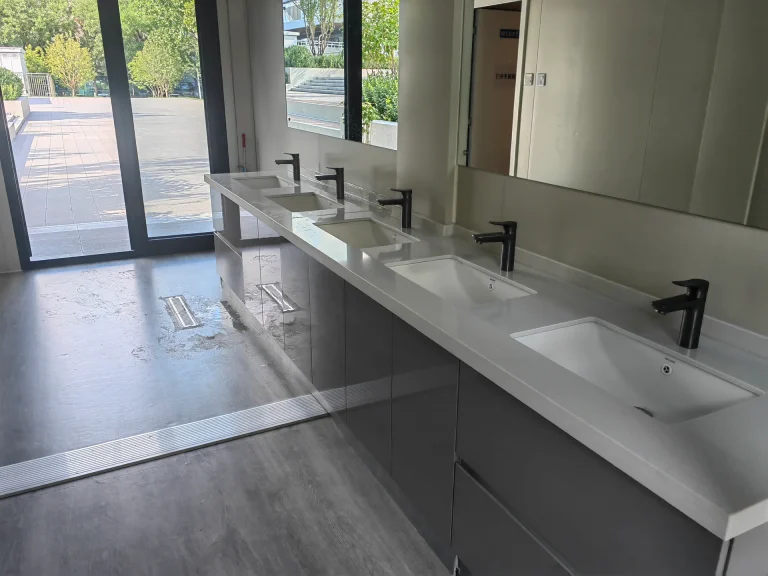
9.2 Plan bathroom and shower capacity carefully
Bathrooms are often underestimated. In shift-based projects, many workers may need showers during the same time window. If the camp does not provide enough capacity, daily routines become inefficient.
Bathroom planning should consider:
- Number of workers
- Shift schedule
- Male/female ratio where applicable
- Distance from dormitories
- Hot water supply
- Drainage capacity
- Cleaning access
- Waterproofing
- Ventilation
- Maintenance space
9.3 Reserve expansion space
A camp that has no expansion space can become expensive later. Additional dormitories, offices, dining capacity, or bathrooms may be needed as the project grows.
The site plan should reserve:
- Future accommodation blocks
- Utility expansion
- Additional sanitary units
- Larger dining capacity
- Storage expansion
- Access roads for future installation
Modular buildings are easier to expand, but only if the site layout allows expansion.
9.4 Plan utilities before placing buildings
Utility planning should not come after building placement. Water, power, sewage, drainage, HVAC, lighting, and internet all affect the camp layout.
Important questions include:
- Where will power come from?
- Is backup power required?
- Where will water be stored?
- How will wastewater be treated?
- Where will rainwater drain?
- What is the air-conditioning or heating load?
- How will internet and communication systems be installed?
- Can maintenance teams access utility areas safely?
Good utility planning reduces later modifications.
9.5 Control walking distance and safety routes
Workers should be able to move safely between dormitories, dining halls, offices, bathrooms, and assembly points. Vehicle routes should be separated from pedestrian routes as much as possible.
In large camps, poor walking routes reduce efficiency every day. A few extra minutes per person per day becomes a significant hidden cost when multiplied by hundreds of workers and many months of operation.
10. Recommended Mining Accommodation Solutions by Project Scenario
10.1 Exploration camp or early-stage mining site
Early-stage mining projects usually need fast, simple, and flexible accommodation. The team size is smaller, the project may still be uncertain, and the site infrastructure may be limited.
Recommended options:
- Folding container house
- Expandable container house
- Small container office
- Basic sanitary unit
- Temporary storage unit
The priority is speed and flexibility. The project should avoid heavy investment before the site plan and workforce scale are confirmed.
10.2 Construction-phase mining camp
During construction, workforce size increases quickly. This phase requires efficient dormitory capacity, remote office space, dining facilities, bathrooms, laundry, storage, and site management rooms.
Recommended options:
- Flat pack container accommodation
- Modular worker dormitory blocks
- Flat pack remote office units
- Bathroom and shower modules
- Dining hall and kitchen modules
- Laundry and storage units
Flat pack container accommodation is often the best balance for this phase because it supports batch delivery, fast assembly, and scalable layouts.
10.3 Long-term mining operation base
Once the mine enters stable operation, the camp may need fewer workers but better durability, comfort, and maintenance performance.
Recommended options:
- Detachable container houses
- Reinforced modular accommodation
- Staff accommodation units
- Permanent remote office blocks
- Dining and recreation facilities
- Maintenance-friendly service units
The priority shifts from fastest setup to lifecycle value.
10.4 Remote mining camp with limited transport access
If the site is difficult to reach, logistics efficiency becomes the main decision factor.
Recommended options:
- Flat pack container house
- Compact modular units
- Standardized camp modules
- Lightweight components where appropriate
The goal is to reduce shipping volume, simplify handling, and minimize the number of difficult final-mile deliveries.
10.5 Harsh-weather mining site
For tropical, coastal, desert, high-wind, high-rainfall, or cold-climate sites, accommodation should be selected according to technical performance.
Recommended options:
- Reinforced prefab container accommodation
- Detachable container houses
- Upgraded insulation panels
- Enhanced waterproofing
- Anti-corrosion treatment
- Stronger roof and anchoring design
For harsh climates, the project should not rely on standard low-spec units. Weather resistance directly affects safety, maintenance, and worker comfort.
11. Why Flat Pack Container Accommodation Is Often the Best Balance
Flat pack container accommodation is often the best economic balance for remote mining and engineering camps because it solves several project problems at once.
11.1 It improves shipping efficiency
Shipping cost is a major concern for remote projects. Flat pack units can be packed more efficiently than fully assembled buildings. This helps reduce freight pressure, especially for international projects.
11.2 It reduces site construction work
Factory production reduces the amount of work that must be completed on site. This is valuable because remote sites often face labor shortages, weather interruptions, and limited equipment availability.
11.3 It supports standardized camp design
Flat pack container buildings can be used repeatedly across dormitories, offices, sanitary units, dining halls, and service rooms. This creates a more predictable design and procurement system.
11.4 It allows phased expansion
Mining projects change over time. Flat pack systems allow the project owner to deploy the first phase quickly and add more units later.
11.5 It supports relocation and reuse
When a project phase ends, some container units can be dismantled and reused at another site. This improves asset value for contractors and project owners who manage multiple remote projects.
12. Questions to Ask Before Requesting a Mining Accommodation Quote
Before requesting a quotation, prepare the following information:
- Project country and site location
- Nearest port or delivery point
- Inland transport distance
- Site road condition
- Expected project duration
- Number of workers in each project phase
- Room type requirements
- Management staff accommodation requirements
- Remote office requirements
- Dining and kitchen requirements
- Bathroom and shower requirements
- Laundry and storage requirements
- Climate conditions
- Wind load, snow load, or local building requirements if available
- Power, water, drainage, and sewage conditions
- Expected installation schedule
- Whether future relocation is required
- Whether the camp will be expanded later
- Required fire safety or insulation standards
- Any special local compliance requirements
A professional supplier should not only quote the room price. They should help evaluate which accommodation type fits the site, how the camp can be phased, how transport can be optimized, and how future expansion can be reserved.
13. KUBO Prefab Mining Accommodation and Remote Office Solutions
KUBO Prefab provides modular container building solutions for mining accommodation, remote offices, construction camps, and large engineering project bases.
Our product options include flat pack container houses, detachable container houses, expandable container houses, folding container houses, and modular camp facilities.
13.1 Flat Pack Container House
Flat pack container houses are suitable for large mining camps and remote engineering sites that require efficient transport and fast installation.
Typical applications include:
- Worker accommodation
- Remote office blocks
- Construction camp dormitories
- Project management offices
- Bathroom and shower units
- Dining halls
- Storage rooms
- Security rooms
This option is especially practical for projects that need batch deployment and future expansion.
13.2 Detachable Container House
Detachable container houses are suitable for semi-permanent mining bases and long-term project camps.
Typical applications include:
- Long-term worker accommodation
- Staff housing
- Engineer accommodation
- Site offices
- Dining facilities
- Service buildings
- Operation support rooms
This option is suitable when durability, reuse, and long service life are important.
13.3 Expandable Container House
Expandable container houses are suitable for fast space creation.
Typical applications include:
- Temporary remote offices
- Small accommodation units
- Management rooms
- First-aid rooms
- Early-stage project support
- Visitor reception rooms
This option is useful when the site needs usable indoor space quickly.
13.4 Folding Container House
Folding container houses are suitable for emergency deployment, short-term use, and temporary project support.
Typical applications include:
- Temporary accommodation
- Guard rooms
- Emergency housing
- Short-term field offices
- Supplementary camp space
This option is practical when speed is the primary requirement.
13.5 Complete camp layout support
KUBO Prefab can support more than individual container units. We can help plan camp layouts based on workforce size, project phase, climate conditions, transport route, and required facilities.
A complete project camp may include:
- Worker accommodation
- Supervisor accommodation
- Remote office
- Meeting room
- Dining hall
- Kitchen
- Bathroom and shower units
- Laundry room
- Storage room
- First-aid room
- Security room
- Recreation room
- Utility support area
By choosing the right modular system from the beginning, mining and engineering project teams can reduce installation complexity, control total cost, and deploy the project base faster.
Conclusion: Choose Mining Accommodation by Total Project Efficiency
The most cost-effective mining accommodation is not the unit with the lowest purchase price. It is the solution that helps the project become operational faster while reducing transport cost, installation risk, maintenance burden, and future expansion difficulty.
For exploration camps, folding and expandable units can provide fast temporary space. For construction-phase mining camps, flat pack container accommodation often offers the best balance of shipping efficiency, installation speed, and scalability. For long-term mining operation bases, detachable and reinforced modular container buildings may deliver better lifecycle value.
For large engineering camps, accommodation and remote offices should be planned together as a complete project base. Dormitories, offices, dining areas, sanitary units, storage, utilities, and safety routes all affect the efficiency of the site.
If you are planning a mining camp, construction camp, remote office, or large workforce accommodation project, KUBO Prefab can help you compare suitable modular container solutions based on your site location, workforce size, climate conditions, required facilities, and deployment schedule.
Contact KUBO Prefab to get a customized mining accommodation and remote office solution for your project site.
FAQ
1. What is mining accommodation?
Mining accommodation refers to housing and living facilities used by workers, engineers, supervisors, contractors, and support teams at mining project sites. It may include dormitories, staff rooms, bathrooms, dining halls, kitchens, laundry rooms, remote offices, first-aid rooms, storage rooms, and other camp facilities.
2. What is the fastest way to build accommodation for a mining site?
For most remote project sites, prefab and modular container buildings are faster than traditional construction. Folding and expandable container houses can be used for very fast temporary deployment, while flat pack container accommodation is often better for larger camps that require batch delivery and scalable layouts.
3. Which type of mining accommodation is the most cost-effective?
The most cost-effective option depends on project duration, workforce size, transport distance, climate conditions, and future expansion needs. For large workforce camps, flat pack container accommodation is often a strong balance of cost, speed, and transport efficiency. For long-term camps, detachable container houses may offer better lifecycle value.
4. Is flat pack container accommodation suitable for large mining camps?
Yes. Flat pack container accommodation is suitable for large mining camps because it supports efficient shipping, standardized installation, phased expansion, and flexible camp layouts. It can be used for dormitories, remote offices, bathrooms, dining halls, and other support facilities.
5. What should be included in a mining camp besides bedrooms?
A complete mining camp may include remote offices, meeting rooms, dining halls, kitchens, bathrooms, showers, laundries, storage rooms, first-aid rooms, security rooms, recreation rooms, generator areas, water treatment systems, sewage systems, parking areas, and emergency assembly points.
6. How should remote offices be planned in a mining camp?
Remote offices should be planned as part of the camp layout. They should be close enough to the work area for management efficiency, but separated from sleeping areas, noisy zones, and high-risk utility areas. Office units should include stable power, lighting, air conditioning, internet, meeting space, and emergency access.
7. Can modular mining accommodation be relocated?
Many modular container accommodation systems can be dismantled, transported, and reused at another project site. Flat pack and detachable container buildings are especially useful for contractors and project owners who manage multiple remote projects.
8. What information is needed to request a mining accommodation quote?
The supplier usually needs the project location, workforce size, project duration, required room types, remote office needs, camp facilities, climate conditions, nearest port, road access, expected installation schedule, and whether future expansion or relocation is required.
9. Why should mining accommodation be planned early?
Accommodation affects workforce mobilization, construction schedule, site management, worker welfare, and camp operations. If accommodation is planned too late, the project may face delayed occupancy, higher temporary housing cost, poor layout efficiency, and future expansion problems.
10. Does KUBO Prefab provide complete camp layout support?
Yes. KUBO Prefab can support modular camp planning based on workforce size, project phase, site location, transport route, climate conditions, and required facilities. Solutions can include worker accommodation, remote offices, dining facilities, sanitary units, laundry rooms, storage rooms, and other project camp buildings.
Sources
- World Bank — Climate-Smart Mining: Minerals for Climate Action
Used for the global critical minerals demand background, including the estimate that production of minerals such as graphite, lithium, and cobalt could increase by nearly 500% by 2050 and that more than 3 billion tons of minerals and metals may be needed for clean energy technologies. - World Bank Group — Minerals for Climate Action: The Mineral Intensity of the Clean Energy Transition
Used for broader context on mineral demand growth driven by wind, solar, geothermal power, and energy storage. - International Energy Agency — Global Critical Minerals Outlook 2025
Used for the broader industry context around critical minerals including copper, lithium, nickel, cobalt, graphite, and rare earth elements. - McKinsey & Company — The capex crystal ball: Beating the odds in mining project delivery
Used for context on mining project cost overruns and schedule challenges. - McKinsey & Company — Making modular construction fit
Used for modular construction benefits, including potential project timeline reduction and cost savings under suitable conditions. - IFC and EBRD — Workers’ Accommodation: Processes and Standards
Used for worker accommodation planning, construction, management, living conditions, health, safety, and welfare considerations. - Millennium Challenge Corporation — Guidance on Accommodation and Welfare for Staff and Labor
Used as supplementary guidance for accommodation and welfare facilities provided to contractor or employer personnel.