

Summary
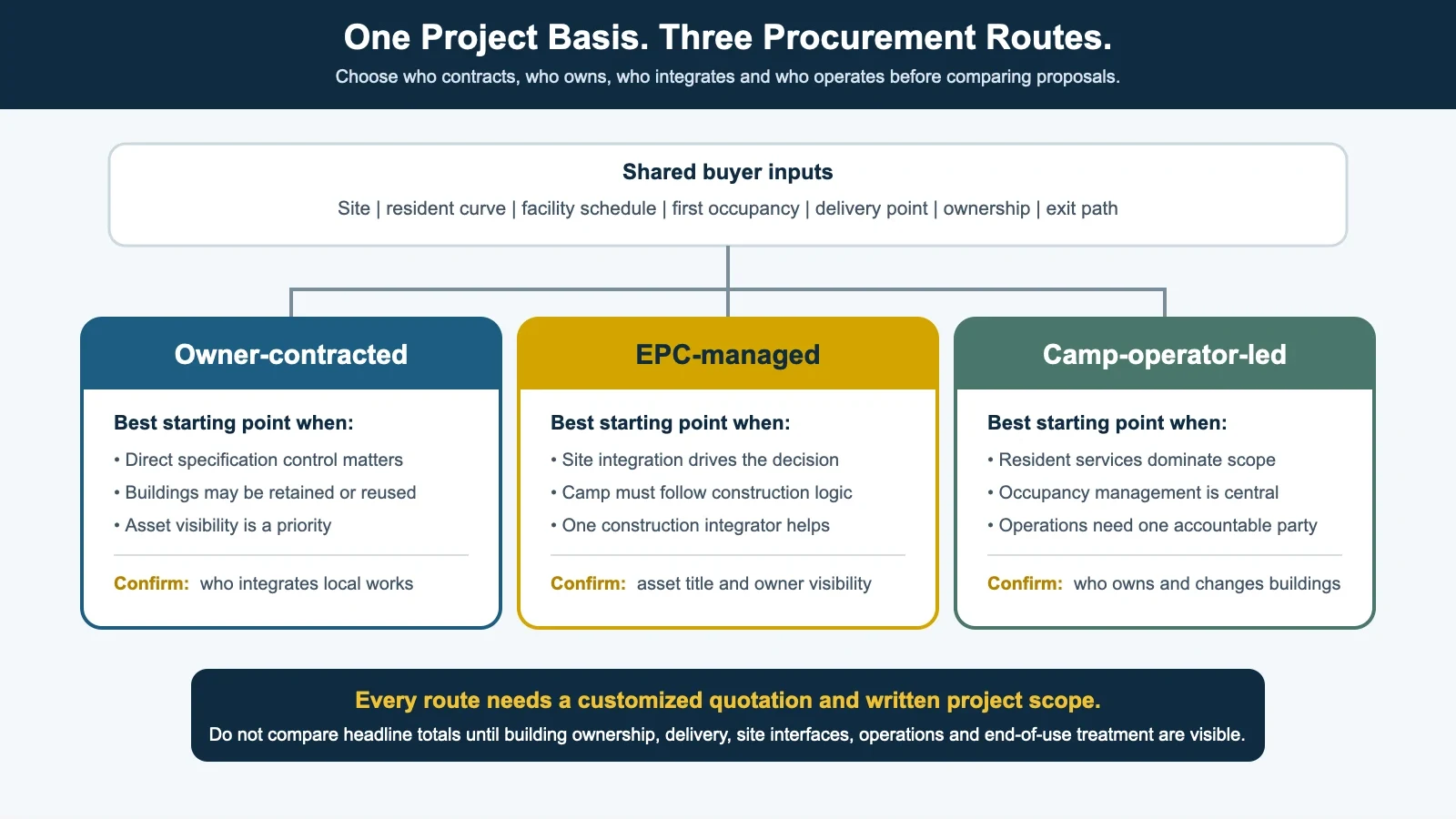
The right renewable energy camp procurement model depends less on the label attached to the buyer and more on four decisions: who should own the modular buildings, who must integrate them with site works and utilities, who will operate resident services, and what should happen to the assets after peak construction. Owner-contracted procurement gives the project owner the strongest direct control over specifications and future asset use. EPC-managed procurement can place camp delivery inside a broader construction-integration structure. Camp-operator-led procurement can suit projects where accommodation operations and resident services are central. Before requesting quotations, use the same workforce, facility, ownership, delivery and exit assumptions for all three routes so the proposals remain commercially comparable.
Choose the Procurement Model Before You Compare Camp Suppliers
A renewable-energy project can define its bedroom count, dining capacity and sanitary requirements accurately and still issue a weak camp RFQ if the contracting model remains unresolved. The missing question is not simply, “Who can supply the buildings?” It is, “Which party should contract the camp building package, hold or control the assets, integrate destination-side work, manage changes and deal with the buildings after peak construction?”
That question should be answered during procurement strategy, before customized requests are sent to manufacturers, EPC subcontractors or camp operators. Otherwise, one proposal may price a modular building asset, another may wrap the same facility into a broader EPC package, and a third may combine buildings with operating services. The totals may look comparable while representing different assets, risks and obligations.
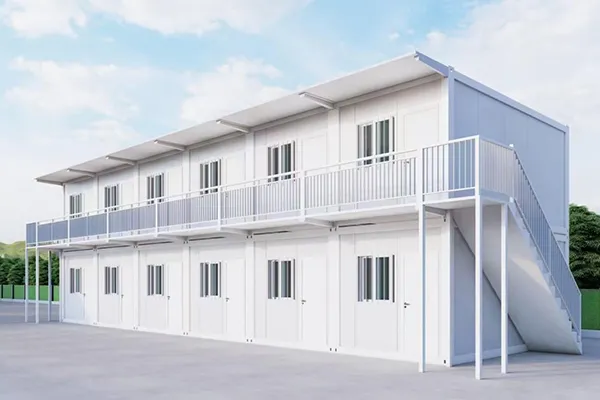
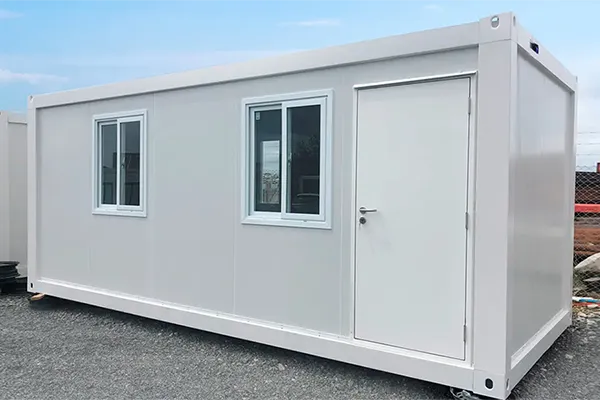
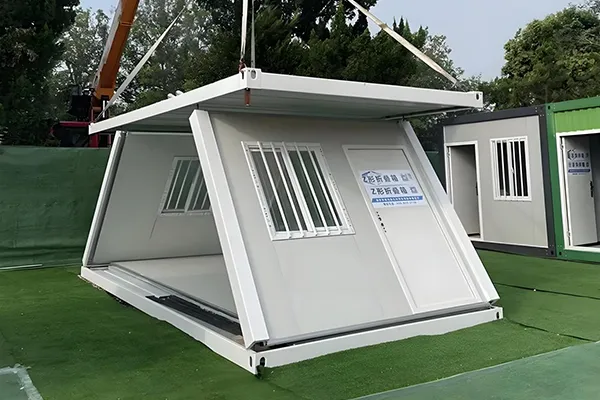
KUBO can configure modular building packages for renewable-energy projects around accommodation, project-control and office space, dining, kitchen and welfare functions, sanitary buildings, storage, workshops and selected supporting facilities. The relevant combination is project-specific rather than a fixed camp package. Factory production, export preparation and project coordination can be discussed against the agreed building scope, while destination interfaces are defined in the quotation and contract for the individual project.
The purpose of this decision is therefore not to identify one universally superior procurement route. It is to select the route that makes ownership, integration, operation and eventual exit easiest to control for your particular project.
What the Three Routes Actually Change
The same renewable-energy construction camp can be procured through very different commercial structures. The building layout may appear similar, but the project exposure is not.
Owner-contracted camp supply
Under an owner-contracted route, the project owner or developer directly contracts the modular building package, while local installation, civil works, utilities, approvals or camp operations may be placed under other contracts or coordinated through an appointed integrator.
This structure is useful when the owner wants strong visibility over room standards, building specifications, documentation and asset disposition. It can also make sense when the owner expects the buildings to remain useful after the construction peak, whether through continued project use, redeployment, storage, resale or another defined exit route.
The trade-off is interface management. Direct ownership does not remove the need to coordinate foundations, access, unloading, utilities, local engineering, installation sequencing and camp services. If those interfaces sit across several contractors, the owner needs clear handover points and an integration mechanism.
EPC-managed camp procurement
In an EPC managed camp procurement route, the EPC contractor controls or manages the camp building package as part of the wider construction delivery strategy. This can align building delivery with civil works, temporary facilities, utilities, access roads, construction sequencing and workforce mobilization.
The model can reduce the number of interfaces the owner has to manage directly, but the owner should still retain visibility into the technical and commercial basis of the camp. Specifications, title to the buildings, variation rules, handover documentation and end-of-project treatment should not disappear inside a high-level EPC scope description.
A project that expects the camp to remain in service after the EPC construction phase has a particular reason to clarify ownership. The contracting party and the party that ultimately owns the modules are not automatically the same.
Camp-operator-led procurement
A camp operator workforce accommodation route places the operating model at the center of the procurement strategy. The operator may be responsible for some combination of accommodation management, meals, cleaning, security, reception, resident services and other operating functions defined by contract.
That does not automatically mean the operator owns the modular buildings, nor does it mean the commercial structure is necessarily rental-based. The project contract must state whether the operator, owner or EPC holds title to the modules and whether the building package is purchased separately, incorporated into an operating-service arrangement or structured as a project-specific hybrid.
This distinction becomes important when the workforce changes quickly. An operator may be well positioned to manage occupancy and service adjustments, but the project still needs an agreed mechanism for physical building additions, removals, configuration changes and final asset disposition.
Lifecycle Comparison: Owner, EPC or Camp Operator?
The most useful comparison places the three routes on the same lifecycle basis. The table below is a decision framework rather than a standard contract allocation. Actual responsibilities must be written into the project-specific procurement documents.
| Decision Area | Owner-Contracted | EPC-Managed | Camp-Operator-Led |
|---|---|---|---|
| Primary contracting structure | Owner directly contracts the camp building package and coordinates or appoints parties for other interfaces. | EPC manages or subcontracts the camp package within the wider project delivery structure. | Camp operator becomes the principal accommodation counterparty for the agreed operating and/or asset scope. |
| Building ownership | Can provide the clearest path to direct owner asset ownership when the contract is written that way. | Must be explicitly stated. EPC procurement does not by itself determine final asset title. | Must be explicitly stated. Do not assume the operator owns, rents or supplies the buildings under one standard model. |
| Configuration control | Owner can directly control room standards, facility mix and approved changes. | EPC can integrate changes with broader construction requirements and schedule control. | Operator can contribute operational requirements, but physical configuration authority should be documented. |
| Civil works, utilities and site readiness | Owner coordinates these interfaces directly or through a designated integrator. | Often easier to coordinate with the EPC’s overall site-work program when included in EPC scope. | Depends on operator contract; local construction interfaces should not be assumed to be included. |
| Installation integration | Requires a clearly identified site party and agreed handover sequence. | Can be integrated with EPC construction sequencing and site logistics. | Depends on whether the operator also holds installation or local integration scope. |
| Camp operations | Owner appoints operating resources separately or manages the function through another contract. | EPC may manage temporary camp operation or appoint a specialist, depending on project scope. | Operating services can be the central commercial purpose of the contract. |
| Demand growth or decline | Owner directly carries the consequences of owning too many or too few modules unless adjustment options are preplanned. | EPC manages the construction-stage effect within its contract, subject to variation rules and asset terms. | Operating demand may be easier to manage commercially, but building additions and removals still need defined rules. |
| Schedule integration | Depends on how effectively the owner coordinates building manufacture, transport and site readiness. | Can provide stronger alignment with overall project construction sequencing. | Can align opening dates with operational readiness if asset delivery and site interfaces are clearly connected. |
| Local-labor dependency | Visible directly to the owner through separate installation and site contracts. | Can be incorporated into EPC resource planning where included. | Varies substantially according to the operator’s agreed construction and operating scope. |
| Maintenance during use | Owner must define who maintains buildings and systems during the project. | Maintenance responsibility should be tied to the EPC handover and operating phase. | Can be integrated with operating services if expressly included. |
| Post-peak treatment | Owner can plan retention, redeployment, relocation, storage, resale or removal around its asset strategy. | Disposition must be visible before EPC closeout, especially if buildings remain useful after construction. | The contract must establish what happens to operator-controlled or project-owned buildings when services end. |
| Principal interface risk | Fragmentation between building supply, local works, installation and operations. | Loss of owner visibility if technical and asset requirements are buried inside a broad EPC package. | Ambiguity between service obligations and physical asset ownership or modification obligations. |
| Best fit when | The owner values direct specification control, asset visibility and a deliberate post-project reuse strategy. | Construction integration and schedule coordination with the wider EPC program are dominant considerations. | Resident services and ongoing camp operation are central to the procurement strategy. |
This matrix should not be used to force every project into one route. Hybrid structures are possible. For example, an owner may purchase the modular buildings directly while an EPC manages site integration and a specialist operator runs the completed camp. What matters is that each commercial and technical interface has a named owner.
Asset Ownership Should Be Decided Before the Camp RFQ
Asset ownership is often treated as a legal detail to be settled later. In a modular camp, it can change the procurement decision itself.
If the owner intends to retain the accommodation after construction, the building specification may need to support a different post-peak use. A project could move from a large temporary construction workforce to a smaller commissioning or operations team. Some buildings may remain useful while others become surplus. That creates questions about which modules are retained, which can be relocated and who has authority to modify the configuration.
If the EPC controls procurement but the owner expects to retain the buildings, the EPC contract and camp subcontract should preserve sufficient technical visibility for the owner. Room schedules, building specifications, approved drawings, equipment lists, handover records and other agreed project documents should remain traceable to the eventual asset owner.
Where a camp operator leads the package, the project should avoid assuming that the service agreement answers the asset question. The contract should distinguish operating services from ownership of the underlying modular buildings.
Use the Exit Path to Test the Procurement Model
A useful way to challenge the selected model is to start at the end of peak construction rather than at the beginning.
Ask what should happen when the resident population falls. A renewable project may have an early mobilization group, a much larger construction peak and a smaller commissioning or O&M tail. The camp procurement route should work across that curve rather than only at maximum occupancy.
The following example is illustrative buyer logic only. It is not a KUBO quotation, project record or standard configuration.
| Project Phase | Workforce Condition | Procurement Question | Asset Decision to Resolve |
|---|---|---|---|
| Early core | Initial management, engineering and enabling teams mobilize before the main construction workforce. | Can part of the camp open before the full package is required? | Identify which buildings form the permanent or reusable core. |
| Construction peak | Resident demand reaches its highest project level. | Who authorizes additional modules, services or configuration changes? | Define title to peak-only additions and who carries underutilization risk if the peak is shorter than expected. |
| Commissioning / O&M tail | Construction workforce reduces while a smaller team remains. | Which facilities stay, which are removed and who manages the transition? | Specify retention, redeployment, relocation, transfer, storage or other agreed end-of-use treatment. |
If the project cannot answer these questions under its preferred procurement route, the model is not yet ready for tender.
Compare the Three Routes Using the Same Renewable Project Camp RFQ Inputs
The second major source of procurement error is comparing proposals built on different assumptions. The commercial route may change, but the core project inputs should not.
Before approaching an owner-side supplier, EPC package contractor or camp operator, issue the same project basis. This keeps the evaluation focused on the procurement structure rather than accidental differences in occupancy assumptions or facility schedules.
Minimum common input set
- Project country and site: enough location information to understand the delivery environment and destination interfaces.
- Project type: for example, wind, solar or another renewable-energy construction program.
- Resident range by phase: not only peak headcount, but the expected progression through mobilization, construction and later project phases.
- First-occupancy window: the point at which the first usable accommodation capacity is required.
- Room standard: the accommodation basis the project expects suppliers to price.
- Complete facility schedule: the required accommodation, project offices, dining, kitchen, welfare, sanitary, storage, workshop and supporting functions relevant to the project.
- Work fronts and rotations: information that can affect occupancy patterns and operating requirements.
- Camp-operating staff: include personnel needed to operate the camp rather than counting only construction workers.
- Desired asset owner: state which party is expected to hold title to the modular buildings.
- Post-peak path: identify whether the project expects retention, redeployment, relocation, transfer, removal or another planned disposition.
- Delivery point: define where the building supplier’s delivery obligation should end.
- Local interfaces: identify how civil works, foundations, utilities, unloading, cranes, local labor, installation and approvals are intended to be managed.
If these inputs vary between bidders, the procurement team may end up comparing three different camps rather than three procurement models.
Same-Input RFQ Comparison Table
The table below can be copied into a procurement worksheet and completed before proposals are requested. It forces each route to answer the same commercial questions without imposing a standard price structure.
| RFQ Comparison Item | Owner-Contracted Route | EPC-Managed Route | Camp-Operator-Led Route |
|---|---|---|---|
| Contracting party | Identify the owner entity purchasing the building package. | Identify the EPC entity holding or managing the camp subcontract. | Identify the operator entity holding the accommodation contract. |
| Legal/economic owner of buildings | State whether title remains directly with the project owner. | State when and how title is held or transferred. | State whether buildings belong to the operator, owner, EPC or another agreed party. |
| Building package | Use the same room and facility schedule. | Use the same room and facility schedule. | Use the same room and facility schedule. |
| Commercial unit | Define the modular-building supply basis and separately visible options or services. | Define the camp subcontract or schedule-of-values structure so the building basis remains visible. | State whether the commercial basis is asset supply, operating service, accommodation charge, management fee or a documented hybrid. |
| Delivery / handover point | State the required supplier handover point. | State where the camp subcontractor hands control to the EPC. | State where the asset-delivery obligation ends and operating responsibility begins. |
| Destination logistics | Allocate import, inland delivery, unloading and site movement. | Identify which elements are integrated into EPC logistics. | Identify whether the operator manages any logistics or only the completed camp. |
| Foundations and site works | Name the responsible local party. | Connect them to the EPC site-work package. | State whether they sit inside or outside the operator’s contract. |
| Utilities | Define building connection points and the party providing external services. | Coordinate with EPC temporary or permanent utility works. | Separate utility infrastructure obligations from operating consumption and services. |
| Approvals / local engineering | Identify responsible project and local parties. | Define EPC coordination responsibility. | Do not assume operating responsibility includes design or approval responsibility. |
| Operating services | Separate contract or owner-managed scope. | EPC-managed or separately subcontracted, depending on project strategy. | List included resident services explicitly. |
| Change mechanism | Define who approves additional modules, removals and configuration revisions. | Connect camp variations to the EPC change-control process. | Separate occupancy/service changes from physical building variations. |
| Handover evidence | Define the documents needed by the owner to operate, maintain or redeploy the assets. | Ensure the owner receives the required technical and asset records through EPC closeout. | Define records required at both asset handover and end of operating service. |
| End-of-use treatment | State retention, redeployment, relocation, transfer, storage, removal or other agreed treatment. | Define treatment before EPC demobilization. | State what happens to both the operating contract and the underlying buildings. |
What KUBO Can Supply Within These Procurement Models
KUBO’s role can be structured around the modular building package regardless of whether the commercial counterparty is the renewable-energy project owner, an EPC contractor or a camp specialist.
For a project-specific camp, KUBO can discuss configurations that combine accommodation with supporting modular buildings such as project offices and control spaces, dining and kitchen functions, welfare areas, sanitary buildings, storage, workshops and selected support facilities. The exact schedule is developed against the buyer’s resident profile, operational requirements and chosen procurement model rather than a predefined standard camp.
The KUBO renewable-energy project camp solution provides the commercial starting point for discussing these building packages.
The chosen procurement model changes who KUBO coordinates with. Under an owner-contracted structure, the owner may directly control the room schedule, facility mix and supply scope. Under EPC-managed procurement, the building configuration may need to align with EPC-controlled site sequencing, civil works and package interfaces. Under a camp-operator-led structure, operational requirements may influence room mix, welfare facilities and service access while asset ownership remains separately defined.
The quotation and contract should establish the applicable building supply basis, trade and delivery terms, handover point and any agreed project coordination or installation-related support. Destination-side activities such as import, inland transport, unloading, cranes, foundations, site utilities, local labor and installation depend on the individual project’s written scope rather than being automatic inclusions.
This project-specific approach is important because a renewable project in one country may choose a completely different interface structure from a similar-sized project elsewhere.
Building Manufacturer and Local Camp Contractor Are Different Roles
A building manufacturer and a local camp contractor do not need to compete for the same role. On many projects, the commercially useful structure is a defined division of work.
The manufacturer can focus on the agreed modular building configuration, factory production, documentation, export preparation and the building interfaces established in the supply documents. A local project contractor may add value by managing site preparation, foundations, unloading, cranes, local utilities, labor, installation activities, regulatory coordination or other destination work included in its contract.
A camp operator adds a different layer: day-to-day accommodation operations and resident services.
The buyer should therefore evaluate intermediaries by the value they make visible. A contractor that integrates several difficult local interfaces can reduce project-management load. An EPC that connects the camp to the construction schedule can improve coordination. An operator that manages resident services can solve an operational problem the building supplier is not intended to solve. The commercial question is whether those functions are clearly defined and priced on a comparable project basis.
Real Projects Show Why Camp Packages Need Their Own Procurement Logic
Large renewable projects do not always place accommodation inside one undifferentiated construction contract.
For the Spicers Creek Wind Farm procurement process, Squadron Energy separately identified packages including civil balance of plant, electrical balance of plant, an O&M building and an accommodation camp, with contractor feedback contributing to the tender and delivery strategy. The historical expression-of-interest process does not establish one universal ownership model, but it illustrates that accommodation can be treated as a distinct project package rather than an incidental construction item.
Another Australian project, Gawara Baya, publicly identifies a workforce-accommodation provider separately from contractors associated with civil works, turbines, roads and bridges, electrical work and power conversion. Again, the example does not establish the ownership or pricing structure of the camp. What it demonstrates is that workforce accommodation can sit within a specialist project interface of its own.
For procurement teams, the practical lesson is straightforward: determine how the camp package connects to the overall construction organization before deciding which type of supplier should receive the RFQ.
A Compact Decision Screen for Procurement Teams
If the project team is still debating the three routes, the following screen can help expose the deciding factor.
| If This Is the Dominant Requirement | Route to Examine First | Question That Must Still Be Answered |
|---|---|---|
| Direct control of building specification, documentation and future asset use | Owner-contracted | Who will integrate local works, installation and camp operations? |
| Alignment with civil works, utilities, access and the overall construction schedule | EPC-managed | Will the owner retain enough visibility over specifications, asset title and post-completion treatment? |
| Accommodation operations, catering, cleaning, security and resident services are the main commercial problem | Camp-operator-led | Who actually owns the modules and who pays for physical building changes? |
| Buildings are expected to remain useful after the construction peak | Owner-contracted or a clearly documented hybrid | Which party receives the asset, technical records and authority to redeploy or modify it? |
| The project wants one construction integrator but a specialist operator after opening | EPC-managed plus separate operator | Where does EPC handover end and operating responsibility begin? |
If none of these routes fits cleanly, a hybrid model may be appropriate. The buyer should still identify one contracting path for the modular building package and record how asset ownership, local integration and operations connect around it.
Do Not Use the Procurement Model to Solve a Facility-Planning Problem
The procurement route should be selected only after the project has a credible resident and facility basis. Changing from owner procurement to EPC procurement will not correct an inaccurate workforce curve, missing kitchen requirement or undersized sanitary schedule.
If the project is still defining resident phases, facility functions, utilities and general camp feasibility, use the renewable-energy project camp planning guide before choosing the contracting model.
Wind projects with dispersed work fronts and construction-specific camp questions can also use the wind farm construction camp planning guide to develop the underlying camp basis.
Once the commercial route is selected, timing becomes a separate control problem. The renewable-energy camp procurement timeline addresses design, approval, production, shipping, site-readiness and opening milestones without replacing the ownership decision covered here.
Prepare Two Types of Enquiry, Not One Generic “Camp Price” Request
For this procurement decision, there are two useful inquiry paths.
Path 1: Project owner or EPC seeking a modular camp building package
Send the country or site, project type, resident range by phase, first-occupancy window and the preferred ownership/operating structure. Add the room standard and facility schedule if they are already available.
KUBO can use those inputs to discuss a project-specific modular building configuration and quotation scope. The discussion can identify which building functions belong in the package and what delivery or destination interfaces still need to be allocated.
Path 2: Local camp contractor or operator seeking a building supply partner
Use the same project inputs, but make the local contractor’s role explicit. State which destination functions your organization will control and where you want the modular building manufacturer’s scope to stop.
This makes it possible to discuss a building package that supports your local integration or operating model without creating duplicate responsibility.
Questions to Resolve Before Releasing the Renewable Project Camp RFQ
- Which entity will sign the modular building contract?
- Which entity should legally or economically own the buildings?
- Who has authority to approve room-standard and facility changes?
- Who integrates foundations, access, utilities, unloading and installation?
- Who manages accommodation, meals, cleaning, security and other resident services?
- How will additional modules or removals be approved if the workforce curve changes?
- What technical and asset records must be handed to the final owner?
- What happens to the camp after construction peak: retain, redeploy, relocate, transfer, store, remove or another agreed treatment?
- Can every bidder price against the same resident range, facility schedule, delivery point and local-interface assumptions?
If these answers are visible before tender, supplier comparison becomes much more meaningful. If they remain unresolved, the apparent price difference between proposals may simply reflect different assumptions about who owns the asset or carries the work.
Procurement FAQs
Should the project owner always buy the camp directly if it wants to keep the buildings?
Direct owner procurement can make asset ownership and future reuse easier to control, but it is not the only workable structure. An EPC can procure the buildings while the contract still provides for transfer or retention by the owner. The important point is to define title, handover documentation and post-completion treatment before the RFQ is evaluated rather than assuming they will be resolved at closeout.
Can the EPC manage the camp while the owner still controls the specification?
Yes. EPC management does not require the owner to give up visibility over critical requirements. The owner can establish room standards, facility schedules, documentation requirements, approved technical criteria and asset-disposition rules while allowing the EPC to integrate the package with site works and construction sequencing. Those requirements should remain traceable through the camp subcontract.
If a camp operator provides accommodation services, should the operator also purchase the modules?
Not necessarily. The operator may own the modules, the owner may purchase them, the EPC may procure them, or the project may use another documented structure. The operating-service contract and the building-ownership arrangement should be treated as separate decisions unless the commercial agreement deliberately combines them.
How should a project compare a purchase proposal with an operator-led service proposal?
Do not compare headline totals alone. Normalize the resident range, facility schedule, room standard, delivery point, local interfaces, operating services, change mechanism and end-of-use treatment. Separate the economic value of the building asset from operating services where the contract structure allows it. The purpose is not to force identical pricing formats, but to reveal what each commercial unit actually contains.
What should be decided if the project expects resident numbers to fall sharply after construction?
Decide which buildings form the long-term core, who owns peak-only capacity, how additions and removals are approved, and what happens to surplus modules. The preferred procurement route should be able to handle both peak mobilization and the commissioning or O&M tail without leaving ownership or removal obligations unresolved.
Discuss Your Renewable Project Camp Supply Scope
You do not need a complete tender package to begin a useful procurement discussion. Send the country or site, project type, resident range by phase, first-occupancy window and preferred ownership/operating model. If available, include the room standard and facility schedule.
KUBO can use those inputs to discuss a project-specific modular building configuration, identify the relevant accommodation and support-building scope, and establish which commercial and destination interfaces should be visible in a customized quotation.
Discuss Your Renewable Project Camp Supply Scope
Related Procurement Guides
- Renewable energy project camp planning guide
- Renewable energy camp procurement timeline
- Modular camp supply-scope comparison
Sources and References
- Squadron Energy — Spicers Creek Wind Farm construction-partner expression of interest. Used as an example of a renewable-energy developer identifying accommodation camp work separately from other construction packages.
- Gawara Baya Fact Centre — project delivery participants. Used to illustrate a project identifying a workforce-accommodation provider separately from other major contractors.
- KUBO renewable-energy project camp solutions. Reference for configurable accommodation, project office, dining, welfare, sanitary, storage, workshop and selected support-building packages.
- KUBO renewable-energy project camp planning guide. Reference for the upstream workforce, facility and project-planning basis.
- KUBO renewable-energy camp procurement timeline. Reference for downstream design, production, logistics and site-readiness sequencing.