


Summary
Mining project accommodation planning should begin while the expansion execution strategy is being developed, not after the additional workforce has been contracted. A mine may have approved production targets, advanced engineering and construction work fronts ready, yet still be unable to mobilize crews because suitable rooms, transport, utilities or support services are not ready.
The scheduling question is whether each labor wave can be housed, transported and supported on the date its work package is released. When personnel cannot start without those conditions, accommodation readiness becomes a project gate alongside site access, temporary power and other enabling works.
This conclusion is strongest for remote developments, brownfield expansions, major shutdowns and commissioning campaigns where existing operations remain active while contractors arrive. It may be less critical near a large housing market with verified spare capacity and dependable transport, but that assumption still needs testing against the project peak.
The strategy may use local rentals, hotels, an existing village, dedicated mining workforce housing or a phased combination. The priority is not early product selection; it is early confirmation that the accommodation system can support the workforce curve without undermining the expansion schedule.
Why Accommodation Is Part of the Mine-Expansion Critical Path
Mine-expansion schedules are normally organized around engineering, procurement, construction, shutdown interfaces and commissioning. Accommodation is often managed outside those workstreams, hiding a basic dependency: appointing a contractor does not make its personnel mobilizable. They must also reach the site, complete induction, work the roster and recover between shifts.
Expansion scope → work packages → labor demand → concurrent on-site population → housing and transport demand → utility and service demand → occupancy readiness → workforce mobilization.
A break in that chain can delay the dependent work package. Reserved rooms may be too far away for the roster. Installed buildings may remain unavailable because water, wastewater, fire systems or the kitchen are not commissioned. An existing camp may have spare capacity during normal operations but become full when construction and commissioning overlap.
IFC and EBRD guidance says accommodation need should be assessed at the initial project stage, including whether communities can absorb the workforce or new facilities are required, and what either option means for local housing. Accommodation therefore belongs in project definition. It becomes critical when local labor, shorter mobilizations or verified third-party housing cannot substitute for the planned capacity without affecting safety or schedule certainty.
How the Workforce Curve Changes During Mine Development and Expansion
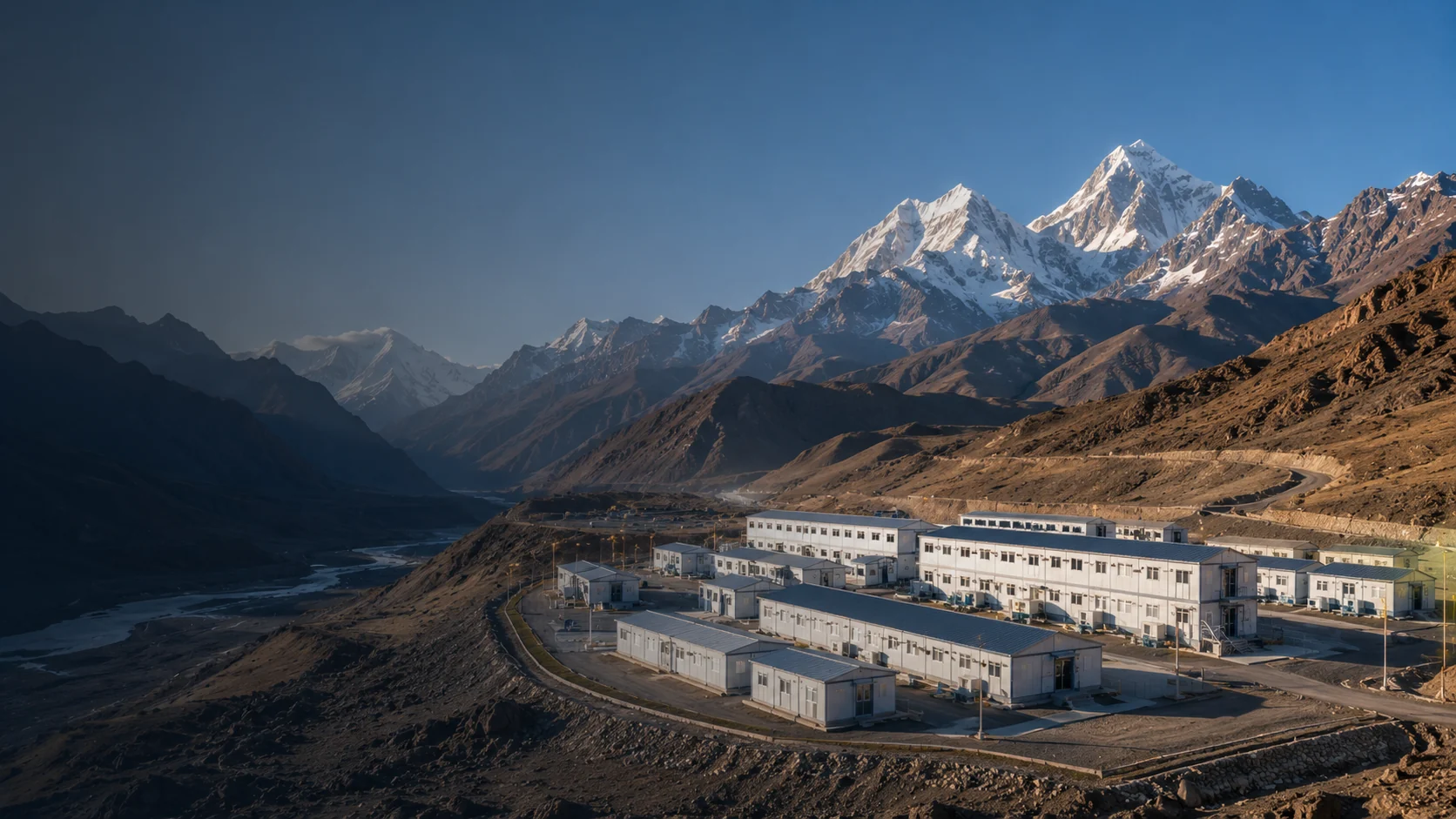
Exploration, Construction and Operations Do Not Create the Same Housing Demand
Exploration teams are often small and mobile. Development adds civil contractors, trades, installers, project controls and specialist vendors. Operations may later stabilize at a lower population, while a brownfield expansion overlays a temporary project workforce on the operating mine.
Accommodation demand follows the execution sequence, not the eventual operating headcount. Early works may need limited capacity; construction creates a larger wave; pre-commissioning and commissioning introduce specialists who may overlap with retained crews. A shutdown can add another peak before construction demobilization.
Sizing only for the operating workforce can leave the project short during construction. Sizing only for the peak without an end-state plan can leave operations with unsuitable surplus capacity.
Brownfield Expansion Creates Overlapping Populations
Brownfield projects are especially sensitive because the operations workforce cannot be displaced to make room for construction. Maintenance contractors, statutory roles, technical visitors and emergency coverage may also consume rooms. During a shutdown, operations, shutdown labor, OEM specialists and commissioning teams can overlap.
The relevant figure is peak concurrent occupancy, not payroll headcount. Rotations, overlap days, delayed departures, weather disruption and induction timing change the number present at once. Some beds are not interchangeable because of privacy, security, fatigue management or shift patterns.
The demand model should therefore be linked to the integrated schedule, showing each labor category’s arrival, rotation, overlap and release period. Early estimates need not imply false precision, but they must expose reliance on unverified capacity.
Which Accommodation Readiness Gates Should Be in the Schedule?

Accommodation becomes manageable when it is converted from a general facilities task into explicit readiness gates. The required evidence will vary by jurisdiction and project, but the decision logic remains consistent.
| Expansion stage | Accommodation readiness gate | Evidence required before the next labor wave | Schedule consequence if unresolved |
|---|---|---|---|
| Scope and execution strategy | Workforce demand is linked to work packages and rosters | Preliminary workforce curve, local/non-local split, existing operations occupancy and overlap assumptions | Housing demand is understated and later packages compete for the same rooms |
| Project definition | The proposed housing and transport strategy is feasible | Local housing baseline, commute assessment, site options, approval pathway and utility concept | Mobilization dates depend on assumptions that have not been tested |
| Early works | Land, access and enabling infrastructure can support first occupancy | Site control, access plan, drainage basis, initial power, water and wastewater plan | Installation begins but legal or safe occupancy remains unavailable |
| Construction ramp-up | Accommodation and services are ready for the next scheduled population | Required approvals, commissioned utilities, room allocation, catering, laundry, security and medical arrangements | Contractors cannot mobilize as planned or must use unstable alternatives |
| Shutdown and commissioning | Surge capacity is protected for critical specialists and temporary crews | Confirmed allocations, transport plan, contingency rooms and controlled demobilization assumptions | Critical-path work loses specialist availability or productive shift time |
| Operations handover | The post-project accommodation model has an accountable owner | Operating scope, maintenance responsibility, downsizing or reuse plan and documented utility handover | Operations inherit unmanaged capacity or facilities that do not match long-term demand |
These gates should sit beside the construction and commissioning milestones they enable. A report showing that accommodation is nearly complete is not sufficient if the remaining work prevents occupancy.
Schedule assurance needs binary questions: Can the defined population move in? Are the utilities and services operating? Are the required approvals in place? Does the transport plan work for the roster? Who accepts the complete system?
Local Housing, Commuting and Dedicated Site Accommodation
Local housing can work where capacity is verified, rooms can be secured, the commute is dependable and project demand will not create unacceptable community pressure. Dedicated or phased site accommodation may suit constrained markets, remote sites, variable travel or projects needing tighter control over workforce availability.
Neither model is universally safer, faster or more economical. The decision depends on which dependencies the project can control.
| Decision factor | Local housing plus commuting | Dedicated or phased site accommodation | Expansion-schedule question |
|---|---|---|---|
| Schedule certainty | Relies on continuing access to third-party rooms and transport | Relies on land, approvals, installation and integrated commissioning | Which dependency can be verified before each mobilization date? |
| Local housing impact | May compete with residents, tourism or essential-service workers | Can reduce direct rental pressure but may still affect local services and land use | What capacity remains available during the actual project peak? |
| Transport reliability | Exposed to road condition, weather, vehicle availability and shift timing | Usually reduces daily travel but still requires reliable regional transfers | Will the travel plan protect sleep opportunity and shift-change reliability? |
| Scalability | Additional rooms may not be available when the workforce curve rises | Can be phased if expansion space and utilities are reserved | Can the next labor wave be accommodated without redesigning the system? |
| Utilities | Mostly carried by local providers, although regional capacity may be constrained | Must be supplied or connected and commissioned by the project | Which utility is the true occupancy gate? |
| Permitting and interfaces | May reduce camp-specific approvals but adds leasing and transport dependencies | May require land-use, building, environmental, fire and occupancy approvals | Who owns every approval and interface required before occupancy? |
| Operational control | Service quality may vary across several providers | Greater consistency is possible when camp operations are integrated | Who controls room allocation, food, hygiene, maintenance and security? |
| End-state flexibility | Rooms can usually be released under commercial terms | Facilities may be retained, reduced, relocated or reused | Is the post-peak strategy defined before procurement? |
A hybrid model can be practical: early personnel use verified local accommodation while site capacity is commissioned, and the site later absorbs the construction peak. It improves resilience only when both parts are verified; combining two weak assumptions does not create a reliable plan.
What Official Project Assessments Show About Accommodation and Expansion
Lake Vermont Meadowbrook: Local Capacity Must Be Tested, Not Assumed
The official Lake Vermont Meadowbrook assessment reported that Dysart’s four worker accommodation villages were at capacity and the rental market was tight. The response combined village expansion with local-housing measures.
The lesson is not that every mine needs a village expansion. It is that an established resource town can still have little usable headroom. The baseline must test capacity during the project period, competing demand and contractual availability.
The project team should also separate housing intended for permanent relocation from accommodation that can support a short-term construction wave. A plan to increase local residency may support workforce retention without providing enough rooms for contractors mobilizing on a fixed date.
Troilus: Site Accommodation and Community Housing Can Serve Different Purposes
The official Troilus assessment says workers would be housed at the mine-site camp while the proponent collaborated with nearby communities on housing availability for people wishing to relocate. This separates rostered site work from longer-term regional residence.
Community housing initiatives may support retention, but they should not be counted as immediate construction capacity unless availability and timing are verified. Site accommodation, relocation and overflow each need a defined role.
This distinction is especially relevant during mine development. The housing strategy for an operating employee who intends to relocate with a family is not necessarily suitable for a specialist who will remain for one commissioning period or a contractor working a remote rotation.
Red Chris: Accommodation Can Require Its Own Approval and Infrastructure Package
The British Columbia Environmental Assessment Office’s 2023 Red Chris amendment report covered maximum on-site accommodation of up to 1,200 people for pre-production activities associated with a proposed underground transition. The scope included additional beds plus kitchen, dining, recreation, potable-water, sewage and backup-power infrastructure.
The example shows why adding rooms is an incomplete concept. Higher occupancy changes utility and common-service demand and may require a distinct approval path, giving accommodation its own sequence through review, infrastructure upgrades, commissioning and acceptance.
Where a camp-capacity increase depends on an environmental-certificate amendment, mine permit change or separate development approval, that pathway needs to appear in the integrated schedule. The production expansion approval should not be assumed to release additional accommodation automatically.
How Commuting and Recovery Affect Mobilization Reliability
A room is not operationally suitable merely because it is within driving distance. The transport plan must be evaluated with the roster, shift length, road condition, weather exposure, departure timing and the worker’s available recovery period.
Safe Work Australia’s 2025 fatigue code treats travel, commuting and sleep opportunity as fatigue considerations. It states that accommodation for regional or remote workers should support adequate sleep, rest and recovery, and that proximity to the workplace can reduce travel and maximize sleep opportunity. It also recognizes that extended commutes may create fatigue risk at work and on the journey home.
This does not make every commute unsuitable. A short, controlled shuttle on a reliable route may be preferable to developing a new camp. A longer journey may still be workable for particular roles or rosters. The conclusion changes when travel variability is high, night work is frequent, the road is exposed to seasonal disruption, or the workforce performs safety-critical tasks after extended shifts.
The schedule effect appears through late arrivals, reduced productive time, transport cancellations, additional vehicle requirements or limits on the shifts that can be safely rostered. These effects should be tested before the project counts local rooms as available accommodation capacity.
Why Utilities and Support Services Control the Occupancy Date

Accommodation buildings are one component of an occupied system. Power, potable water, wastewater, drainage, fire protection, communications and waste handling must work at the planned population. Dining, laundry, healthcare, security, housekeeping and maintenance must also be operational.
SafeWork NSW’s 2026 worker-accommodation code lists drinking water, toilets, washing and laundry facilities, waste disposal, protection of sleeping quarters from noise and vibration, ventilation, thermal comfort, structural and electrical safety, and fire safety among the relevant provisions.
The code is specific to its jurisdiction, but the planning principle is broadly useful: occupancy readiness depends on the complete living environment, not the visual completion of sleeping units. Local legal requirements and project-specific engineering standards still govern the actual design and approval basis.
Potable water illustrates the interface problem. The World Health Organization’s guidance issued on 17 June 2026 describes a catchment-to-consumer risk-management framework supported by health-based targets, water-safety planning and surveillance.
For a mine expansion, a water connection or treatment unit is not sufficient evidence of readiness. The project needs a reliable source, treatment and storage arrangements, distribution, monitoring, operating procedures and accountable personnel.
The same systems must be checked against each phase of occupancy. A first-stage camp may function correctly, while the next accommodation block remains unusable because wastewater treatment, backup power or dining capacity was not expanded at the same time. Phasing succeeds only when common infrastructure follows the cumulative workforce curve.
How to Phase Mining Workforce Housing Around the Expansion Schedule
A phased strategy should begin with labor waves, not building purchases. Early capacity may support enabling works, a larger phase may release construction crews, and protected surge capacity may support shutdown or commissioning. The retained phase should match the operating end-state.
Planning should work backward from each required occupancy date:
- Identify the work package and personnel that must mobilize.
- Confirm the maximum concurrent population, roster and overlap with existing operations.
- Define the required rooms, transport and support services.
- Confirm land, approvals and responsibility boundaries.
- Complete and commission the utility capacity needed for that population.
- Establish operational acceptance, room allocation and emergency arrangements.
- Release the workforce only after the readiness evidence is complete.
Phasing fails when later capacity is added without reserving land, access, drainage, utility connections or common services. It also fails when demobilization is assumed to occur exactly on schedule. The model should show room priority, overflow and how extensions are approved.
Facilities transferring to operations need records, maintenance responsibility, trained operators and accepted utility handover. Facilities intended for removal or reuse need a release point that does not conflict with remaining work.
Who Should Own Accommodation Readiness?
Responsibility is often split among the owner, EPC contractor, civil contractor, accommodation provider, utility contractors and camp operator. Dividing work is normal; dividing accountability for occupancy is dangerous.
One integrated readiness plan should show who designs, approves, supplies, connects, commissions, operates and maintains each element, including transport and camp services. IFC and EBRD guidance emphasizes contractual responsibilities and monitoring where contractors provide accommodation. The same principle applies across expansion packages: each contractor can finish its scope while the overall system remains unavailable.
A single readiness owner should coordinate evidence, exceptions and release decisions so approvals, utilities and operations converge on the required mobilization date.
That owner should not replace the authority of engineers, regulators, health and safety personnel or camp operators. The role is to make sure their requirements are closed in time to support the workforce milestone shown in the project schedule.
What Should an Early Accommodation-Planning Brief Contain?
Before selecting a housing approach, the project team should prepare a brief that tests the key assumptions:
- the expansion location and site-access conditions;
- the integrated schedule and work packages that drive labor demand;
- a workforce curve showing peak concurrent population by phase;
- shift, roster and rotation assumptions;
- existing operations occupancy and protected room requirements;
- verified local rental, hotel and accommodation-village capacity;
- commute routes, transport ownership, travel variability and seasonal constraints;
- available land and the likely approval pathway for dedicated accommodation;
- power, potable-water, wastewater, drainage, fire and communications conditions;
- kitchen, dining, laundry, healthcare, security and worker-welfare requirements;
- owner, EPC, contractor, supplier and operator responsibility boundaries;
- the intended operating, downsizing, relocation or reuse strategy after the peak.
This information is sufficient to compare local, dedicated and hybrid approaches without drifting into premature layout or modular-system selection. It also gives project controls a basis for adding accommodation gates to the schedule and testing whether the workforce mobilization plan is executable.
Teams developing that brief can review the Mining Camp Accommodation Guide and Resources for related planning topics, then explore Industrial and Mining Accommodation Solutions once the workforce, site, utility and schedule assumptions are defined. The purpose at this stage is to understand the dependencies and prepare better project inputs, not to force an early purchasing decision.
Frequently Asked Questions
When Should Mining Project Accommodation Planning Begin?
It should begin while the expansion execution strategy and preliminary workforce plan are being developed. At that stage, the project can still change work-package sequencing, roster assumptions, local recruitment, transport strategy, camp phasing and responsibility boundaries.
Waiting until major contracts are awarded turns unverified assumptions into commitments. The required planning horizon varies with land status, approvals, access, utilities and market conditions, so a universal lead time would be misleading.
How Does Mine Site Worker Housing Directly Affect an Expansion Schedule?
Mine site worker housing affects the date on which additional crews can safely and reliably mobilize. A contractor may be appointed and materials may be available, but the work package still cannot start as planned if the crew lacks suitable accommodation, transport, dining, sanitation or essential services.
The effect becomes critical when those personnel are required for construction, shutdown work, testing or commissioning and cannot be replaced without changing the execution sequence.
Can a Mine Expansion Rely Entirely on Local Rentals and Hotels?
It can where suitable capacity is verified for the actual project peak, commercial arrangements protect availability, commuting remains reliable and the demand does not create unacceptable pressure on the community.
The review should distinguish advertised rooms from rooms available for long-stay workforce use. It should also consider competing projects, seasonal demand, transport capacity and the possibility that rooms expected during planning will not remain available when mobilization begins.
How Should Peak Accommodation Demand Be Calculated?
The project should calculate maximum concurrent occupancy by phase rather than total employment. The model should combine the existing operations population, construction contractors, owner’s personnel, camp-service staff, shutdown labor and specialists.
Rotation overlap, induction, delayed departures, weather disruption and rooms that cannot be freely reassigned should be considered. The result should be mapped to work packages so every increase in occupancy has a clear schedule reason.
When Is Commuting Preferable to Expanding Site Accommodation?
Commuting may be preferable when the local housing market is stable, the route is dependable, transport can be controlled around shift changes and travel does not materially reduce sleep or recovery.
It may be less suitable where roads are weather-sensitive, travel is lengthy or variable, night shifts are common, or personnel perform safety-critical work after extended shifts. The decision should be made through a combined housing, roster, transport and fatigue assessment.
Which Approvals May Gate Mining Site Accommodation?
Requirements vary by jurisdiction and site. They may include land-use, development, building, environmental, water, wastewater, fire, electrical, food-service and occupancy approvals, as well as amendments to existing mine or environmental authorizations.
The project should establish an approval register with an accountable owner, submission dependency, decision point and required occupancy date. It should not assume that approval of the mine expansion automatically approves additional accommodation capacity.
Which Utilities Must Be Ready Before Workers Can Occupy the Accommodation?
The required systems depend on local law and the operating model, but commonly include reliable power, potable water, wastewater collection and treatment, drainage, fire systems, lighting, ventilation or thermal control, communications and waste management.
Readiness should be demonstrated at the intended population, not only under empty-building conditions. The project also needs operating procedures, trained personnel, monitoring arrangements and maintenance responsibility.
Can Mining Workforce Housing Be Installed and Commissioned in Phases?
Yes. Phasing can align accommodation capacity with early works, construction ramp-up, shutdown or commissioning peaks and the later operating workforce.
Each phase must have an occupancy gate, while shared utilities and services must be checked against cumulative demand. Space, access, drainage and connection points for later phases should be protected early. Without that preparation, later expansion can require redesign or leave completed rooms unusable.
Should Expansion Accommodation Be Temporary or Designed for Longer-Term Use?
The decision should follow the workforce curve and the post-expansion operating model. Temporary capacity may suit a construction or shutdown peak. Longer-term accommodation may be appropriate where the operating workforce will increase, local housing remains constrained or future projects are likely.
The team should test maintenance, downsizing, conversion, relocation, reuse and asset-handover requirements before procurement. A temporary designation does not remove safety, approval or utility obligations.
Who Is Responsible for Accommodation Readiness?
Package responsibilities may be divided, but the integrated occupancy date needs one accountable owner. The mine owner or EPC contractor may control the schedule and approvals, suppliers may provide facilities, contractors may install and connect them, and a camp operator may run services.
The interface matrix should state who designs, approves, supplies, commissions, certifies, operates, maintains and demobilizes every element. Package completion alone is not evidence that the workforce can move in.
Sources and References
- IFC and EBRD Workers’ Accommodation: Processes and Standards
- Queensland Coordinator-General’s Evaluation Report on the Lake Vermont Meadowbrook Social Impact Assessment
- Troilus Mine Project Environmental and Social Impact Assessment
- British Columbia Environmental Assessment Office Assessment of the Red Chris Mine Accommodation Amendment
- Safe Work Australia Managing the Risk of Fatigue at Work Code of Practice
- SafeWork NSW Worker Accommodation Code of Practice
- World Health Organization Guidelines for Drinking-Water Quality