


1. Summary
Most modular camp project failures are not caused by poor construction quality.
They are the result of early planning mistakes that only become visible once the camp is occupied and operating at scale.

Modular camps are complex operational environments. They combine accommodation, services, circulation, utilities, and management systems into a single, high-density site. When planning decisions are made in isolation—or in the wrong sequence—small assumptions quickly turn into systemic problems.
Key Takeaways:
- Modular camp failures are more often caused by planning and decision-order errors than by modular construction itself.
- Treating camps as simple accommodation rather than operational systems leads to congestion, safety risks, and inefficiency.
- Wrong system selection, miscalculated capacity, and ignored climate stress are the most common root causes.
- Many costly issues originate before construction begins, when they are hardest to detect and easiest to prevent.
- A structured, risk-first planning approach significantly reduces operational and compliance problems.
- In modular camp projects, early decisions define long-term performance far more than the choice of individual building units.
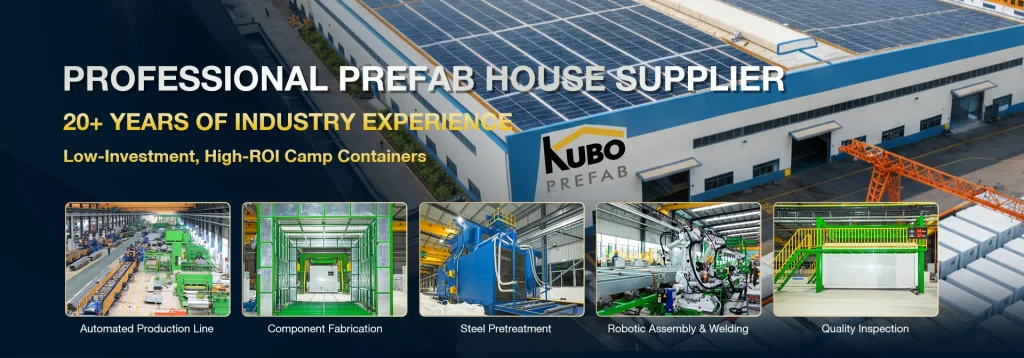
Early Risk Review with KUBO Prefab
KUBO Prefab supports project teams by reviewing camp-level planning assumptions—layout logic, capacity, system selection, and lifecycle fit—before execution begins.
Contact KUBO Prefab to review potential risks in your modular camp project.
2. Why Modular Camp Projects Fail (Before Construction Begins)
When modular camps encounter problems, the root cause is often misattributed to the modular system itself. In reality, most failures occur upstream, during the planning and decision-making phase—long before modules arrive on site.
Camps Are Operational Systems, Not Just Buildings
A modular camp is not a collection of rooms. It is an operational ecosystem that must function continuously under peak demand.
Key operational elements include:
- Movement and circulation during shift changes
- Shared facilities such as dining, sanitation, and medical services
- Utilities sized for peak rather than average use
- Safety separation between pedestrians, vehicles, and service operations
When these elements are not planned holistically, the camp may technically “work,” but operate inefficiently and unsafely.
The Amplification Effect of Early Planning Errors
In modular camp projects, early assumptions are replicated at scale.
For example:
- An undersized dining facility becomes a daily bottleneck for hundreds of occupants
- A poorly placed service zone increases travel distance and management cost every day
- A system selected without considering climate or duration degrades faster across the entire site
Because modular systems repeat standardized units, planning mistakes scale faster than in conventional construction.
Common Failure Patterns Seen Across Projects
Across workforce, infrastructure, and industrial camps, similar patterns appear repeatedly:
- Capacity is calculated by bed count, not by operational load
- System selection is driven by unit price or speed, not lifecycle fit
- Layout decisions are made after module selection, rather than before
- Climate and environmental stress are treated as secondary concerns
- Expansion and change are assumed to be “future problems”
- Individually, these decisions may seem reasonable. Combined, they create camps that are difficult to operate, costly to maintain, and risky to expand.
Why These Failures Are Hard to Fix Later
Once a camp is occupied:
- Layout changes disrupt daily operations
- Capacity upgrades require additional infrastructure
- System retrofits affect many units simultaneously
- Compliance corrections may trigger inspections or shutdowns
This is why modular camp failures are often described as “unexpected,” even though their causes were embedded in early decisions.
Failure Is Predictable—and Preventable
Industry experience shows that modular camp issues are highly predictable when viewed through a planning and risk lens. Most problems follow recognizable patterns tied to decision order, not construction method.
The most effective way to avoid failure is to:
- Treat the camp as an operational system from day one
- Validate planning assumptions before procurement
- Align system choice, layout, capacity, and climate strategy early
Plan Before You Build with KUBO Prefab
KUBO Prefab helps project teams identify planning-stage risks that commonly lead to modular camp failures—before they become operational problems.

3. Mistake #1: Treating Modular Camps as Simple Accommodation
One of the most common—and most damaging—mistakes in modular camp projects is treating the camp as nothing more than a collection of sleeping units.
This assumption often drives planning decisions that focus on:
- Maximizing bed count
- Minimizing unit cost
- Compressing installation timelines
While these factors matter, they overlook the reality that a modular camp is a 24/7 operational environment, not a static housing block.
Why This Mistake Happens
This mistake typically occurs when:
- Camp planning is handled as a procurement exercise rather than an operational one
- Module selection happens before layout and circulation are defined
- Short-term project pressure outweighs long-term usability considerations
Because modular units arrive quickly and look “finished,” it is easy to underestimate the complexity of how hundreds—or thousands—of occupants move through, use, and rely on the camp every day.
Operational Consequences Once the Camp Is Occupied
When camps are planned as accommodation-only, predictable problems emerge shortly after occupancy:
- Congestion during shift changes, particularly around dining and sanitation facilities
- Conflicting pedestrian and vehicle movement, increasing safety risk
- Overloaded shared services, such as kitchens, laundry, and medical rooms
- Higher supervision and management costs, due to inefficient layout
These issues are not caused by poor module quality. They are symptoms of missing camp-level operational planning.
Why Modular Camps Amplify This Error
In conventional construction, layout mistakes may affect a single building.
In modular camps, the same mistake is replicated across dozens or hundreds of units.
For example:
- An undersized dining facility affects every shift, every day
- Poor zoning increases walking distance for all occupants
- A misplaced service core creates permanent operational friction
Because modular systems scale quickly, planning errors scale even faster.
How to Avoid This Mistake
Avoiding this issue requires a shift in planning mindset:
- Treat the camp as an operational system, not a housing product
- Define circulation, zoning, and shared facilities before selecting modules
- Plan layout around peak movement and service demand, not average occupancy
- Integrate accommodation, services, utilities, and management into a single planning framework
When layout logic and operational flow are addressed early, module selection becomes a supporting decision—not a constraint.
Camp-Level Planning Review with KUBO Prefab
KUBO Prefab supports project teams by reviewing camp layout logic, zoning, and operational assumptions before module procurement and site deployment.
Contact KUBO Prefab to assess whether your modular camp is planned as an operational system—not just accommodation.
4. Mistake #2: Choosing the Wrong Modular System
Another frequent cause of failure in modular camp projects is system misalignment—selecting a modular system that does not match the camp’s intended lifespan, climate exposure, operational intensity, or expansion needs.
This mistake often remains hidden during procurement and installation, only to surface once the camp is occupied and operating under real conditions.
Why This Mistake Happens
System selection is commonly driven by:
- Lowest unit price
- Fastest delivery schedule
- Familiarity with a single system type
In many projects, modular systems are compared as interchangeable products, rather than as structural strategies with different risk profiles. As a result, temporary or lightweight systems are frequently applied to camps that operate for years, in harsh climates, or at high occupancy levels.
Industry guidance from the Modular Building Institute consistently emphasizes that temporary, relocatable, and long-term modular systems are not interchangeable, even when they appear similar in form.
How the Wrong System Creates Long-Term Problems
When system choice does not align with project reality, common issues include:
- Accelerated wear and degradation under continuous use
- Poor thermal and moisture performance, especially in hot-humid or cold climates
- Limited ability to expand or reconfigure without disrupting operations
- Higher maintenance and retrofit costs than initially anticipated
These problems are systemic. They affect every unit built on the same platform and cannot be resolved through minor adjustments.
Temporary Systems Used as Long-Term Camps
A particularly common misjudgment is selecting a system intended for short-term or relocatable use for a camp that:
- Remains occupied for multiple years
- Supports permanent or semi-permanent staff
- Operates in demanding environmental conditions
Temporary systems often prioritize transport efficiency and speed over envelope robustness, insulation continuity, and lifecycle durability. Under sustained use, their limitations become operational liabilities.
Climate and System Selection Are Interdependent
System suitability cannot be evaluated independently of climate.
For example:
- Lightweight systems may underperform in hot-humid climates without robust moisture control
- Poorly insulated systems struggle in cold regions where continuous heating is required
- Systems not designed for corrosion resistance degrade rapidly in coastal environments
- Ignoring this interdependence often leads to system-level failure that no amount of operational management can fully mitigate.
How to Avoid This Mistake
Avoiding system misalignment requires reframing system selection as a risk and lifecycle decision, not a procurement shortcut:
- Define the realistic operating duration of the camp
- Evaluate climate severity and environmental exposure
- Consider peak occupancy and daily operational load
- Assess expansion and reconfiguration needs from the outset
- Only after these parameters are clear should system options be compared.
System Alignment Review with KUBO Prefab
KUBO Prefab helps project teams evaluate whether a proposed modular system is appropriate for the camp’s lifespan, climate, and operational demands—before procurement decisions are finalized.
5. Mistake #3: Ignoring Layout Logic & Circulation
In modular camp projects, layout decisions are often treated as a secondary task—something to be finalized after modules are selected and quantities confirmed. This leads to one of the most persistent problems in camp operations: poor circulation logic.
A modular camp is defined not only by what buildings are present, but by how people, vehicles, and services move between them. When circulation is poorly planned, operational inefficiency and safety risk become daily realities.
Why Layout Logic Is Commonly Overlooked
This mistake typically occurs when:
- Planning focuses on unit counts rather than movement patterns
- Layout is constrained to leftover site geometry
- Circulation is assumed to “work itself out” after installation
Because modular units arrive quickly, there is often pressure to place them as efficiently as possible—without fully modeling how the camp will function once fully occupied.
Typical Symptoms of Poor Circulation Planning
Once the camp is operational, layout issues surface rapidly:
- Congestion during peak hours, especially at dining halls and sanitation facilities
- Pedestrian and vehicle conflicts, increasing accident risk
- Excessive walking distances, reducing daily efficiency and morale
- Service disruption, as logistics and waste routes interfere with residential areas
These problems are structural. They cannot be solved through management policies alone.
Why Modular Camps Amplify Circulation Errors
In modular camps, circulation mistakes are repeated and reinforced across the site.
For example:
- A poorly located dining facility affects every shift change
- Narrow access routes become permanent bottlenecks
- Mixed-use paths force pedestrians and vehicles into conflict daily
Because modular layouts scale quickly, a small planning oversight can impact hundreds of occupants simultaneously.
Key Circulation Principles Often Missed
Effective modular camp layouts typically apply the following principles early:
- Clear functional zoning between residential, service, and utility areas
- Separation of pedestrian and vehicle routes wherever possible
- Direct, intuitive paths between dormitories and shared facilities
- Emergency access and evacuation routes integrated into the master plan
- Ignoring these principles usually results in camps that meet capacity targets but fail operationally.
How to Avoid This Mistake
To prevent circulation-related failures:
- Design layout logic before finalizing module quantities
- Model movement patterns during peak occupancy and shift overlap
- Treat circulation as a core safety and efficiency system, not leftover space
- Align layout planning with capacity and operational assumptions
- Layout logic should be validated at the camp level—not unit by unit.
Layout & Circulation Review with KUBO Prefab
KUBO Prefab supports project teams by reviewing camp zoning, circulation logic, and movement patterns early—helping prevent safety and efficiency issues that emerge after occupancy.
6. Mistake #4: Miscalculating Capacity and Peak Demand
One of the most damaging planning errors in modular camp projects is equating capacity with bed count. While bed numbers are easy to calculate, they rarely reflect how a camp actually performs under real operating conditions.
In practice, camps fail not because they lack beds—but because shared facilities, circulation, and utilities are overwhelmed during peak demand.
Why Capacity Is Commonly Miscalculated
This mistake usually occurs when:
- Capacity is defined as “number of beds installed”
- Planning assumes evenly distributed usage throughout the day
- Shift overlap and peak hours are underestimated
- Shared facilities are sized for average, not worst-case use
These assumptions may appear reasonable on paper, but they break down quickly once the camp is fully occupied.
Nominal Capacity vs Operational Capacity
Nominal capacity refers to how many people can sleep in the camp.
Operational capacity reflects how many people the camp can support safely and efficiently at peak demand.
Operational capacity is constrained by:
- Dining hall throughput during shift changes
- Sanitation and shower availability
- Medical and emergency access
- Internal circulation width and access points
- Power, water, and waste system limits
- A camp can meet its nominal capacity and still fail operationally if these systems are undersized.
The Impact of Shift Patterns and Peak Load
In many workforce camps:
- Shifts start and end at similar times
- Large groups move simultaneously
- Demand on dining, sanitation, and circulation spikes sharply
- If peak demand is not modeled, the result is:
- Queuing and congestion
- Hygiene and safety risks
- Increased management and supervision burden
- Reduced workforce satisfaction and efficiency
These issues are structural, not behavioral—and cannot be solved by rules or scheduling alone once the camp is built.
Why Modular Camps Amplify Capacity Errors
Because modular camps scale quickly, capacity miscalculations scale just as fast.
For example:
- An undersized dining facility affects every shift, every day
- Insufficient sanitation capacity creates recurring bottlenecks
- Limited circulation width compounds congestion during emergencies
- Once modules are installed, correcting these limitations often requires additional infrastructure, reconfiguration, or operational compromise.
How to Avoid This Mistake
Avoiding capacity-related failure requires shifting from static counts to operational modeling:
- Plan capacity around peak occupancy and worst-case scenarios
- Account for shift overlap, not just total workforce size
- Size shared facilities and utilities for simultaneous use
- Integrate capacity planning with layout and circulation logic
- Capacity should be validated as part of a camp-wide operational plan, not as an isolated calculation.
Capacity & Peak Demand Review with KUBO Prefab
KUBO Prefab helps project teams evaluate operational capacity, including peak demand on shared facilities and internal circulation—before layouts and system quantities are finalized.
Contact KUBO Prefab to review whether your modular camp capacity assumptions hold up under real operating conditions.
7. Mistake #5: Ignoring Climate and Environmental Stress
Another critical—and frequently underestimated—mistake in modular camp projects is treating climate as a secondary or technical issue, rather than a core planning constraint.
In reality, environmental stress is one of the fastest ways to expose weaknesses in system selection, envelope design, and operational assumptions.
Why This Mistake Happens
Climate considerations are often minimized because:
- Standard modular solutions are assumed to be “proven”
- Project schedules prioritize speed over environmental adaptation
- Climate is reduced to average temperature, ignoring humidity, wind, or corrosion
- As a result, camps are deployed with systems that are technically functional, but poorly matched to local environmental conditions.
How Climate Stress Manifests in Modular Camps
Once camps are occupied, climate-related issues tend to surface quickly:
- Condensation, mold, and indoor air quality problems in hot-humid regions
- Excessive heating demand and heat loss in cold climates
- Corrosion and premature degradation in coastal or industrial environments
- Increased maintenance and energy costs across the entire camp
Because modular camps replicate standardized units, climate-related design weaknesses scale across the site, amplifying their impact.
Why Camps Are Especially Vulnerable to Climate Errors
Modular camps are often:
- High-occupancy
- Continuously operated
- Located in remote or exposed environments
These factors reduce tolerance for environmental failure. What might be a manageable issue in a low-occupancy building becomes an operational risk in a camp setting.
How to Avoid This Mistake
Avoiding climate-driven failure requires integrating environmental assessment into early planning:
- Evaluate dominant climate stressors, not just temperature
- Align system selection and envelope strategy with environmental exposure
- Avoid using temporary or lightweight systems in high-stress climates
- Plan HVAC and ventilation based on real occupancy and humidity loads
- Climate adaptation should be treated as baseline risk management, not an optional enhancement.
8. Mistake #6: No Plan for Expansion or Change
Few modular camp projects remain static. Workforce size, project scope, and operational requirements often change over time. Yet many camps are planned as if nothing will ever change.
The absence of an expansion or adaptation plan is one of the most common causes of long-term inefficiency and disruption.
Why This Mistake Happens
This mistake often stems from:
- Overconfidence in initial workforce forecasts
- Pressure to minimize upfront planning effort
- Assumptions that expansion can be “handled later”
Because modular systems are flexible, there is a false sense that future change will be easy, regardless of how the camp is initially planned.
What Happens When Expansion Is Not Planned
When camps need to expand without a predefined strategy, common outcomes include:
- Disorganized placement of additional modules
- Overloaded utilities and shared facilities
- Disrupted circulation and zoning
- Increased safety and management complexity
- Ad hoc expansion often solves short-term capacity needs while degrading overall camp performance.
Why Expansion Mistakes Are Hard to Reverse
Once a camp is occupied:
- Relocating modules disrupts daily operations
- Infrastructure upgrades affect multiple zones
- Circulation changes impact safety and access
Without reserved expansion zones and infrastructure foresight, even small changes become costly and disruptive.
How to Avoid This Mistake
Effective modular camp planning assumes change:
- Reserve clear zones for future expansion
- Size infrastructure with phased growth in mind
- Maintain consistent layout logic and modular grids
- Distinguish between temporary and long-term zones
- Planning for expansion does not require overbuilding—it requires strategic foresight.
9. Mistake #7: Delaying Compliance & Approval Strategy
One of the most dangerous mistakes in modular camp projects is treating compliance and approvals as a downstream task—something to be resolved after systems are selected, layouts finalized, or construction underway.
In reality, compliance strategy is a planning constraint, not an administrative formality. When it is delayed, it can invalidate otherwise reasonable design and procurement decisions.
Why This Mistake Happens
This mistake often stems from assumptions such as:
- “The camp is temporary, so approvals will be simple”
- “We’ll deal with local requirements once installation starts”
- “Modular buildings are treated differently, so full codes won’t apply”
- In early project phases, these assumptions can appear to reduce friction. In later phases, they often create project-level risk.
How Compliance Issues Surface in Modular Camps
When approval strategy is not addressed early, common consequences include:
- Requests for redesign or reclassification after layout or system selection
- Delays caused by additional reviews or inspections
- Forced upgrades to meet fire, life-safety, or accessibility requirements
- Temporary suspension of camp operations in regulated environments
- In public-sector, industrial, or audited projects, these issues can escalate quickly.
“Temporary” Does Not Mean “Unregulated”
A recurring misconception is that labeling a camp as “temporary” avoids regulatory complexity.
In practice:
- Many jurisdictions impose strict limits on how long temporary facilities may operate
- Extensions often trigger full compliance requirements
- Camps serving workers, contractors, or the public are frequently subject to safety and health regulations regardless of duration
- Misclassification at the planning stage is one of the fastest ways to create compliance exposure later.
Why Modular Camps Are Especially Sensitive to Compliance Delays
Modular camps often:
- House large numbers of occupants
- Operate continuously
- Exist within industrial, infrastructure, or public project frameworks
These characteristics attract higher scrutiny from:
- Safety authorities
- Labor and health regulators
- Project auditors and stakeholders
When compliance is addressed late, corrective actions affect many units at once, multiplying cost and disruption.
How to Avoid This Mistake
Avoiding compliance-related failure requires shifting approvals into early planning:
- Identify likely regulatory classification (temporary vs long-term) early
- Align system selection and layout with expected approval pathways
- Consider fire separation, egress, accessibility, and service requirements upfront
- Treat compliance as a design input, not a post-design checkpoint
- Early alignment reduces uncertainty and protects downstream decisions.
Compliance-Aware Camp Planning with KUBO Prefab
KUBO Prefab helps project teams integrate compliance and approval considerations into early modular camp planning—reducing the risk of redesign, delay, or operational disruption.
Contact KUBO Prefab to review compliance risks before finalizing your modular camp strategy.
Why Compliance Mistakes Are Often the Most Expensive
Unlike layout or capacity issues, compliance problems:
- Can halt projects entirely
- Are difficult to mitigate through operational workarounds
- Carry reputational and contractual consequences
This is why experienced project teams treat compliance strategy as foundational planning, not paperwork.
10. How KUBO Prefab Helps Avoid These Mistakes
Most modular camp failures are not caused by a single wrong decision, but by a chain of misaligned decisions made in the early stages—often under time pressure and incomplete information.
KUBO Prefab helps project teams avoid these mistakes by focusing on decision order, system alignment, and risk visibility, before designs are finalized and procurement commitments are made.
A Camp-Level Planning Perspective
Rather than evaluating modular camps as collections of individual units, KUBO Prefab approaches them as integrated operational systems.
This includes early review of:
- Camp layout logic and zoning
- Circulation and movement patterns
- Shared facility distribution
- Infrastructure and service coordination
By addressing these elements together, KUBO Prefab helps teams avoid the common trap of optimizing one component at the expense of overall camp performance.
Aligning System Selection with Project Reality
KUBO Prefab supports system selection by clarifying:
- Intended operating duration (temporary vs long-term)
- Climate and environmental exposure
- Expected occupancy density and usage intensity
- Expansion and reconfiguration requirements
This ensures that the selected modular system is not only fast to deploy, but appropriate for how the camp will actually be used.
Capacity and Peak-Demand Validation
Instead of relying on nominal bed counts, KUBO Prefab helps teams validate operational capacity, including:
- Peak demand during shift overlap
- Load on dining, sanitation, and medical facilities
- Circulation performance under worst-case scenarios
This reduces the risk of camps that meet theoretical capacity targets but fail under real operating conditions.
Climate- and Environment-Aware Planning
KUBO Prefab integrates climate considerations into early planning decisions, including:
- System suitability under environmental stress
- Envelope and ventilation strategy implications
- Durability and maintenance risk over time
- By treating climate as a planning constraint rather than a technical afterthought, long-term performance issues are significantly reduced.
Compliance Considered from the Start
KUBO Prefab helps project teams identify:
- Likely regulatory classification
- Approval and inspection pathways
- Compliance-sensitive design constraints
- Early compliance awareness prevents late-stage redesigns, approval delays, and operational interruptions.
Reducing Risk Before It Becomes Costly
The common thread across all these areas is timing. KUBO Prefab focuses on making risks visible when they are easiest to address—during planning, not after installation.
In modular camp projects, the most valuable risk mitigation happens before the first module is ordered.
12. FAQ: Modular Camp Project Risks & Mistakes
What is the most common mistake in modular camp projects?
Treating the camp as simple accommodation rather than an operational system. This leads to poor layout logic, undersized shared facilities, and daily operational inefficiency.
Are modular camps suitable for long-term use?
Yes—if they are planned and classified correctly. Camps intended for multi-year operation should use systems, layouts, and compliance strategies appropriate for long-term use.
Why do modular camps experience congestion even when bed count is correct?
Because capacity is often calculated by bed numbers instead of operational capacity. Dining, sanitation, circulation, and utilities must be sized for peak demand and shift overlap.
Can modular camps be expanded later?
They can—but only if expansion is planned from the beginning. Camps without reserved expansion zones or infrastructure foresight often experience disruptive, inefficient growth.
How does climate affect modular camp performance?
Climate influences moisture control, energy demand, durability, and maintenance. Ignoring humidity, wind, or corrosion risk often leads to early degradation and operational issues.
Do modular camps require building code compliance?
In many jurisdictions, yes. Even “temporary” camps may be subject to safety, health, and labor regulations. Long-term or public-facing camps typically require full code compliance.
Why are compliance issues so difficult to fix later?
Late compliance corrections often require redesign, retrofitting, or operational interruption—affecting many units simultaneously in a modular camp environment.
When should camp planning and risk review take place?
Ideally during the concept or feasibility stage, before system selection and procurement. This is when changes are least disruptive and most cost-effective.
How can KUBO Prefab help reduce modular camp risk?
KUBO Prefab helps project teams review planning assumptions, align systems with real operating conditions, and identify risks early—before they become operational or compliance problems.