


Summary
When sourcing modular buildings from China, overseas project buyers should verify much more than unit price, sample appearance, or a supplier’s factory photographs. The initial-screening decision should confirm who will contract with the buyer, who actually fabricates the structural frame, which packages are purchased and integrated in the factory, which drawings and BOMs control production, how inspection access works, how packing and export handover are defined, and which responsibilities remain with the local EPC or site contractor. For KUBO projects, manufacturing follows approved project drawings, material schedules, signed commercial scope, and contract requirements; the factory fabricates and assembles the contracted structural frame while purchased components are integrated where included in the approved scope. A practical next step is to issue every shortlisted supplier the same project brief, responsibility matrix, controlled-document request, and logistics interface schedule so that technical and commercial responses can be compared on the same basis.
What an Overseas Buyer Is Really Screening
The buyer at this stage is usually an EPC procurement manager, project-owner procurement lead, international engineering contractor, or sourcing team building a supplier longlist before factory approval or purchase-order release. The commercial question is not simply, “Can this company sell modular buildings?” It is, “Can this supplier translate our project definition into a controlled manufacturing and delivery package that fits our destination responsibilities?”
That distinction matters because modular construction crosses several workstreams. The International Code Council’s off-site and modular construction standards overview describes an industry process that spans planning, design, fabrication, transport, assembly, inspection, approval, regulatory compliance, and MEP-related work. For an international buyer, those workstreams may be split among the manufacturer in China, an exporter, a freight party, the buyer, a local EPC contractor, specialty installers, and the authority having jurisdiction in the destination market.
A useful first-screening standard is therefore simple: every bidder should be able to explain the same chain from project input to released drawing, production scope, inspection, packing, shipment, local assembly, utility connection, testing, approval, and handover. If one quotation includes factory-integrated electrical and plumbing packages while another includes only structure and enclosure, the two prices are not yet commercially comparable. If one supplier prices to port delivery while another assumes buyer collection at the factory, the difference is a scope issue before it is a price issue.
1. Define the Buying Route Before Comparing Suppliers
Before asking a China modular building supplier for a quotation, define the project in a form that can be answered consistently. At minimum, provide the destination country, intended building use, expected occupancy or workforce capacity, facility list, required-on-site date, available site information, and the party expected to perform local assembly and utility connections. A camp with accommodation, offices, sanitation, dining, laundry, medical support, and storage is a different procurement package from a single office block even when both use the same modular system.
Buyers should also decide whether they are sourcing only the modular building package or a broader project scope. The wider the package, the more important it becomes to identify engineering review, local approvals, foundations, lifting, unloading, assembly, external MEP, testing, furniture, appliances, specialist equipment, and final commissioning as separate responsibility lines. This allows a supplier to quote clearly instead of filling unknowns with assumptions.
For KUBO, the commercial path is tied to the approved project scope. The company’s manufacturing and project-delivery page describes a workflow in which layouts, building functions, quality controls, export preparation, and delivery support are connected to project requirements. The relevant point for a buyer is not a generic factory-capacity claim; it is whether the intended project can be converted into a defined, reviewable scope before production release.
2. Identify the Contracting and Responsibility Chain
Cross-border sourcing becomes much easier to control when the buyer knows exactly which entity performs each commercial and technical role. The manufacturer, contracting seller, exporter of record, engineering reviewer, freight party, local EPC contractor, and after-sales contact may be the same organization in some projects and different organizations in others. The buyer should request a written responsibility chain rather than inferring these roles from a website, quotation header, or sales discussion.
| Role | What the Buyer Should Confirm | Typical Evidence or Response | Why It Matters at Shortlist Stage |
|---|---|---|---|
| Contracting entity | Legal entity that signs the quotation, contract, and commercial terms | Quotation identity, contract details, payment beneficiary information, agreed commercial scope | Establishes who is commercially responsible for the order |
| Manufacturer | Which factory fabricates the structural frame and performs the contracted assembly | Factory address, production-scope description, approved drawings, manufacturing records relevant to the order | Connects the commercial seller to the physical production process |
| Exporter / shipping party | Who prepares export handover and shipment documentation under the agreed trade route | Packing list, shipment lot plan, export-document responsibility, Incoterm | Prevents gaps between factory completion and international shipment |
| Local EPC / site contractor | Who receives, unloads, lifts, assembles, connects utilities, tests site works, and manages local approvals where applicable | Responsibility matrix, site method inputs, interface drawings, local scope schedule | Separates factory deliverables from destination execution |
| Buyer / owner | Who approves layouts, specifications, deviations, commercial changes, and site interfaces | Approval workflow, nominated reviewers, change authority, required submittals | Keeps production decisions aligned with the party authorized to accept them |
This matrix is especially important when a buyer works through an international contractor or local integrator. A strong sourcing process does not assume that “manufacturer” and “supplier” are interchangeable labels. It asks who fabricates, who sells, who exports, who installs, and who signs off each interface.
3. Separate Fabricated Work, Factory-Integrated Packages, and Site Scope
One of the most common comparison errors in China modular buildings sourcing is treating the complete finished building as if every item were manufactured by the same factory. In practice, modular projects combine fabricated structural work, purchased building components, optional equipment packages, and destination-site work.
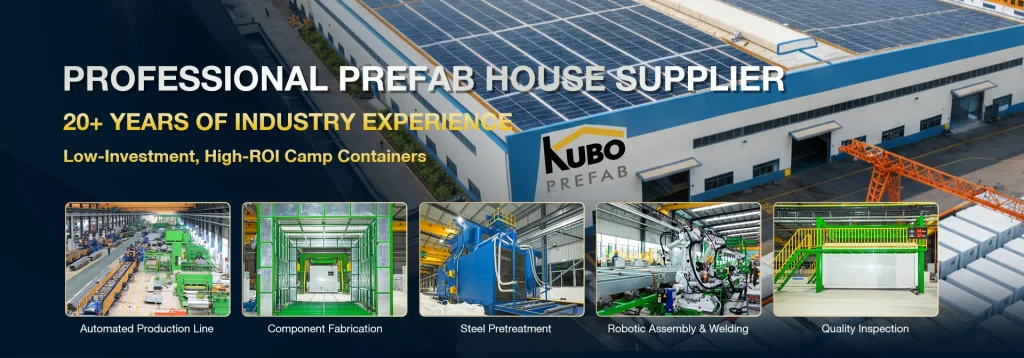
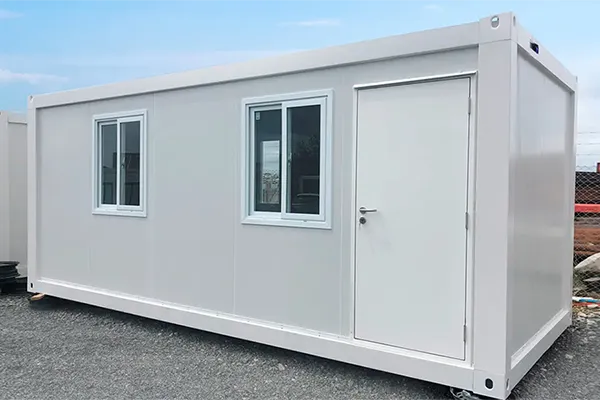
KUBO fabricates and assembles the contracted structural frame. Its public manufacturing chain includes steel preparation, automated forming and cutting, frame welding, surface treatment, panel and MEP integration, finished-unit inspection, and protected loading. Panels, doors, windows, electrical and plumbing components, HVAC equipment, furniture, appliances, and specialist items are purchased packages integrated only when they are included in the approved project scope.
| Scope Category | Typical Modular-Project Content | Buyer Verification Point | Commercial Treatment |
|---|---|---|---|
| Fabricated in-house | Contracted structural frame and related fabricated steel components | Released production drawings, material schedule, fabrication route, inspection stage | Confirm exact structural scope and drawing revision in supplier offer |
| Purchased and factory-integrated | Panels, doors, windows, electrical/plumbing components, HVAC, furniture, appliances, specialist items when included | Approved brand/specification or performance requirement, quantity, installation extent, interface responsibility | List each included package separately instead of using “complete unit” as the only description |
| Destination / site scope | Foundations, unloading, lifting, local assembly, external utilities, local testing, permits, approvals, specialist site works as allocated by the project | Responsible party, site prerequisites, method, local design input, inspection and acceptance owner | Show as buyer, EPC, subcontractor, or separately priced supplier responsibility |
This separation improves both technical review and commercial negotiation. It also helps procurement teams compare substitutions. If a bidder proposes a different window, panel, HVAC unit, sanitary fixture, or electrical component, the buyer can evaluate the proposed package against an agreed specification rather than assuming all “included” items are equivalent.
4. Establish the Controlled Document Set Before Production
A serious modular building factory in China should be able to work from a controlled set of project documents rather than a chain of informal messages. The exact document package varies by project, but buyers benefit from defining the expected set during initial screening.
For KUBO projects, manufacturing scope follows approved project drawings, the BOM or material schedule, the signed quotation, and the contract. The buyer should align those commercial and technical documents so that the same scope appears across the layout, production release, purchased packages, and shipment plan.
The controlled set commonly includes the project layout, building or room schedule, production drawings, BOM or material schedule, door/window and fixture schedules where relevant, interface drawings, approved component data, deviation or clarification register, packing list, shipment-lot record, and handover documents. The purpose is practical: when procurement asks what is being bought, engineering asks what is being built, and logistics asks what is being shipped, all three functions should be looking at compatible information.
The ISO quality management principles are useful here for two general ideas: a process approach and evidence-based decision-making. In sourcing terms, that means the buyer should connect each important acceptance decision to the controlled input and record that supports it. This reference is an industry-management principle, not a statement about any KUBO certification.
5. Confirm the Design-Release and Change-Control Path
A modular project can move quickly once drawings are released, which makes pre-release discipline valuable. Before production, the buyer and supplier should agree who may approve layouts, material substitutions, component changes, room schedules, MEP interfaces, and shipment-affecting revisions.
A practical release path can be kept simple. The buyer issues the project brief and available specifications. The supplier develops the relevant layout and production information. The designated buyer or EPC reviewer returns comments. Open items remain visible in a clarification or deviation register. Production is released only against the approved revision and agreed commercial scope. Later changes are assessed for effect on material, work already completed, purchased packages, packing, and delivery lots.
This is particularly important when the buyer’s local engineer is reviewing destination requirements in parallel with the factory. The World Trade Organization’s Technical Barriers to Trade overview explains that technical regulations, standards, and conformity-assessment procedures can differ across markets while serving legitimate objectives such as health and safety. For procurement, the useful conclusion is that destination requirements belong in the project input and review path rather than being assumed from a product sold in another country.
6. Plan Supplier Verification Without Turning Sourcing Into a Factory-Audit Exercise
Initial sourcing and detailed factory auditing are related, but they are different decisions. At longlist stage, the buyer needs enough information to determine whether the supplier’s commercial identity, manufacturing role, document control, project scope, inspection access, and export handover are credible enough to justify deeper review.
KUBO’s office and production factory are located at the same site in Shunde, Foshan. Overseas buyers can arrange a scheduled factory visit to discuss system selection, steel-frame fabrication, panel and enclosure work, relevant MEP interfaces, production and inspection workflow, packing, drawings, and specifications. Access to active production, demonstrations, project batches, photography, and confidential customer work is confirmed in advance so the visit can be prepared around what is available and appropriate.
Once a supplier reaches the detailed verification stage, buyers can use KUBO’s separate modular building factory audit checklist for the audit method itself. That guide covers how to walk the factory, connect samples with records, close findings, and make a bounded audit decision. Keeping that work separate prevents the sourcing article from becoming a duplicate audit procedure.
7. Define Packing, Shipment, Incoterm, and Destination Handover
International modular procurement is not complete when the factory says the buildings are finished. The buyer needs a shipment and destination handover plan that connects factory packing with the actual site sequence.
Start by defining shipment lots. If the project will be delivered in stages, identify which buildings or components belong in each lot and how they will be recognized at destination. The packing list should match the approved configuration and make it practical for the receiving team to identify structural parts, enclosure materials, integrated packages, loose components, and any items required early for site progress.
The agreed Incoterm should then be recorded precisely. The International Chamber of Commerce’s Incoterms rules clarify seller and buyer tasks, costs, and risks in the delivery of goods. Procurement teams should treat that trade term as one layer of the commercial structure and keep a separate project supply matrix covering customs-document responsibility, shipment-lot sequence, unloading, lifting, temporary storage, assembly, utility connections, testing, and site approvals.
This approach avoids a common misunderstanding: the trade term may define where delivery risk or cost responsibilities change, while the project still needs a detailed plan for what happens physically before and after that point.
8. Use the Same RFQ Structure for Every Shortlisted Supplier
The strongest way to compare modular buildings from China is to give every bidder the same input package and require the same response structure. That moves evaluation away from brochure quality and toward scope clarity.
| RFQ Input or Document | Supplier Response Required | Evidence / Attachment | Acceptance or Clarification Field |
|---|---|---|---|
| Destination, project use, occupancy/workforce and facility list | Proposed building system, building schedule and scope basis | Layout or facility schedule | Matches project use / revise / open point |
| Contracting and delivery route | Contracting entity, manufacturer, exporter and key contacts | Quotation and responsibility chain | Accepted entities / clarification required |
| Required building configuration | Fabricated scope, purchased packages, optional items and exclusions | BOM/material schedule and component schedule | Included / excluded / buyer-supplied |
| Available drawings and specifications | Drawing list, design-review path, document assumptions | Submittal register or document list | Reviewer / due date / approval status |
| Change-control requirement | Method for recording substitutions, deviations and revisions | Deviation register or equivalent response format | Approved / rejected / further review |
| Inspection requirement | Proposed buyer/third-party access and notification points | Inspection plan relevant to the order | Witness / review / record requirement |
| Shipment and required-on-site sequence | Packing concept, shipment lots, agreed Incoterm and document responsibilities | Packing and logistics proposal | Sequence confirmed / interface open |
| Destination works | Factory, buyer, local EPC and specialist subcontractor responsibilities | Responsibility matrix and interface drawings | Named owner for every site task |
| Local regulations and approvals | Inputs required from buyer/local engineer and supplier submittals available | Project-specific document list | Authority / reviewer / approval path |
By the time the RFQ reaches shortlist review, the procurement team should be able to compare the bidders line by line. Price remains important, but it is read alongside the building schedule, purchased-package list, local work allocation, document set, inspection arrangement, packing route, and commercial assumptions.
A Bounded Example: KUBO’s Tanzania EPC Site Camp
KUBO’s published Tanzania EPC site camp case illustrates why these boundaries matter. The project combined site offices and workforce accommodation in an EPC environment, with factory build, staged logistics, and interfaces between supplier-delivered work and destination execution.
The useful sourcing lesson is not to treat that project as a universal specification or delivery timetable. Instead, it shows the structure of an international modular project: different facility functions are converted into a coordinated building package; factory work is completed against the project scope; shipments are staged to suit delivery needs; and destination parties still need clear responsibility for site reception, assembly, interfaces, and project completion.
For a new EPC project, buyers should ask the supplier to reproduce that clarity for their own facility schedule. Which office blocks, accommodation buildings, sanitary units, or support spaces are in the supplier package? Which purchased components are integrated before shipment? Which loose items travel separately? Which local works must be ready before arrival? Which party closes the interfaces? These are shortlist questions because they determine whether the quotation can become an executable contract package.
How to Turn Supplier Screening Into a Shortlist Decision
After the commercial and technical responses are returned, procurement can score the longlist against a small number of decision categories: identity and contracting clarity, manufacturing-scope clarity, document-control readiness, ability to integrate purchased packages, inspection access, packing and export definition, destination interface clarity, and responsiveness to project-specific inputs.
A supplier does not need to answer every future construction detail during the initial screening stage. It should, however, show a credible route for resolving those details. A clear answer such as “local foundation design will be provided by the buyer’s engineer; KUBO will provide the building interface information required for coordination” is more useful than a broad statement that the supplier provides a “complete solution.”
The same applies to schedules. Instead of asking for a universal lead time, give the supplier the required-on-site date, expected quantity, facility mix, drawing status, destination, and shipment assumptions. The supplier can then explain the information needed to establish a project-specific production and delivery plan. This keeps the shortlist focused on executable scope rather than generic promises.
Procurement FAQs
Should the buyer contract directly with the factory that manufactures the modular buildings?
Direct contracting can simplify some projects, but the better screening question is whether the contracting entity, manufacturer, exporter, engineering reviewer, and destination contractor are clearly identified and coordinated. A buyer may use a manufacturer-led contract, an EPC procurement route, or another commercial structure. What matters is that the agreement names who is responsible for each deliverable and that the manufacturing scope matches the commercial scope.
How can a buyer tell which components are genuinely made by the modular building factory?
Ask the supplier to separate fabricated structural work from purchased and factory-integrated components. For KUBO, the contracted structural frame is fabricated and assembled by the factory, while panels, doors, windows, MEP components, HVAC, furniture, appliances, and specialist items are purchased packages integrated where included. The RFQ should identify the specification and inclusion status of each important package.
What documents should be agreed before production release?
The exact set depends on project complexity, but buyers commonly need the approved layout, production drawings, BOM or material schedule, room or fixture schedules where relevant, interface drawings, approved purchased-component information, open-deviation register, and the commercial scope. The key is consistency: production should be released against the same revision and scope that procurement and engineering have approved.
Does an Incoterm tell the buyer who unloads, assembles, connects utilities, and completes local approvals?
Use the Incoterm to define the agreed trade-delivery allocation of tasks, costs, and risks. Keep unloading, lifting, storage, assembly, external utilities, testing, permitting, and local approval responsibilities in a separate project responsibility schedule. This prevents logistics terminology from being used as a substitute for the site-execution plan.
When is the right time to visit a modular building factory in China?
A visit becomes most useful when the buyer has enough project definition to ask specific questions about the proposed system, structural fabrication, enclosure work, MEP interfaces, inspection workflow, drawings, packing, and shipment preparation. Schedule the visit in advance and identify what you want to review so the supplier can confirm which relevant production activities, products, records, and access conditions will be available.
What should an overseas buyer send KUBO for an initial sourcing review?
Send the destination country, intended use, building or facility list, quantity or workforce capacity, known site conditions, required-on-site date, expected contract boundary, and any available layouts, specifications, room schedules, or reference drawings. That gives KUBO a practical basis to review system direction, scope boundaries, document needs, factory integration, and the next quotation step.
Build the Shortlist Around a Comparable Project Scope
Sourcing modular buildings from China becomes more manageable when the procurement team converts a broad supplier search into a controlled comparison. Define the project use and facility list, identify every commercial and technical role, separate fabricated work from purchased packages and destination works, establish the document set, agree the release and change path, plan verification access, and map packing and site handover before comparing final quotations.
For a project-specific review, send KUBO your project brief with the destination country, intended use, building or facility list, quantity or workforce capacity, site conditions, required-on-site date, expected contract boundary, and available drawings or specifications. KUBO can use that information to align the proposed modular system, manufacturing scope, purchased-package integration, documentation, and delivery interfaces for your initial supplier evaluation.